Tracking a Wife’s Phone: What the Law Says and What Trust Costs

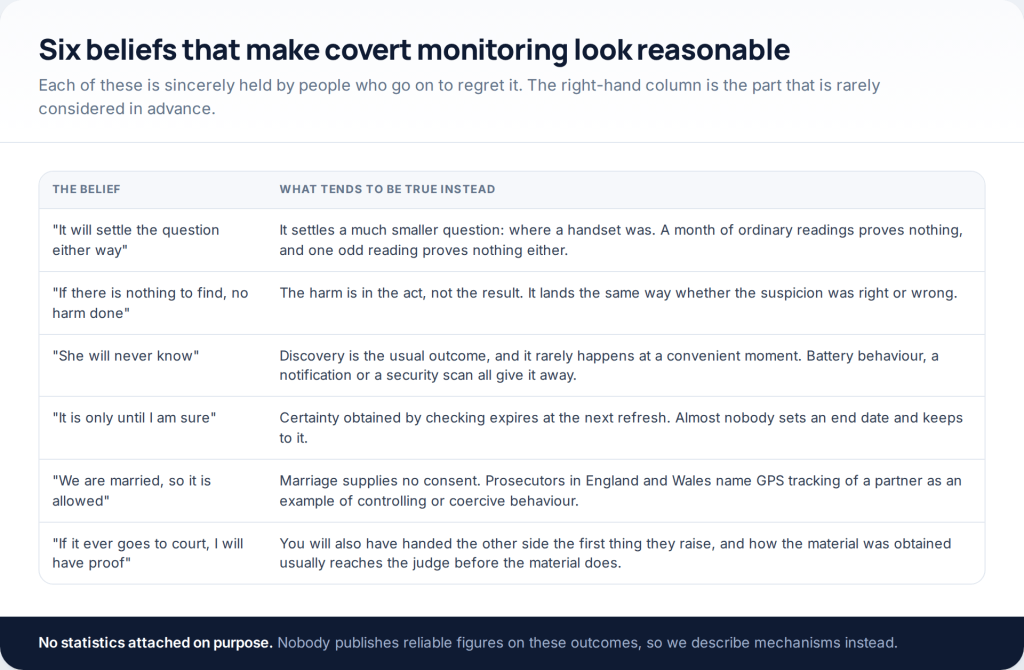
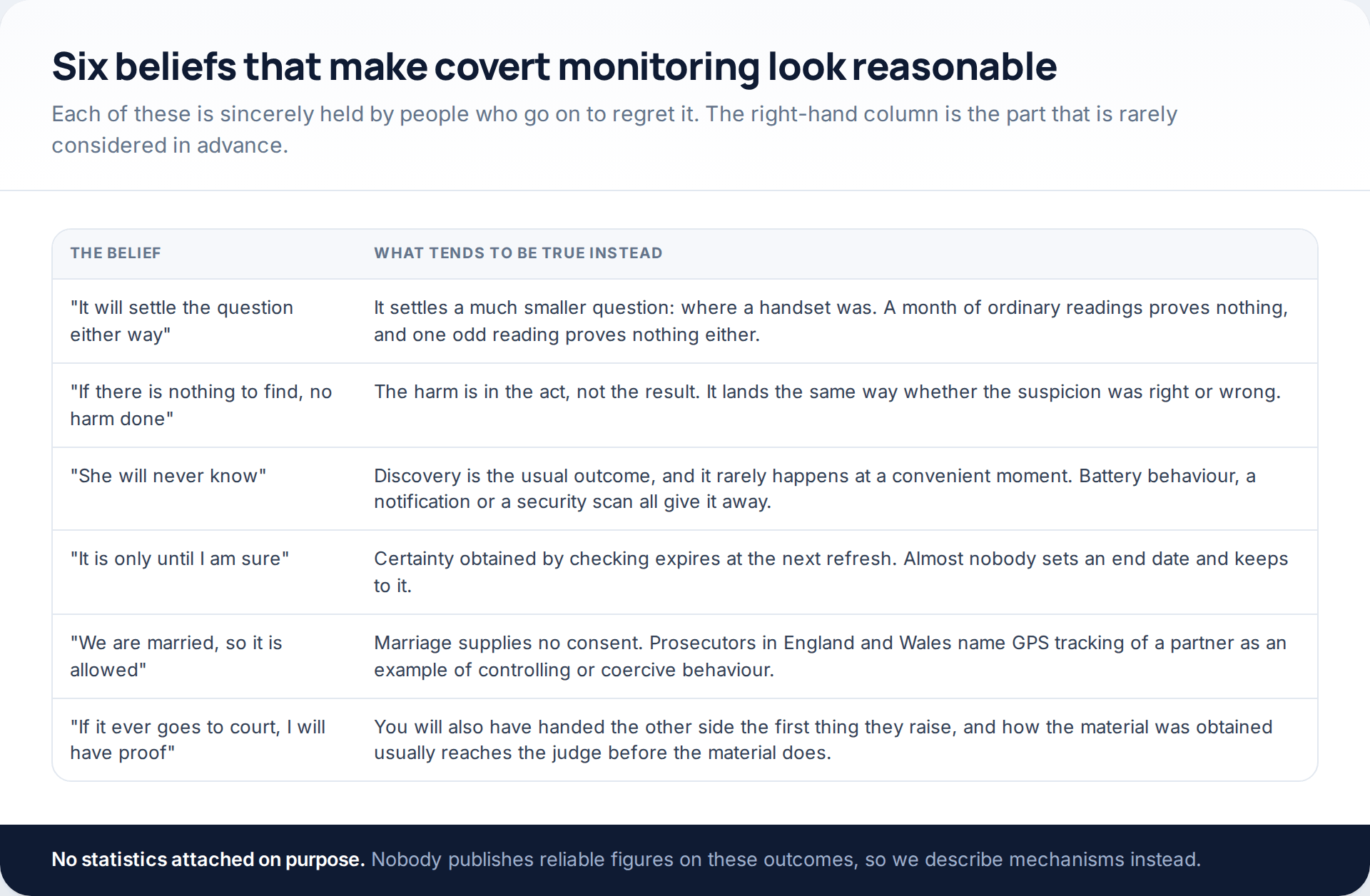
The belief that makes people search for a way to track my wife’s phone is that a location history will settle the question. It will not. It produces coordinates without explanations, it costs the same whether or not it finds anything, and it is usually discovered — often in the middle of an argument about something else. This page is about that cost, and about the three things that do move something.
Start with what the monitoring is expected to do
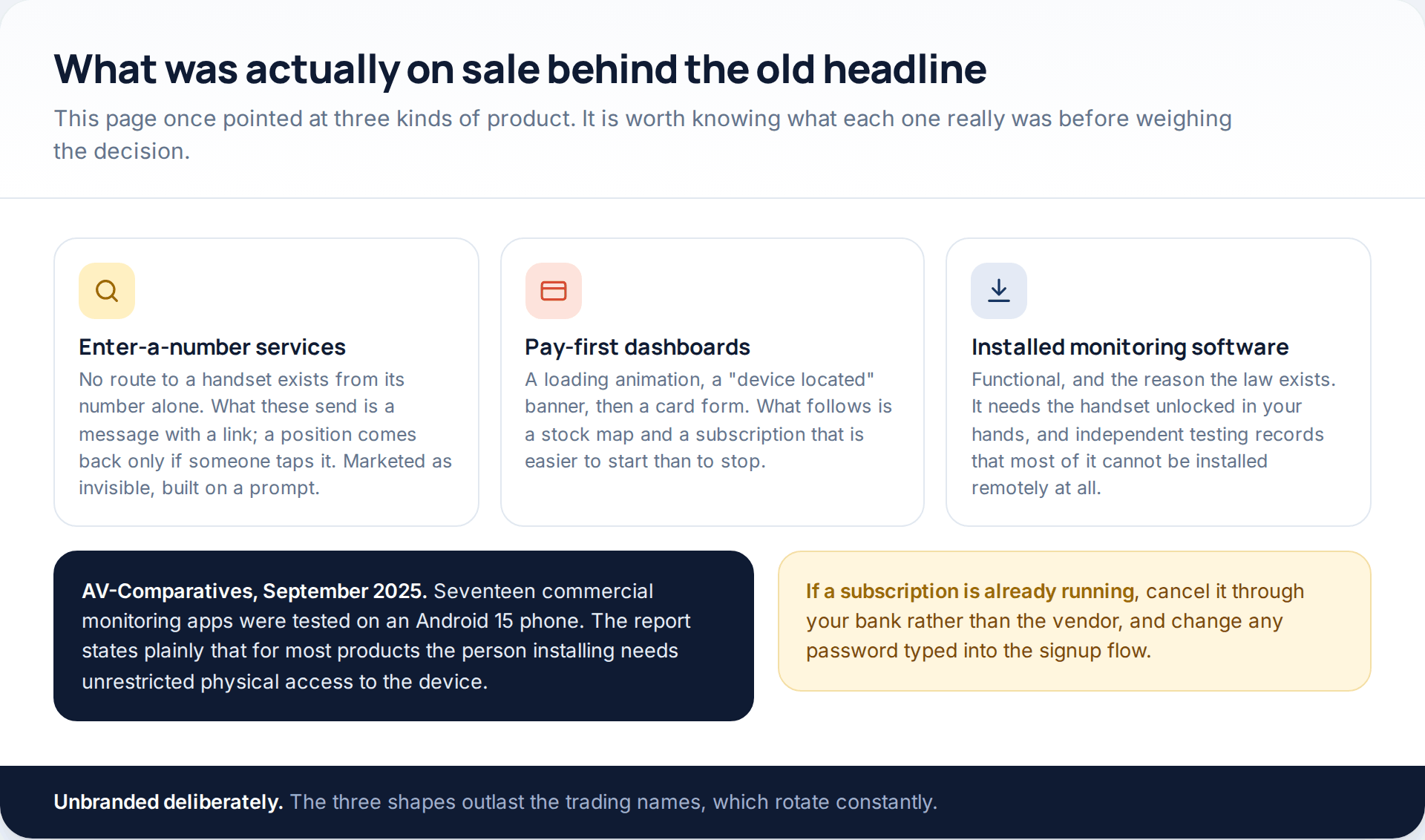
This page used to promise covert tracking, and it no longer does. Partly because what was being sold did not work — number-entry pages that quietly text a link, and pay-first dashboards that show a stock map. Partly because the one product that does work has to be installed by hand on the phone, which is the point at which worry becomes an offence in a great many places.
It is worth separating two questions that get run together. The legal one — which statutes are engaged, what courts have done about it — is set out in detail in the companion piece on consent rules for tracking a partner’s phone, which covers the same law from the other direction. The short version is that marriage supplies no consent, that prosecutors in England and Wales name GPS tracking of a partner as an example of controlling or coercive behaviour, and that several jurisdictions make using a tracking device on a person a criminal offence in its own right.
This page takes the other question: what happens to you, and to the marriage, in the ordinary case where nothing illegal is ever charged and nothing damning is ever found.
The cost of finding nothing
Most covert monitoring finds nothing. That is not an argument that the suspicion was silly; plenty of justified suspicions produce no evidence, because evidence of this kind is not usually lying around in map coordinates. It is an argument that you should price the boring outcome before you start, because the boring outcome is the likely one.
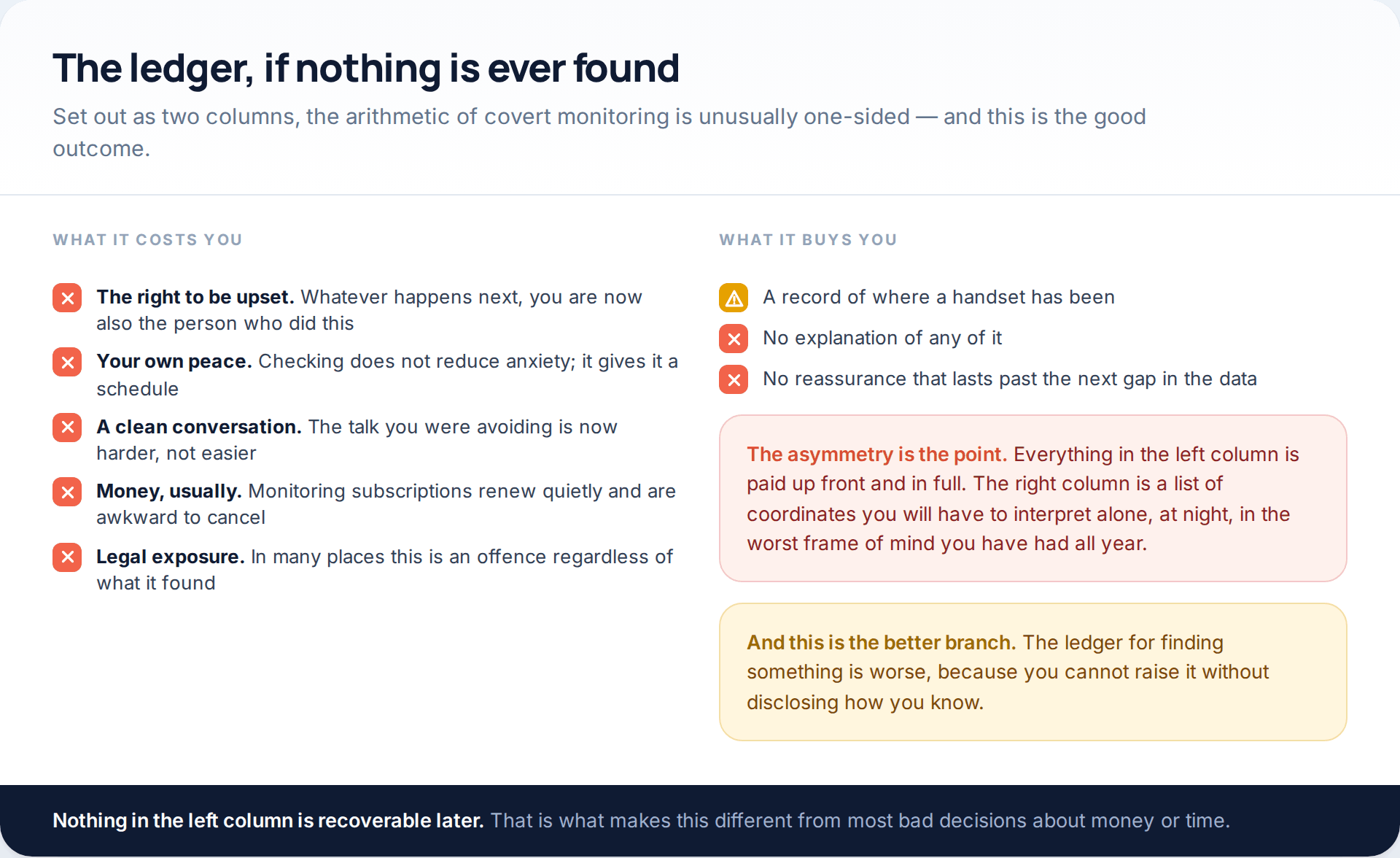
The first line of that ledger is the one people underestimate. Up to the moment you install something, you are a person with a worry. Afterwards, you are also a person who did this — and that changes every conversation that follows, including the ones about the original worry. If it later turns out you were right about something, you will find that being right does not restore the position you gave up.
Eight weeks, in practice
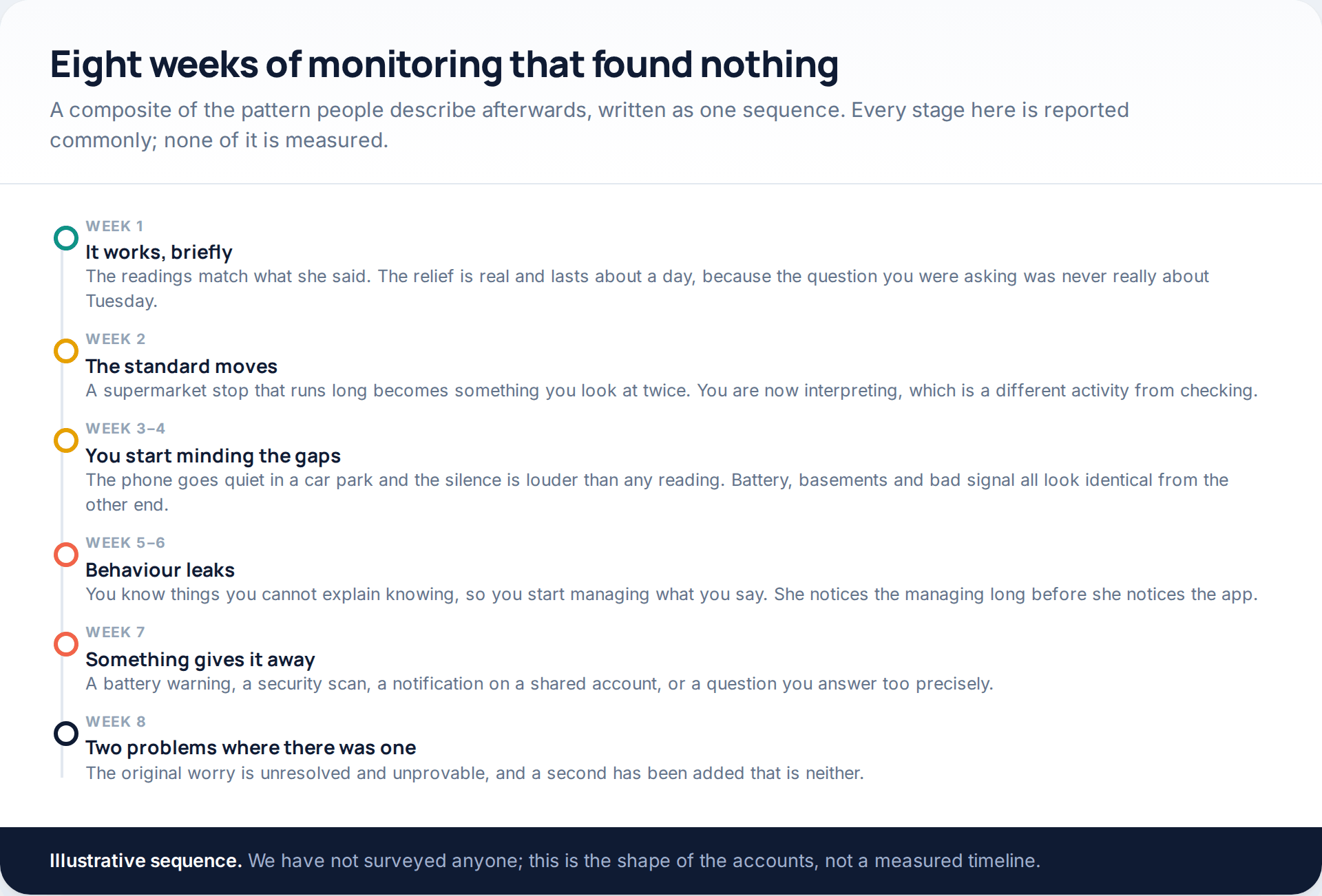
Week five is the stage nobody predicts. Having information you are not supposed to have changes how you speak: you avoid certain questions, you react wrongly to news you already had, you are strangely incurious about a day you have watched all of. Most people are far worse at concealing this than they expect, and partners generally register that something has changed weeks before they identify what.
Why “she will never know” is the weakest assumption
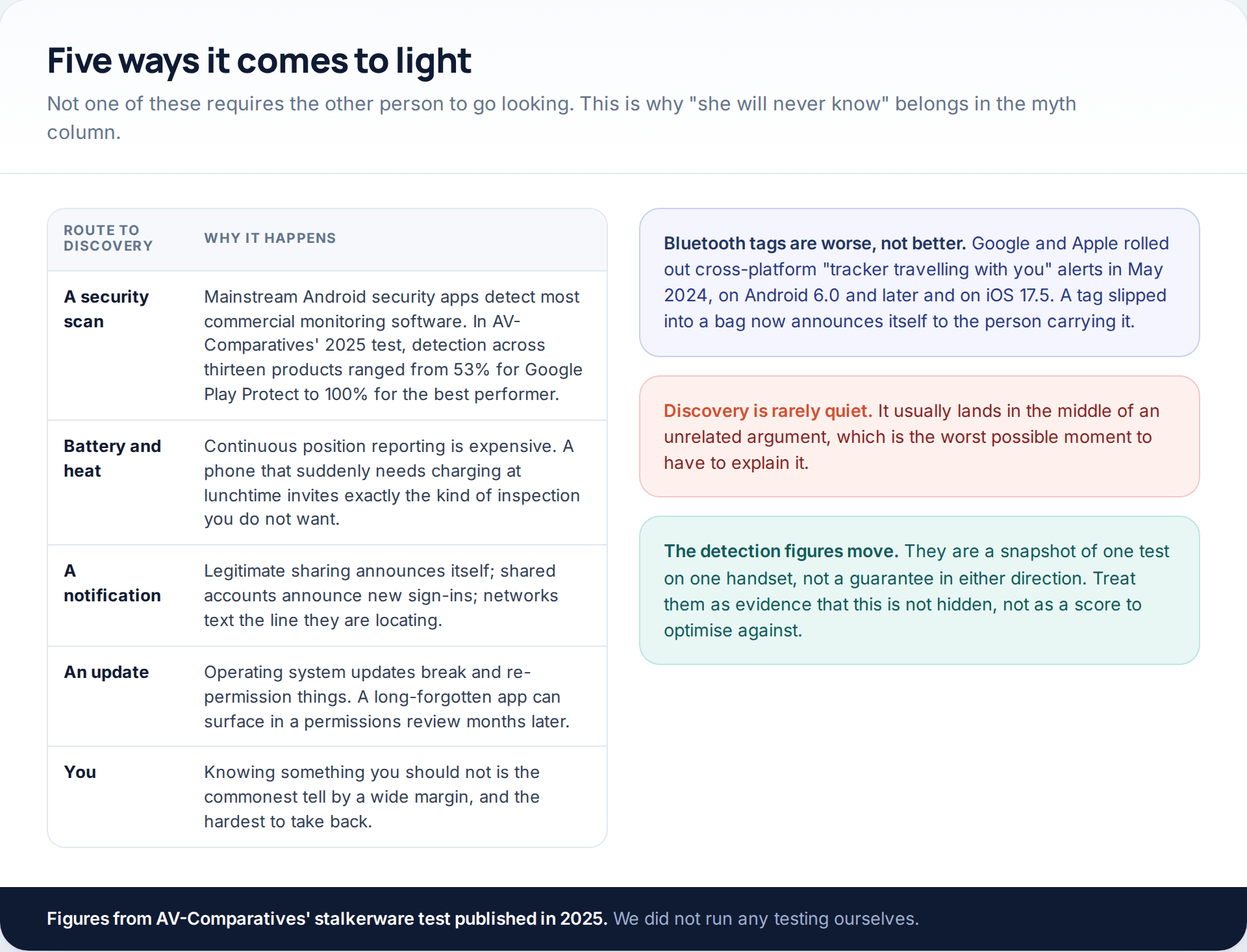
The security-scan line deserves a number, because it is one of the few things here that has been measured. AV-Comparatives published a stalkerware test in 2025 in which thirteen Android security products were run against seventeen commercial monitoring apps on a Samsung Galaxy A36 in September that year. Detection ranged from 53% for Google Play Protect, which is on every Android phone by default, up to 100% for the best-performing product. These apps are not invisible to ordinary software, and the people who sell them know it.
If you are reading this from the opposite position — wondering whether something has been installed on your own phone — the checks are set out step by step in our complete guide to detecting spyware, including the permissions and device-administrator entries that matter most.
And if it does find something
This is the branch people plan for and it is worse, not better. A location reading that looks wrong is not an explanation; it is a new question you cannot ask without revealing where it came from. The moment you do, the conversation changes subject. You will be discussing your software rather than her Thursday, and the person with the explaining to do will be you.
In a separation, the problem compounds. Material gathered covertly generally needs the court’s permission before anyone can rely on it, and the application to rely on it puts the method of collection in front of the judge first. England’s Family Justice Council, in guidance published on 15 May 2025 about covert recordings in children proceedings, recorded that courts have been entitled to treat the use of recording equipment as a form of intimidation capable of being restrained by injunction, and that how a recording was made may be directly relevant to assessing the person who made it. That guidance is about recordings rather than trackers, but it is the clearest published statement of how covert surveillance between partners tends to be read.
The asymmetry worth absorbing. Unlawfully obtained material can still be admitted — and the fact that it was unlawfully obtained can still be held against the person who obtained it. Both of those things are true at the same time, which is why “at least I will have proof” is a poor plan.
Three things that actually move something
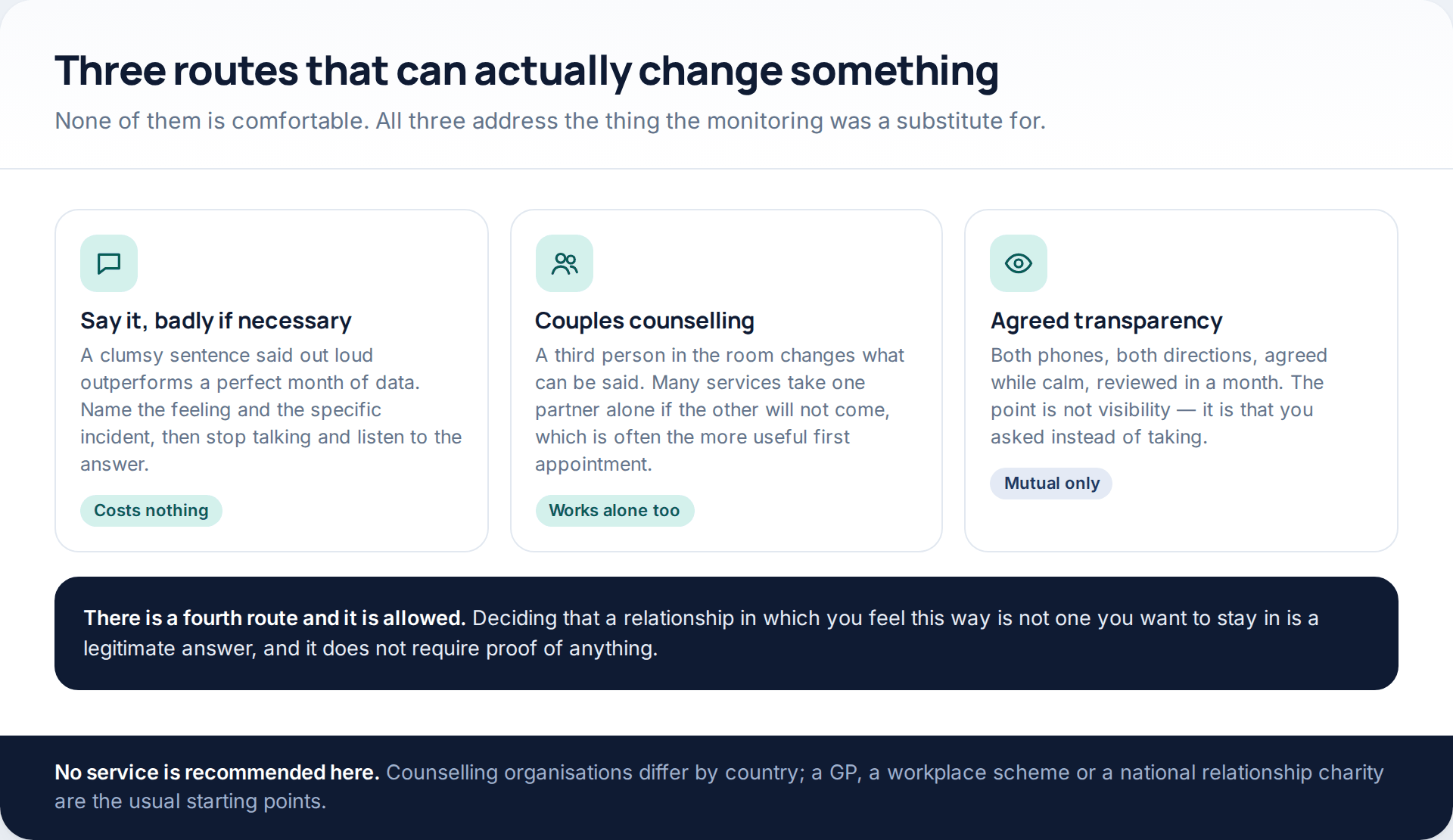
Saying it badly beats monitoring well
The sentence does not have to be elegant. “I have been anxious for a month and I would rather tell you than keep sitting with it” is enough to start, and it has the enormous advantage of being true. Pick a time that is not midnight and not in a car. Say the thing, then be quiet long enough for a real answer, which usually takes longer than feels comfortable.
Counselling is not only for couples who are both willing
A common blocker is that one partner will not attend. Many relationship services will see one person alone, and a first appointment on your own is often the more useful one: it is where you work out what you are actually asking for, before anyone else is in the room. A GP, an employer’s assistance scheme or a national relationship charity are the usual routes, and in several countries the first session is free or means-tested.
Agreed transparency, if you both want it
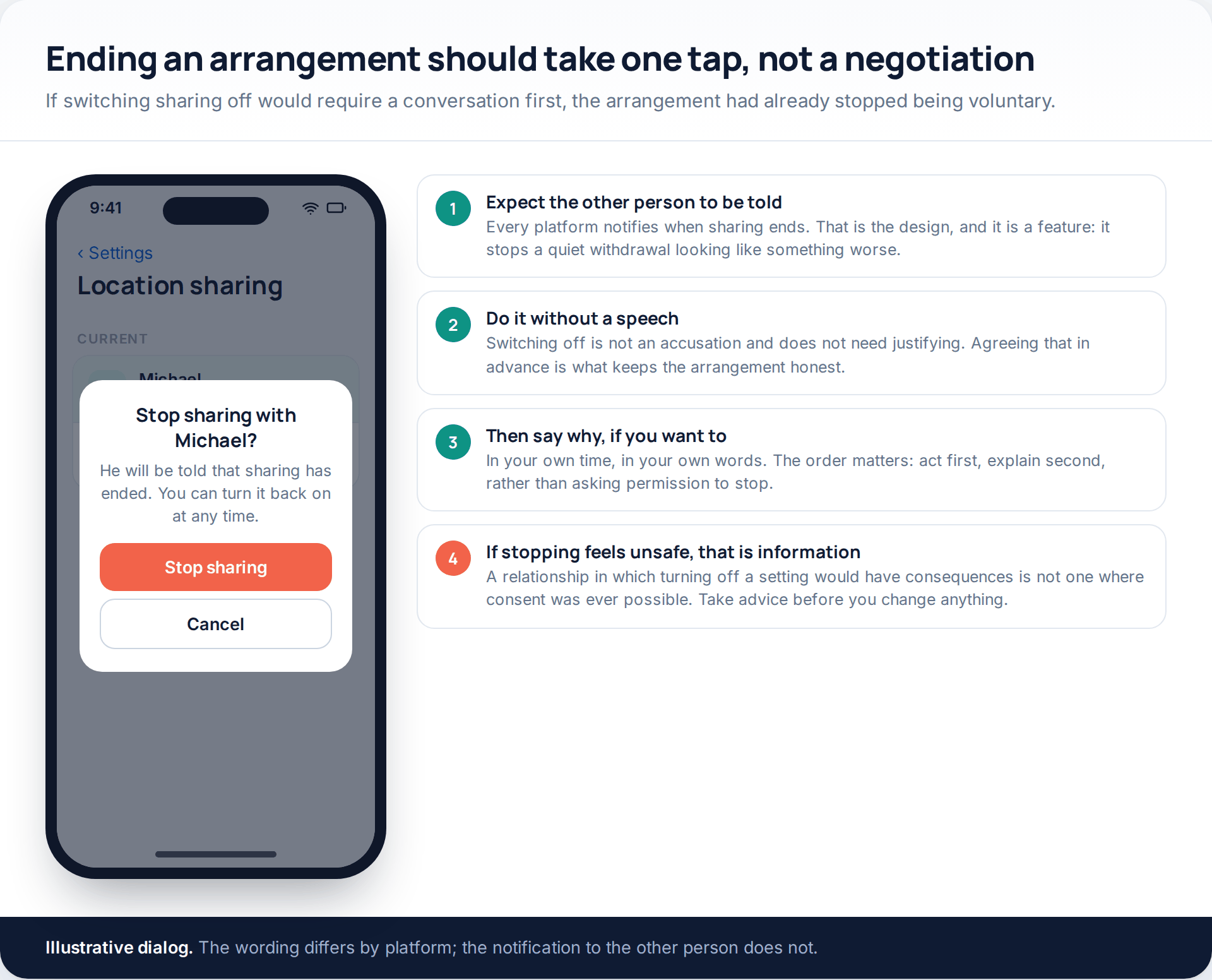
Some couples share locations permanently and find it unremarkable. It works on three conditions: it runs in both directions, both people chose it while calm, and either can end it without that being treated as an admission.
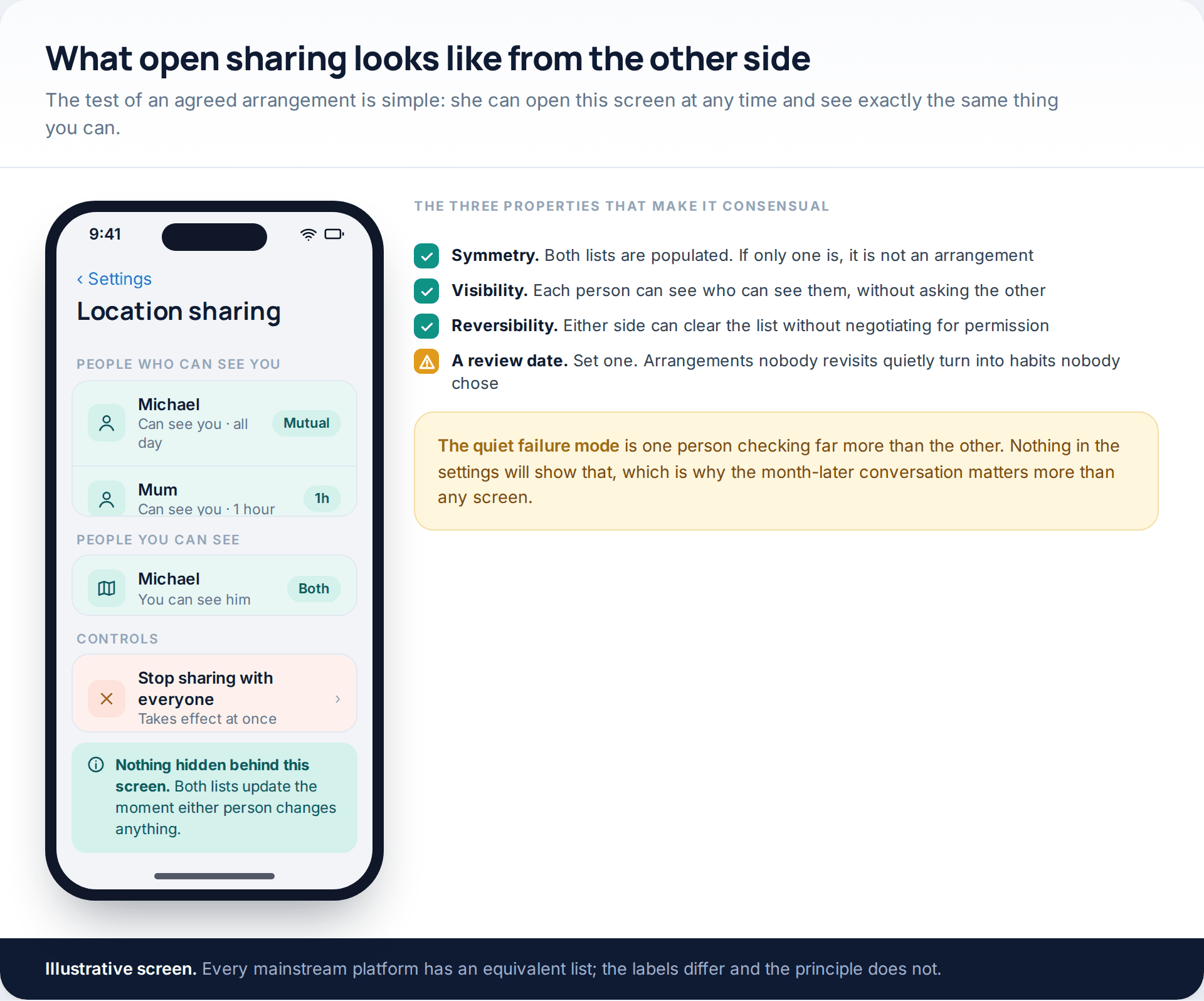
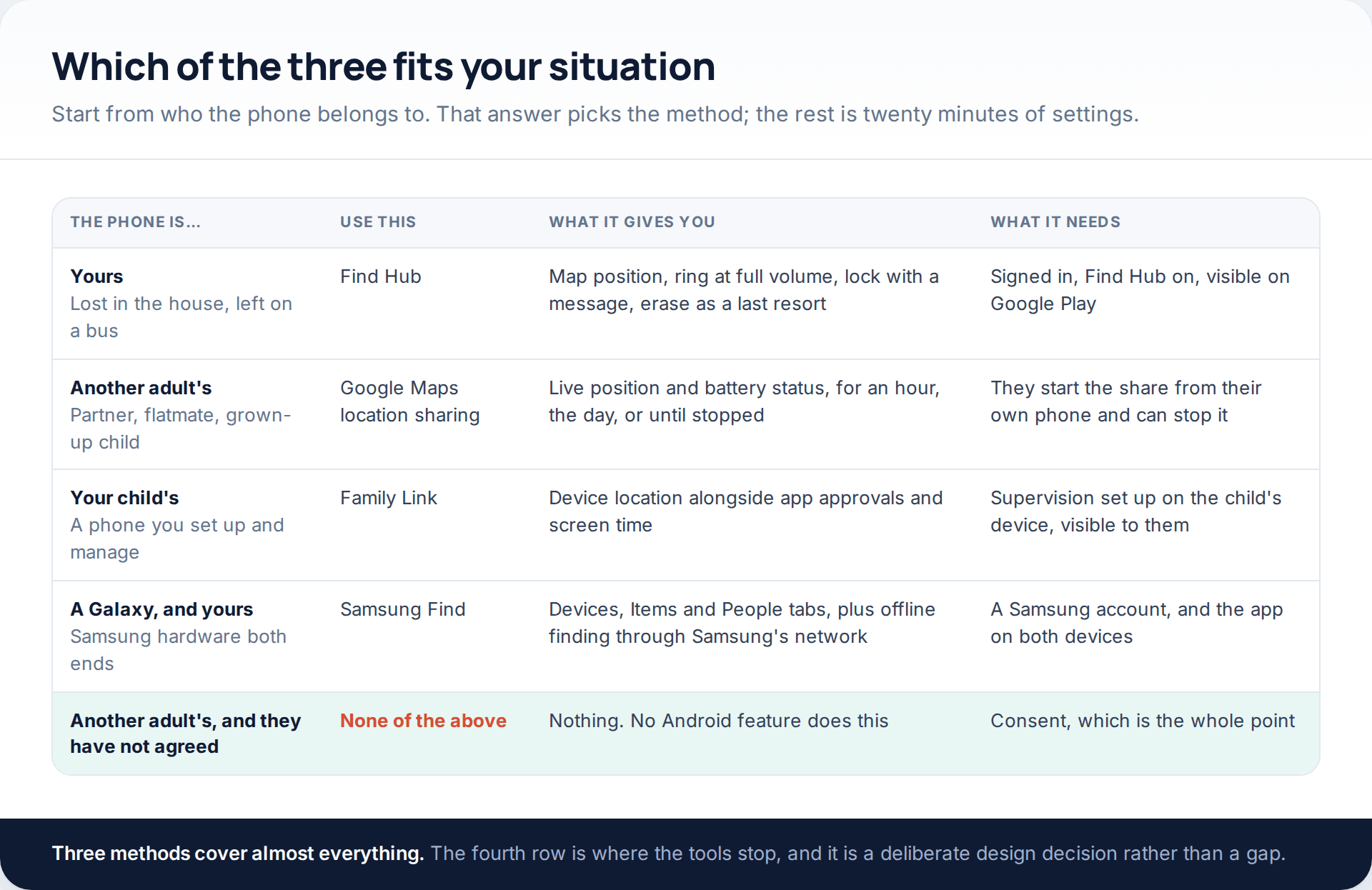
Mechanically it is the same on every platform. On iPhone it lives in Find My under the People tab; on Android, Find Hub and Google Maps both offer person-to-person sharing; Google Maps is the one that works between an iPhone and an Android phone. All three offer the same durations — about an hour, the rest of the day, or until someone stops it — and all three tell the other person when sharing begins. Labels shift between versions, so search the app’s settings for “share” rather than hunting for a specific menu name.
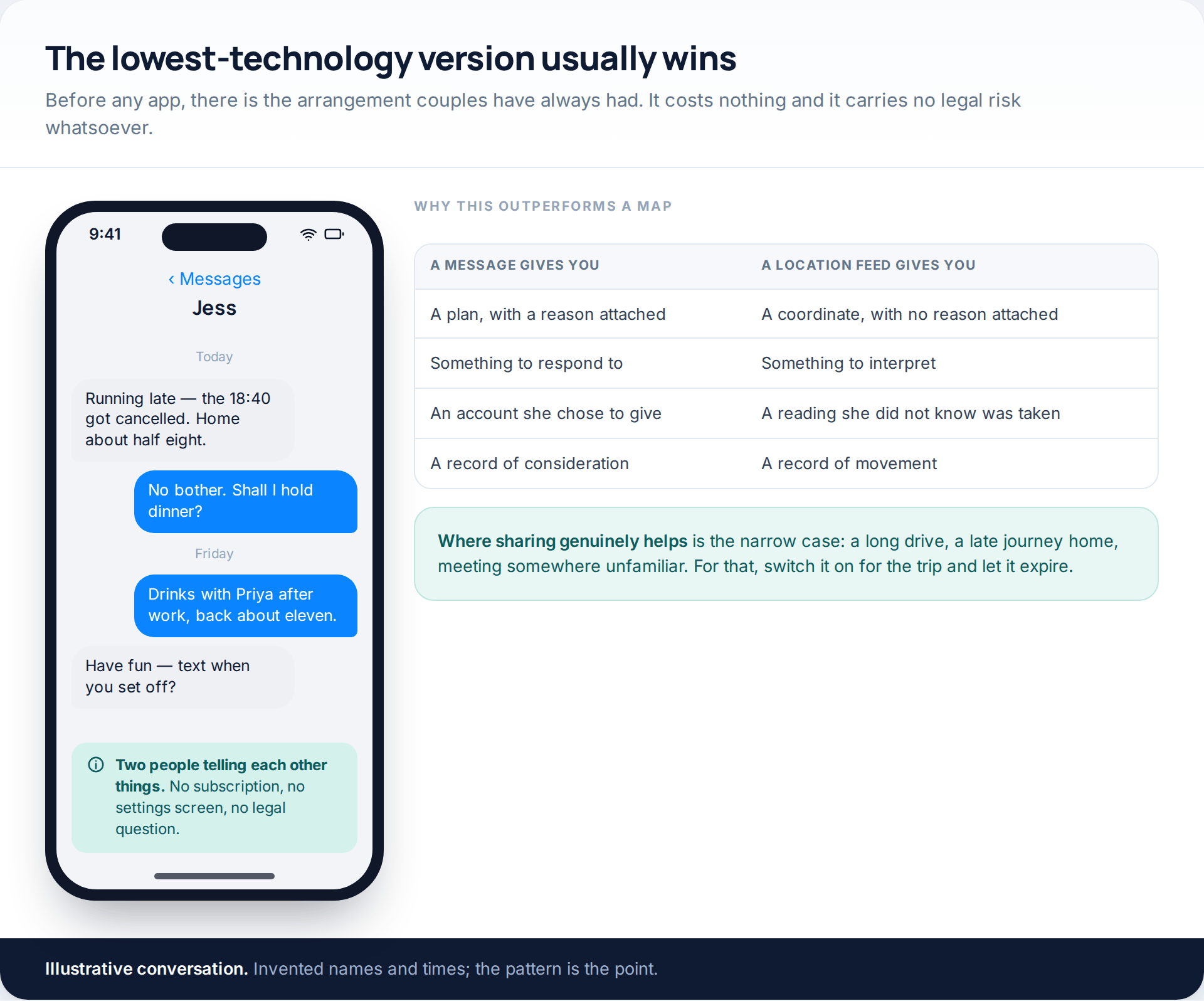
Before any of that, though, consider the version with no settings screen in it. A message that says “running late, home about half eight” supplies a plan, a reason and an invitation to respond. A dot on a map supplies none of those and demands interpretation instead. For most of the situations people reach for tracking to solve, the message is strictly better.
If the worry is your own safety
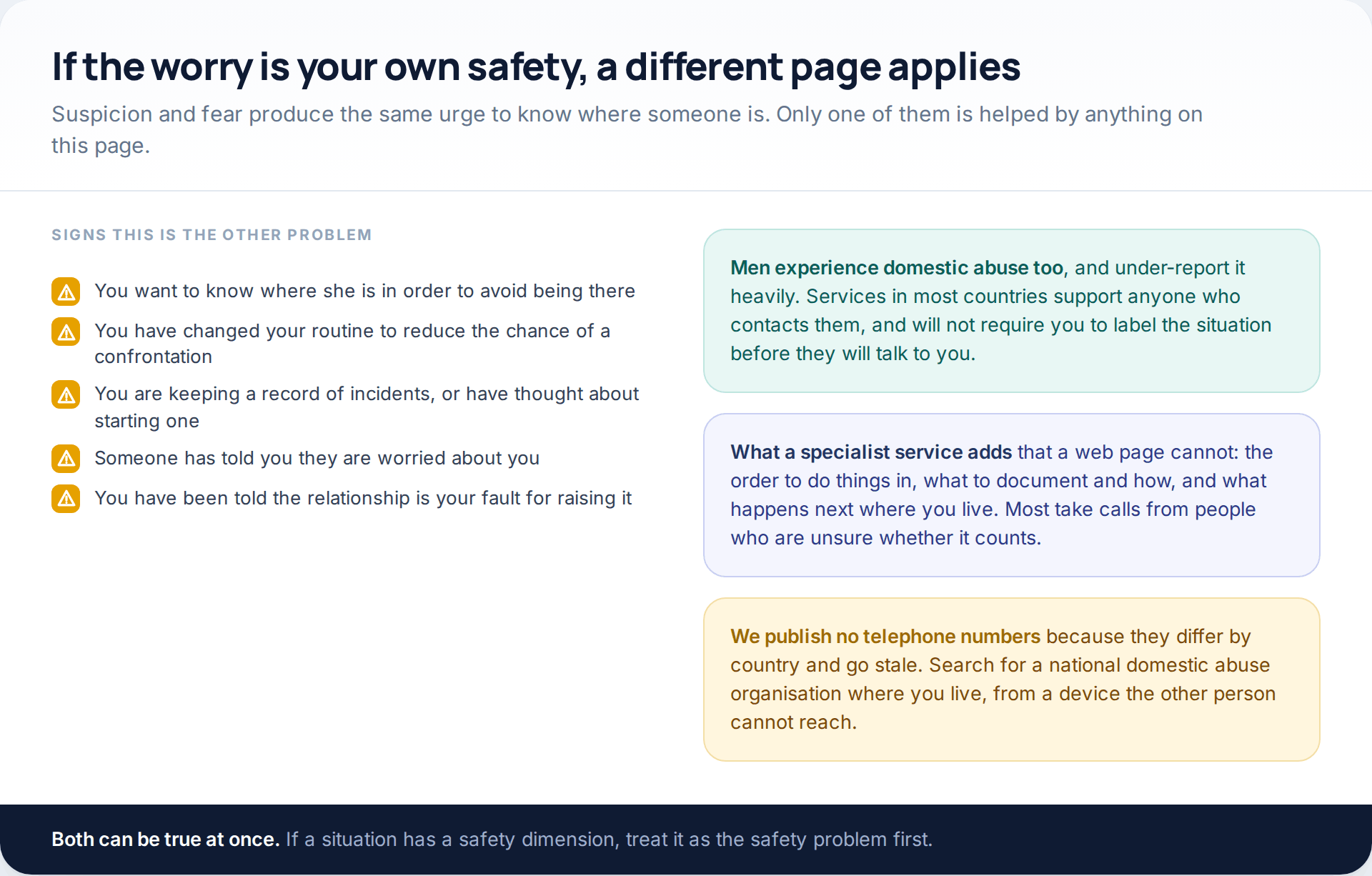
Some people want to know where a partner is because they are managing a risk rather than a doubt: avoiding a confrontation, predicting an arrival, staying out of the way. That is a safety question, and surveillance is a poor instrument for it — partly because it does not help much, and mostly because being discovered tends to escalate rather than defuse.
How this page was put together
The detection figures come from AV-Comparatives’ stalkerware test published in 2025, which assessed thirteen Android security products against seventeen commercial monitoring applications on a Samsung Galaxy A36 running Android 15 in September 2025, and which also records that most such software cannot be installed remotely. The cross-platform unwanted-tracker alerts were announced jointly by Google and Apple in May 2024 for Android 6.0 and later and iOS 17.5. The family-proceedings material comes from the Family Justice Council’s guidance of 15 May 2025 on covert recordings in children proceedings, and the point about prosecutors naming GPS tracking of a partner comes from Crown Prosecution Service legal guidance on controlling or coercive behaviour. Platform behaviour was checked against Apple’s and Google’s own help pages in October 2026.
Everything behavioural on this page is described rather than quantified. The eight-week sequence is a composite of commonly reported accounts, not a study; we have surveyed nobody, interviewed nobody, and invented no percentages for how often covert monitoring is discovered or what happens to marriages afterwards. No monitoring product is named, recommended or tested, and no counselling service is endorsed. Nothing here is legal advice — the rules differ by country and, in federal systems, by state.
One further choice worth stating. We have not described how any monitoring product is installed, configured or hidden, and we will not, including in the sections about how such software is detected. Describing detection does not require describing deployment, and the two get bundled together far too often on pages of this kind.
Questions that come up
Is tracking a wife’s phone illegal if we are married?
In many places, yes. The statutes that address tracking devices generally ask whether the person located consented, not what their relationship is to the person tracking them. England and Wales treat repeated monitoring of a partner as capable of amounting to controlling or coercive behaviour, and some jurisdictions have standalone offences for using a tracking device on a person.
What if I only want to know she is safe?
Then ask for mutual sharing, openly, and set it up together. Safety is the one motive that survives being said out loud — which makes it a strange thing to pursue covertly. If the real reason could not be stated to her, the motive is probably not the one being claimed.
How likely is it to be discovered?
We will not put a number on it, because none that is trustworthy exists. What can be said is that mainstream Android security apps detect most commercial monitoring software, that continuous location reporting is visible in battery behaviour, and that the commonest giveaway is the monitor knowing something they cannot account for.
Can I use what I find if we divorce?
Possibly, and it may cost more than it gains. Reliance on material of this kind usually requires permission, which means the method of collection is examined before the content. Published English guidance on covert recordings notes that how such material was obtained can be directly relevant to how the person who obtained it is assessed.
She already shares her location with me. Is checking it constantly a problem?
It is the commonest way an agreed arrangement turns into something nobody agreed to. Sharing set up for convenience and then used for monitoring is a different thing in practice, whatever the settings say. If you would not describe your checking habits out loud, that is the signal.
What about a private investigator?
Not necessarily safer. Germany’s Federal Court of Justice upheld criminal convictions in 2013 against investigators who fitted covert GPS trackers to vehicles, including for clients who suspected a spouse of infidelity, holding that only an interest close to an emergency could justify it. Paying someone else to do an act does not change its character.
We have children. Does that change anything?
It raises the stakes rather than lowering them. Covert surveillance of the other parent is the kind of conduct that gets examined in children proceedings, and English guidance is explicit that the manner in which covert material was obtained may be directly relevant to assessing the parent who obtained it.
Using a monitoring app for this? GuestSpy is parental monitoring for Android that stays visible on the child's phone and runs from any browser. If it fits your family, see the Location & Places feature.
Related guides
Track SMS Messages: Free SMS Monitoring Apps for Parents, Compared
You cannot track SMS messages on a child’s phone from your own phone alone, and no free app changes that.…
Track an Android Phone From Another Android Phone: Three Family-Safe Methods
To track an Android phone from another Android phone, you need one of three things arranged in advance. Find Hub…

Best 10 Free SMS Tracker for Android and iPhone
Earlier, when there we no messenger apps, people used to rely on text messages. Although time and technology are changing,…
Monitoring your child can see.
Location, screen-time budgets, routines, app and website blocking and the alerts that matter, run from any browser and visible on the phone. Pair an Android phone in about fifteen minutes.