Watch over the phone, not behind their back
GuestSpy is a visible app on your child's Android phone and a panel in your own browser. You set a bedtime, a daily budget, a few saved places and the alerts you want, and the phone shows your child every single thing it shares. Nothing is collected until you switch a rule on. The core costs nothing, with no card and no subscription.
Three parts, and only one of them is software on a phone
A monitoring app usually means two apps and a server in between. GuestSpy is simpler than that, and the simplicity is where the honesty comes from.
The child app
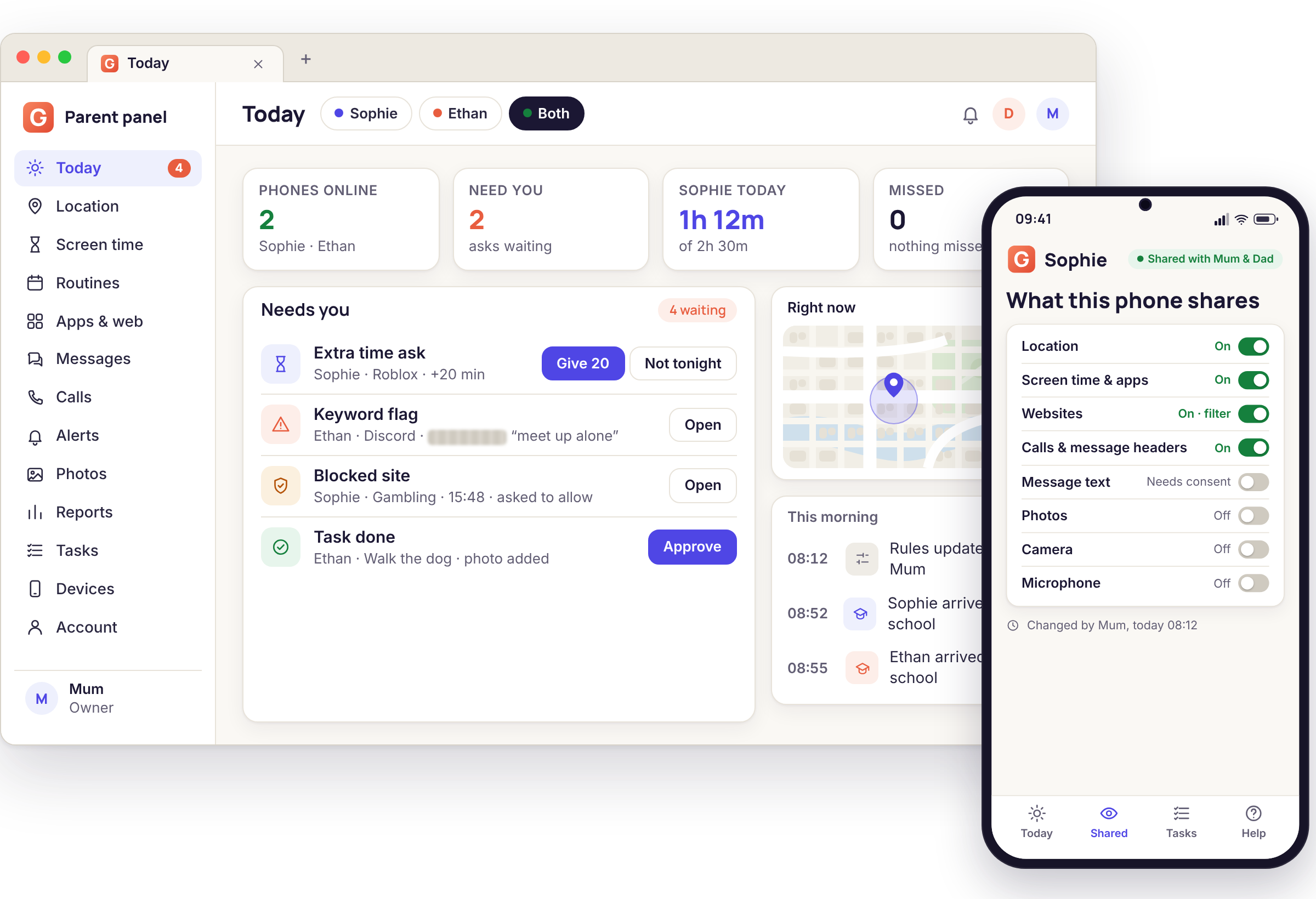
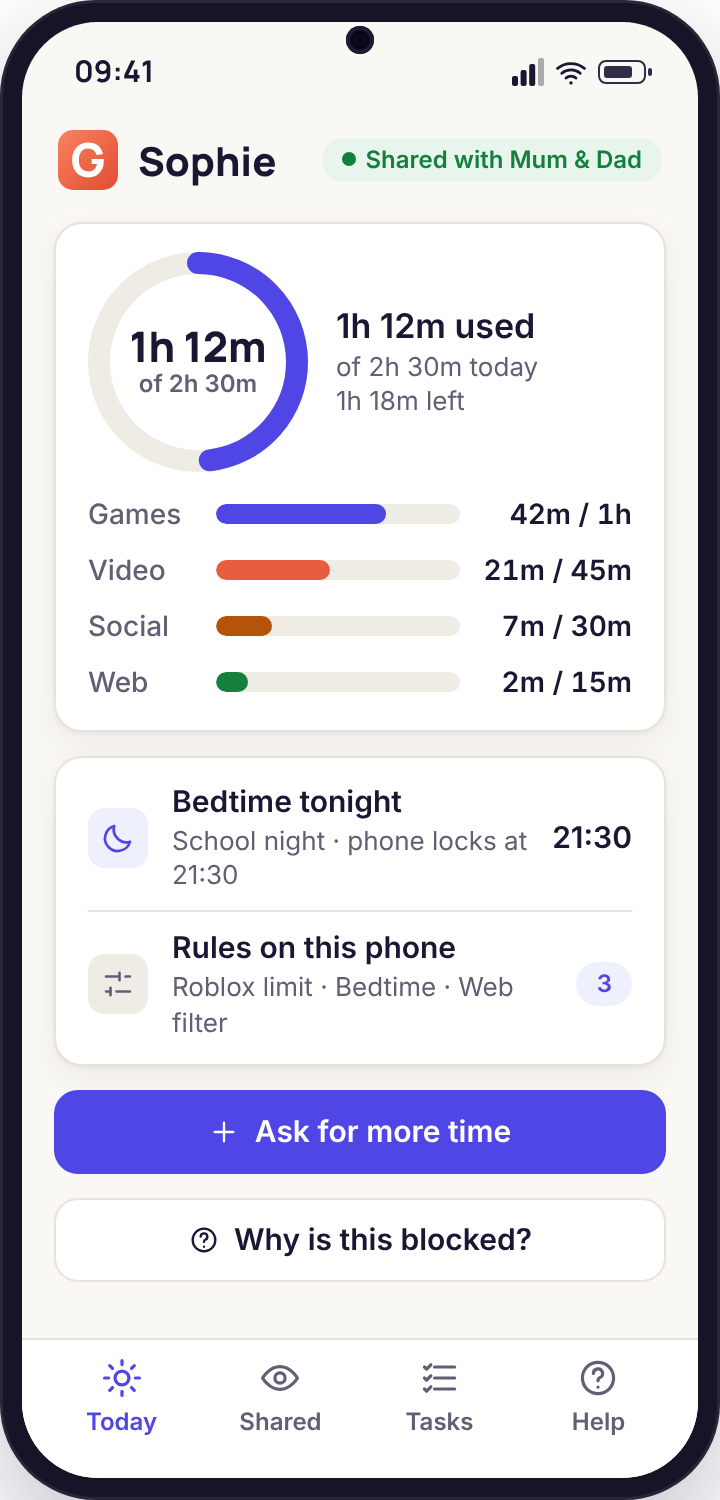
It installs on an Android phone or tablet running Android 9 or newer, from Google Play or as a direct download. The icon stays in the app drawer. Open it and the first screen is the Transparency list, which names each category the phone can share and shows whether that category is currently on. Below it is the child's own Today: minutes used, tonight's bedtime, and any rule that applies. Remote actions announce themselves on the phone the moment they happen.
The web panel
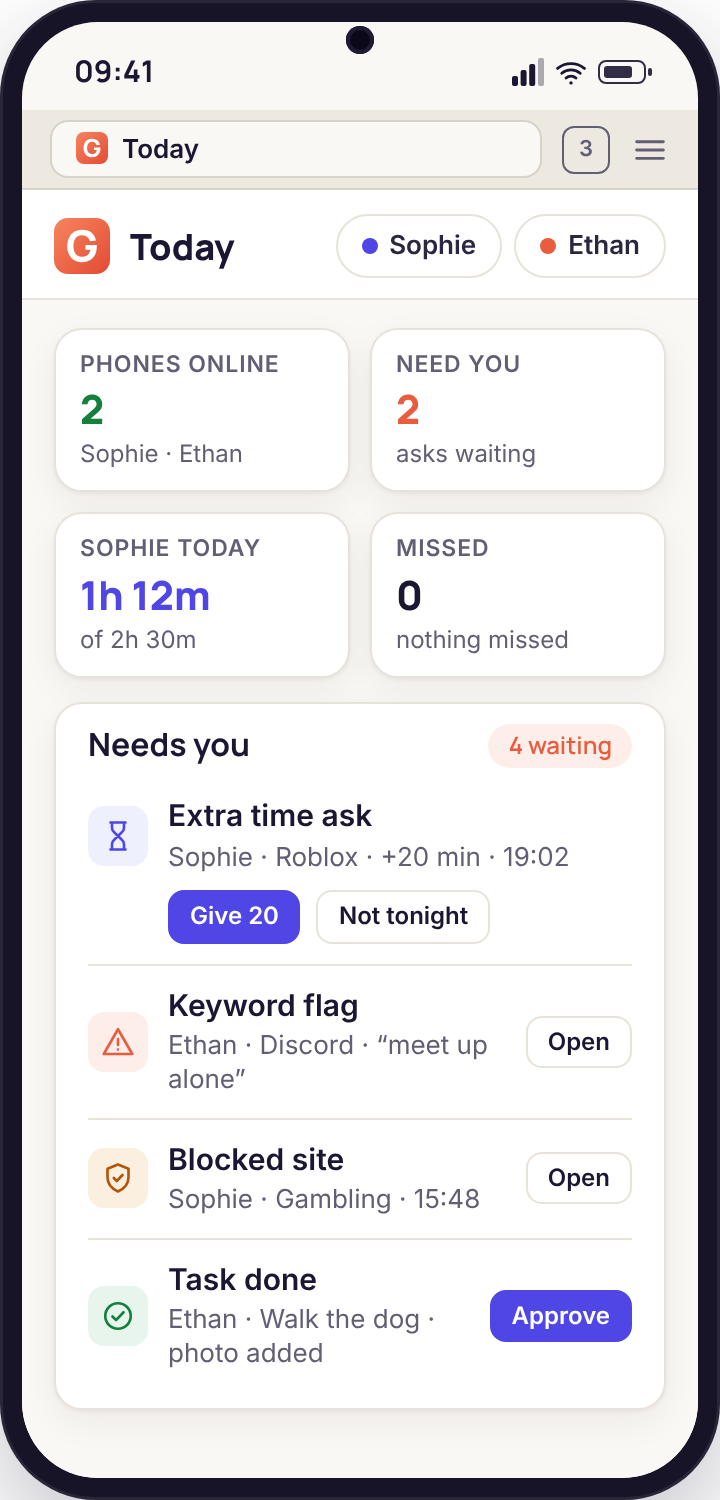
There is no parent app. You sign in at a web address from whatever you have to hand: a laptop at work, an iPad on the sofa, an iPhone in the car park. The Today page leads with a short "Needs you" list and four tiles across the top: phones online, needs you, screen time against budget, missed arrivals. Two-factor authentication and a list of signed-in sessions are under Security, and a second parent can be added with their own login.
The agreement
Pairing needs a code from your panel typed into the phone, so it happens with both of you present. The sensitive tools, such as reading message bodies or asking the phone for a photo, each have a consent switch that only the person holding the phone can accept. The panel can request; it cannot override. That arrangement is not a limitation we are apologising for. It is the reason a twelve-year-old can live with this app without resenting it.
Six tools that cover an ordinary week
All six are in the Google Play build and all six stay free. Each is off until you turn it on, and each has its own page that says plainly what it cannot do.
Location and Places
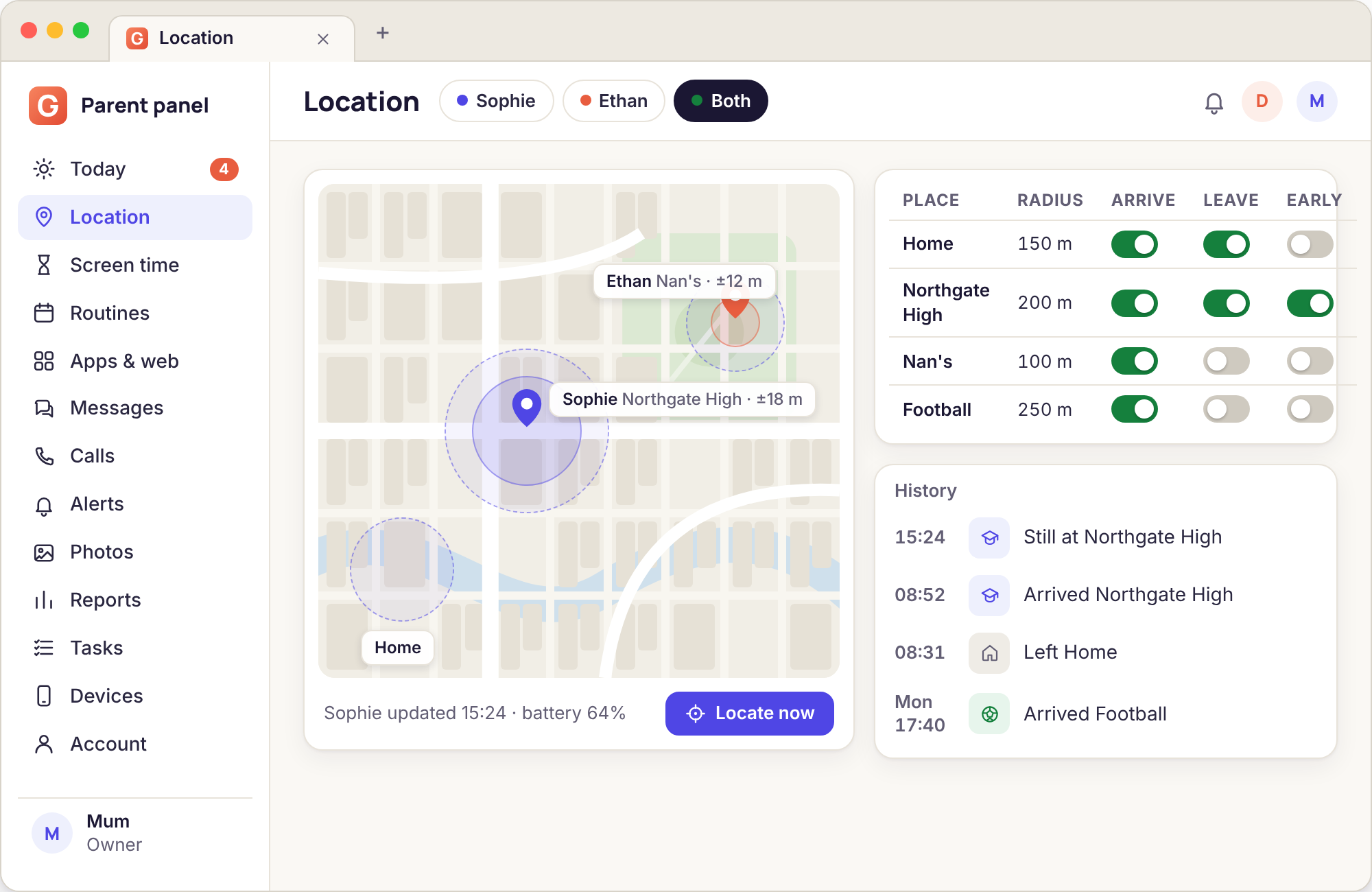
The map shows the last fix with an accuracy ring and the phone's battery level, and keeps 30 days of history. Save the places your week revolves around, give each one an arrive, leave or left-early alert, and let the Places do the watching. "Locate now" asks the phone for one fresh position and shows a notice on the screen; there is no live feed to sit and stare at.
Screen-time budgets
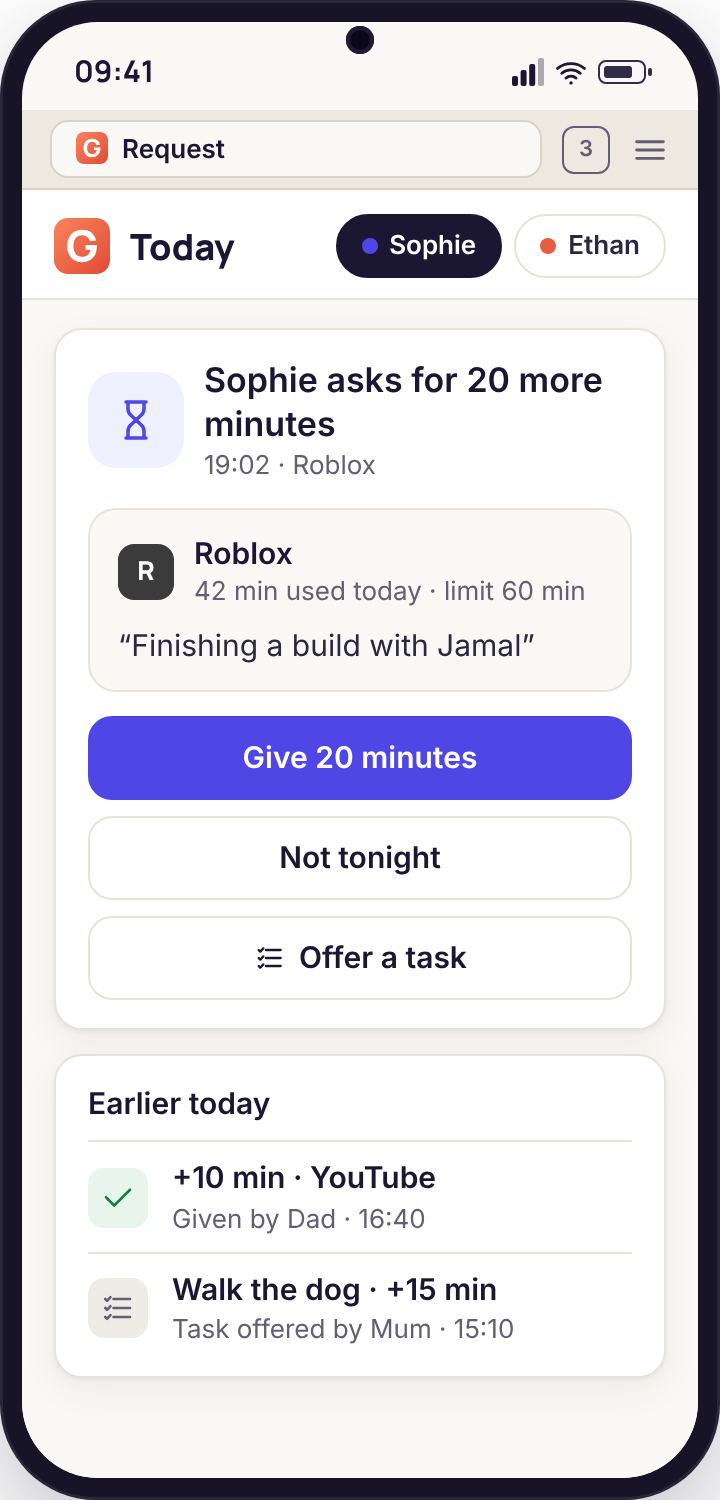
A daily allowance in minutes, one figure for weekdays and another for weekends, split between games, video, social and web. The phone does the counting itself, so a dead spot on the train changes nothing. When the minutes are gone, the child can ask for more with a reason, and you answer from wherever you are.
Routines and bedtime
Bedtime, School hours, Homework hour and Dinner pause are windows the phone keeps to without you touching it. Calls to parents and emergency numbers go through whatever the hour. Because tonight's bedtime is printed inside the child's app, the lock at half past nine is never a surprise.
App and website blocking
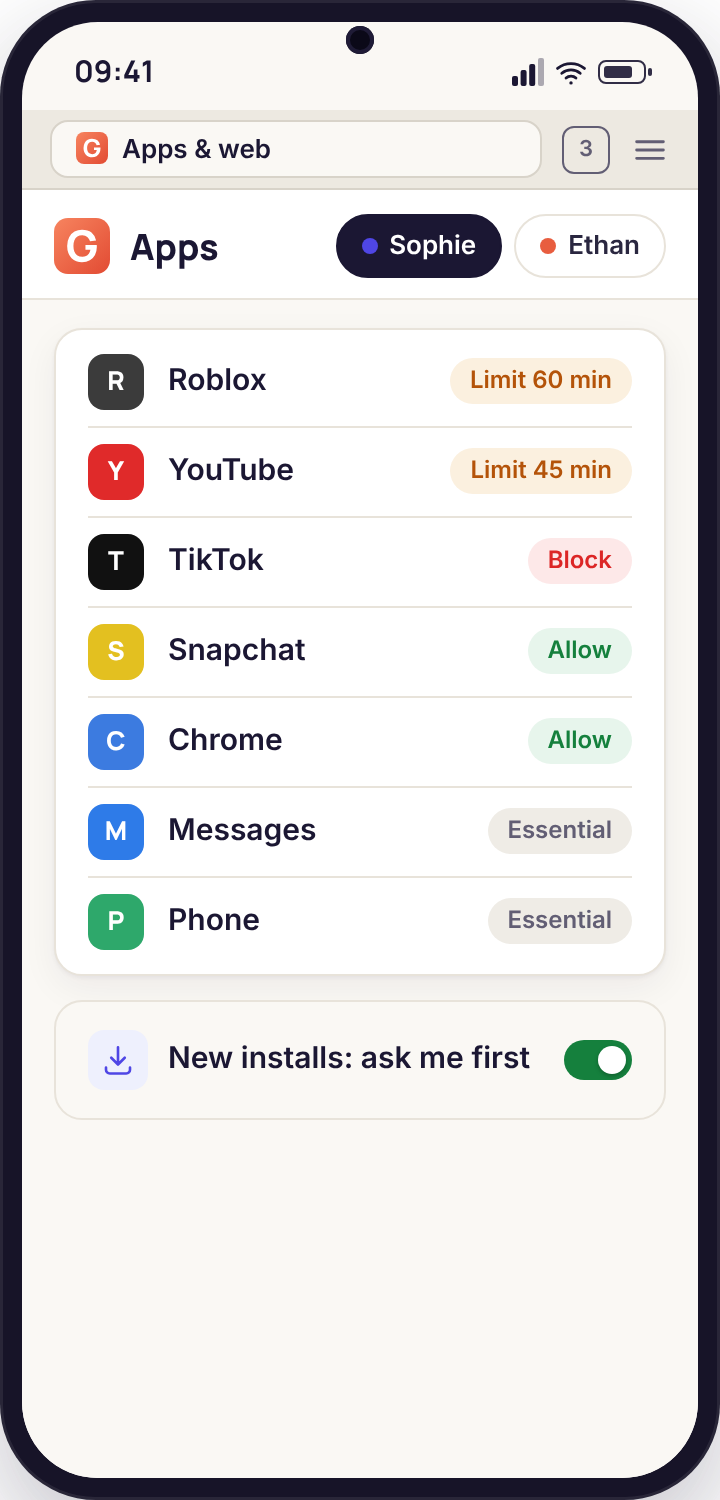
Each app is allowed, limited or blocked. Phone, Messages, Maps, Camera and Settings are protected, so a lock-out by mistake is impossible. "Ask me first" holds new installs until you say yes. The website filter runs on the phone itself, covers the categories you would expect, forces SafeSearch, and keeps a blocked-site log.
Messages and calls, without the words
What you see by default is the shape of a conversation: the contact, the app, the time, and how many messages. That applies to SMS and to the notification lines from WhatsApp, Instagram, Snapchat, Messenger, TikTok and Discord, with a flag whenever a number or sender is new. Calls show the name, direction, duration and a late-night total. Reading the actual text needs the direct-download build and a consent step tapped on the phone, and most families leave that switch alone.
Message headers in detail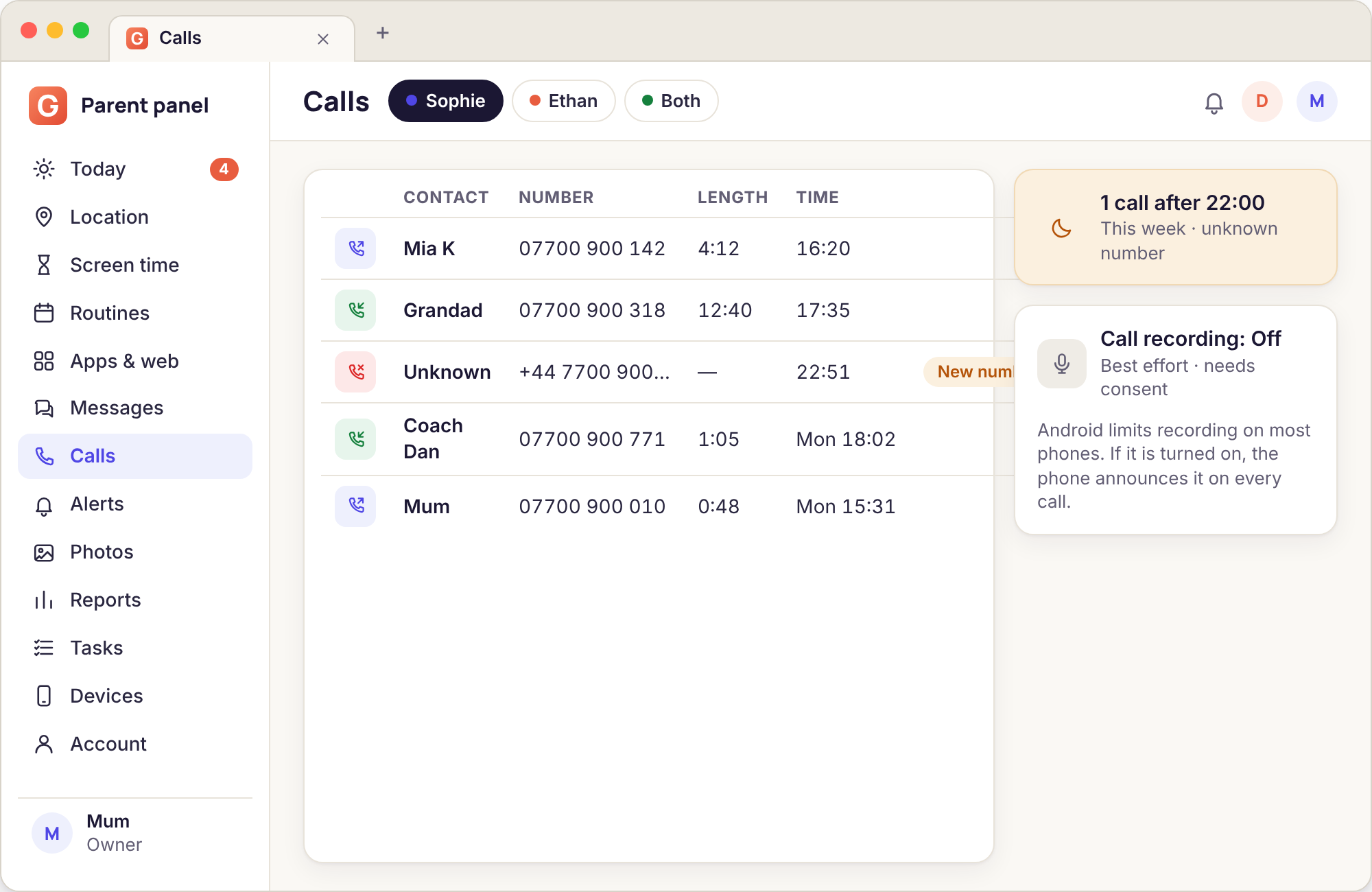
Alerts and keywords
Four built-in groups, meeting alone, grooming language, bullying and crisis words, are kept up to date by us, and you can add lists of your own. Rules are written the way you would say them: "leaves school before 15:20". Choose push, a daily email digest or an immediate email, and every alert records who handled it.
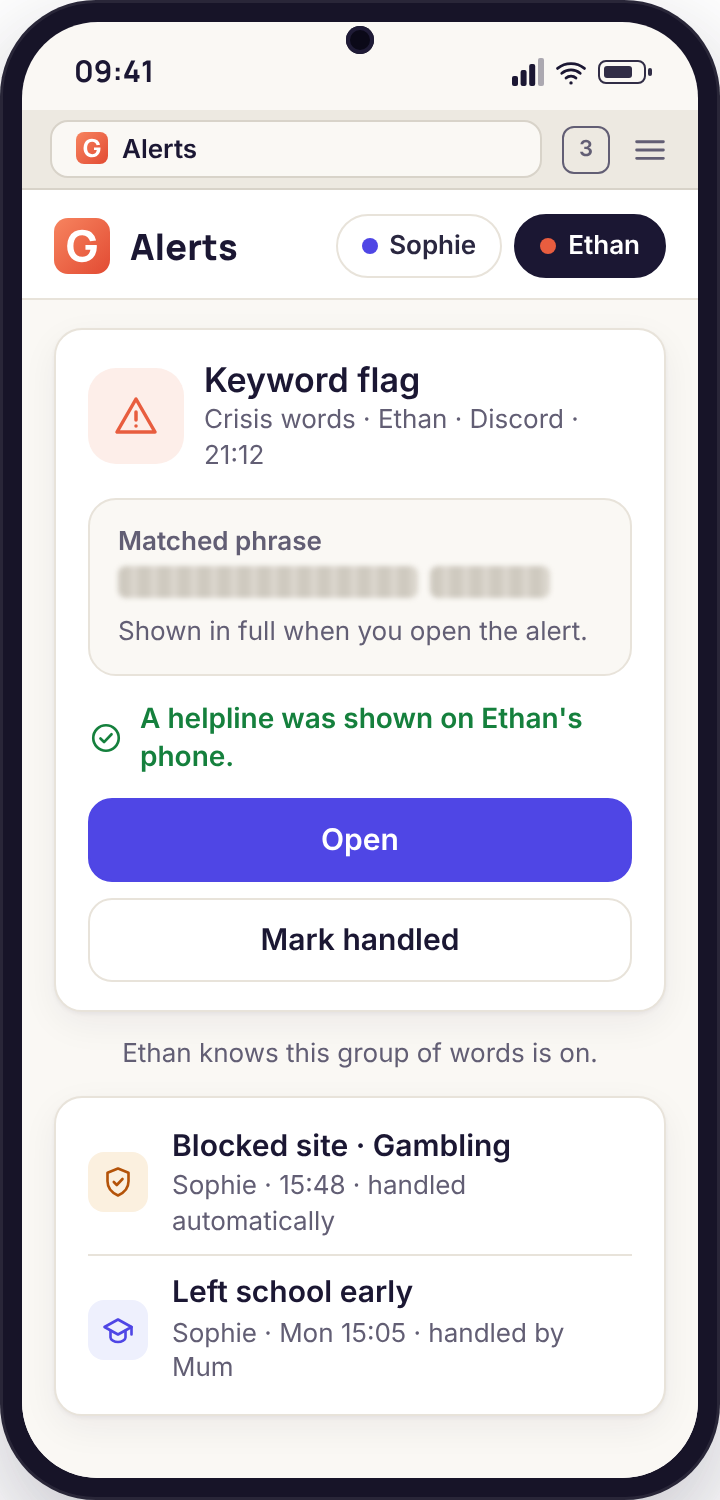
Photo review, the remote camera, ambient audio, call recording and Wi-Fi and email headers are in the direct-download build and sit behind consent switches. The full feature list covers all fourteen tools in one place.
A Thursday with GuestSpy
Maya is twelve, in Year 8, with a 90-minute weekday budget and a bedtime of 21:00. Her dad, Dan, has the panel open on a work laptop. Her mum, Ruth, reads the evening digest on an iPhone. Here is how a school day actually plays out, with the quiet bits left in.
Phone comes off the charger
Maya's phone has been locked by the Bedtime routine since nine the night before and unlocks itself at a quarter to seven. Nothing is sent to anybody. Dan has not opened the panel and will not need to for a while. The only thing the phone did overnight was charge.
"Maya arrived at School"
One line on Dan's laptop, no map attached. The School place has a 150-metre radius because the gate is a long way from the classroom block, and the arrive alert fires as soon as the phone crosses it. Twenty minutes later the School-hours routine starts: games, video and social pause until 15:10, while Phone, Messages and Maps carry on as normal.
A Wi-Fi network with no password
The phone joins an open network called "Library_Guest". That shows up in the Wi-Fi history with an open-network flag, because Ruth turned Wi-Fi history on after a conversation about public hotspots. It is not an alert and nobody is notified; it is a line in a list that Ruth will skim on Sunday. The school library does, in fact, have free Wi-Fi.
A new sender on Discord
Over lunch a Discord notification arrives from a username the panel has never seen. The Messages page shows exactly that: the app, the username, 13:20, one message. No text, because the message-body switch has never been accepted on Maya's phone. Dan sees the new-sender flag on the Today page, recognises the username as a cousin's gaming handle, and marks it handled.
Left early, by two minutes
The left-early alert is set to "leaves School before 15:10" and the phone crosses the boundary at 15:08. Ruth's rule sends an immediate email; Dan's sends a push. The explanation turns out to be a bus that was early and a teacher who let them go. Two minutes is not a problem, but the point of the alert is that a two-hour gap would have been caught just the same.
Homework hour
From half past four to half past five the Homework hour routine pauses the same apps School hours did. Maya's budget stops counting while it runs, which she regards as fair. She uses Maps to check a bus time for Saturday and sends two texts, neither of which is interrupted.
The budget runs out
The ten-minute wind-down warning appeared at 18:25. At 18:35 the video app stops opening and Maya taps "Ask for more time", typing "want to finish the episode". The request lands in Dan's Needs you list with three buttons. He taps Offer a task. The phone shows "Take the recycling out · 15 min". She does, photographs the empty bin, and the minutes are credited before the next episode starts.
Bedtime, and the Sunday report fills in
The phone locks. The lock screen says "Locked by Bedtime routine" and lists the numbers that still connect. Ruth's digest arrives at 21:30: 1 h 45 min used against a 90-minute budget, one task done, one new sender handled, one left-early alert, one open Wi-Fi network. On Sunday the same day will appear as a bar in the weekly report, and that will be the last anyone thinks about it.
Their phone tells them exactly what yours can see
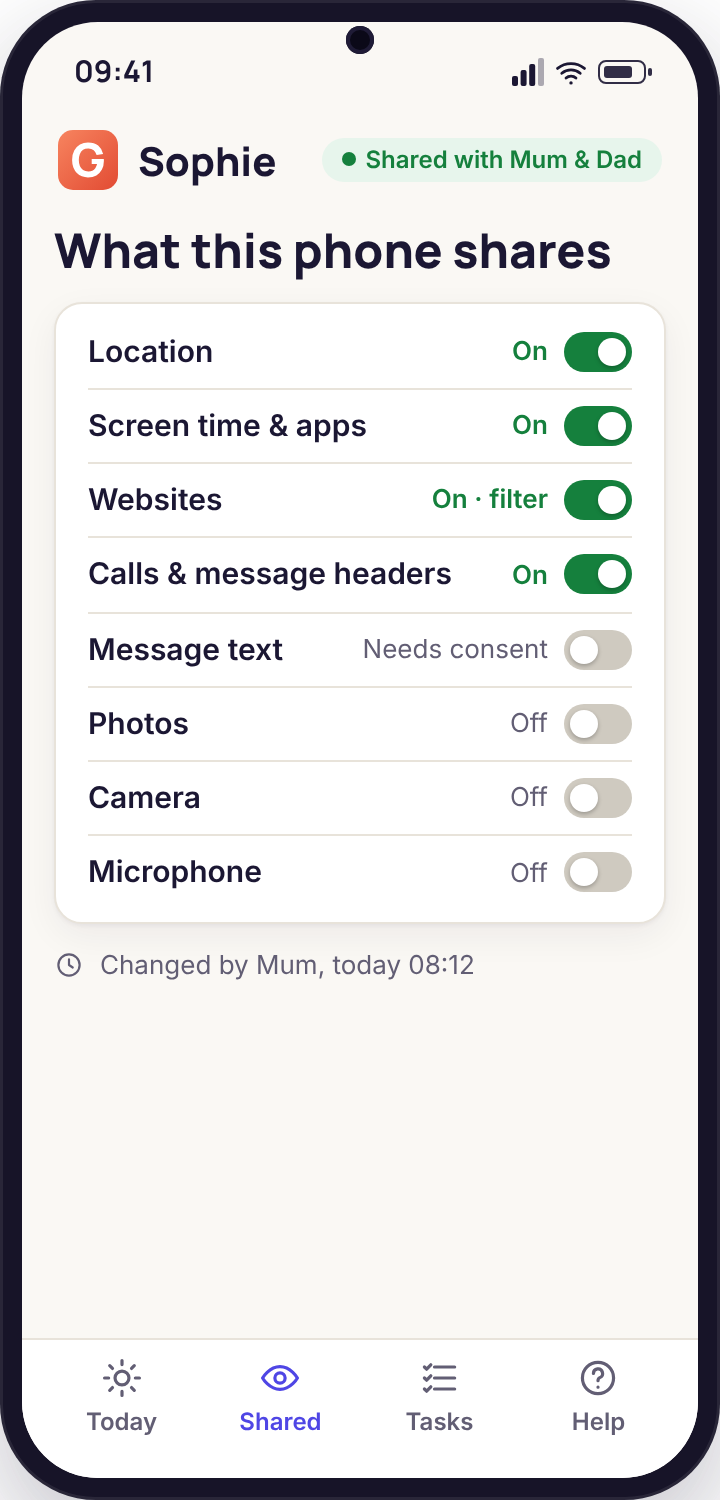
Hand the phone to your child, let them open the app, and the Transparency screen is what greets them. It is a plain list: location, screen time, apps, websites, message headers, calls, Wi-Fi, and the advanced tools, each with the word on or off beside it. Switch location history on from your browser and the list on the phone updates within seconds. Switch it off and it updates again. The child never has to take your word for what is being shared, because the phone states it.
The same screen carries a short activity list: the time you pressed Locate now, the time a rule was re-sent, the time a lock happened and who did it. A photo request shows "A parent asked for a photo". An audio request shows "Recording a 60-second clip, requested by Dad". None of this can be turned off from the panel, and we have no plan to add a setting that would.
What the child cannot do from their side is change the rules. The budget, the routines, the Places and the filter live in your panel. What they can do is ask: for more time, for a blocked site to be allowed, and whether to accept or decline a consent request. Those three decisions belong on the phone, and we think a reasonable teenager would agree.
- Every category listed with its current on or off state
- Every remote action named on the phone as it happens
- The icon cannot be hidden and the app cannot run silently
Fifteen minutes, both of you, one code
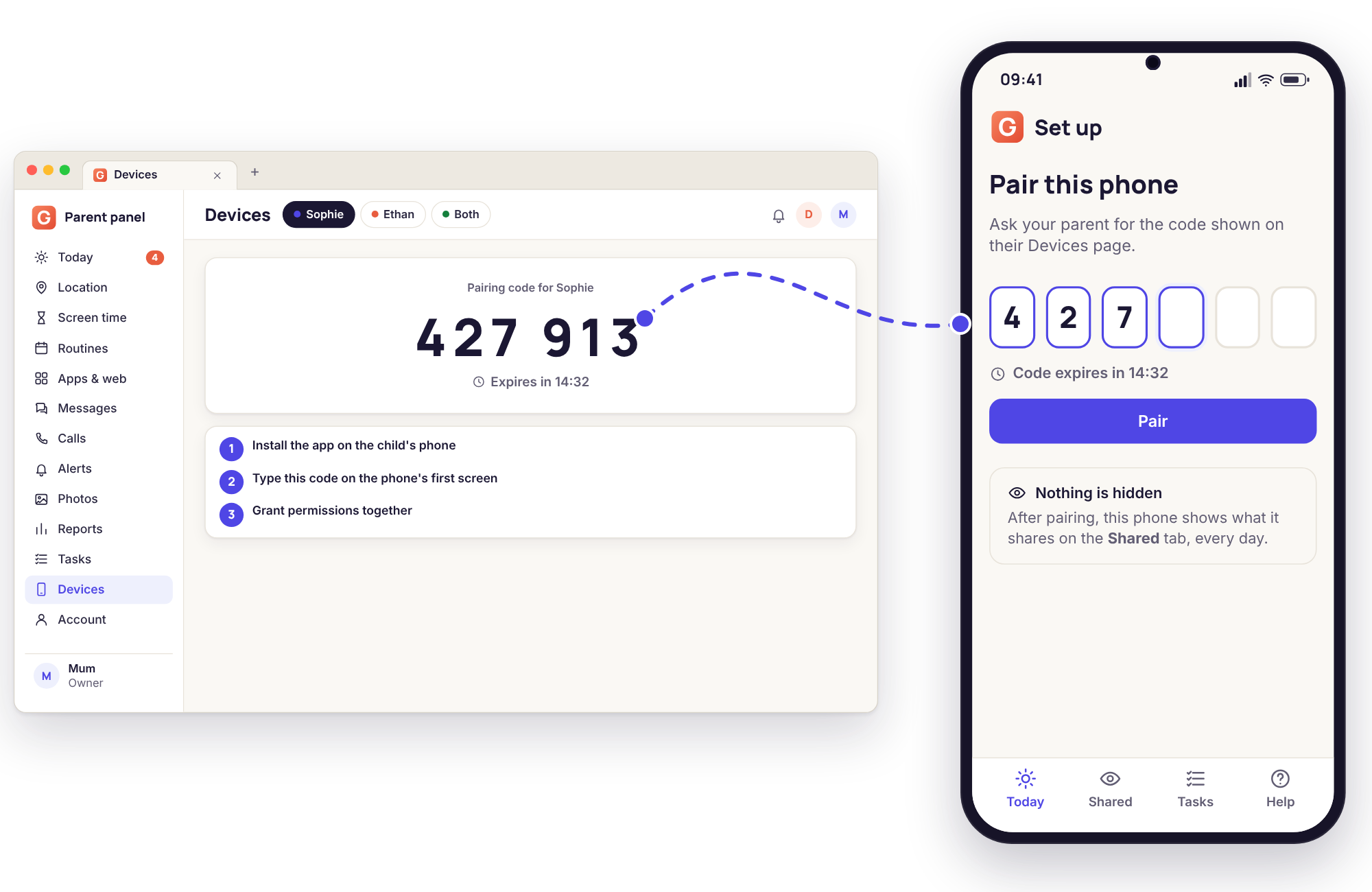
Make an account in your browser and add a child by first name and age. The Devices page shows a six-digit code that lasts fifteen minutes. On the phone, install the app from Google Play or from our direct download, open it, and type the code in. The app then asks for each Android permission in turn and explains in one sentence what it unlocks, so your child can read along and ask why. Location needs "Allow all the time" for Places to work in the background, and the walkthrough says so.
Once paired, the phone shares nothing at all. There is no budget, no routine, no filter, no alert, and the Transparency screen shows an empty list to prove it. Most families turn on location and a bedtime the first evening and stop there until the first weekly report arrives. The report shows the real numbers, and a budget set from real numbers is one a child will accept.
Look round a real panel first
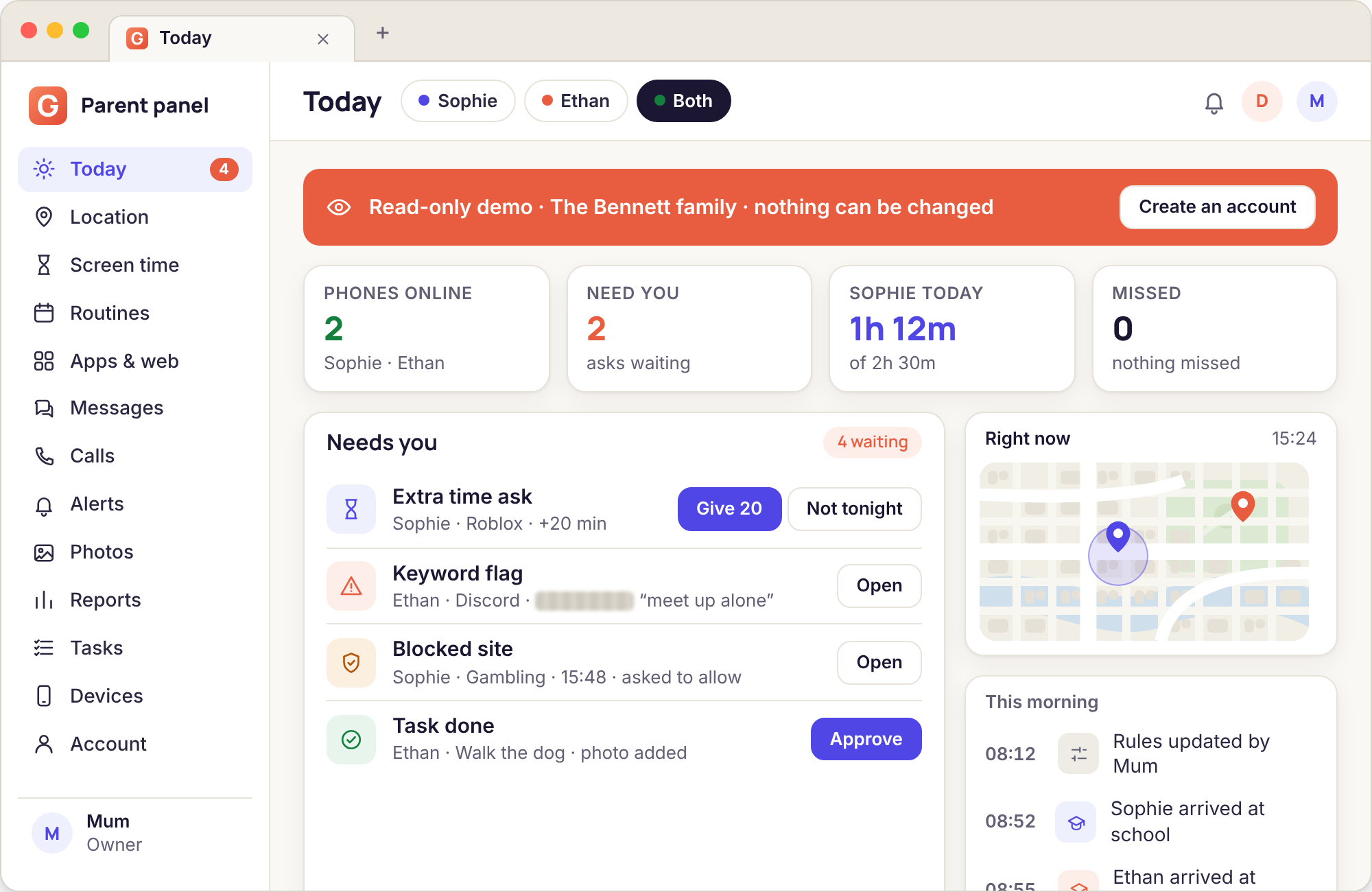
The demo signs you into the Bennett family's account, read only. Sophie is fifteen and Ethan is eleven, and their phones have a full week of ordinary life loaded: an extra-time ask that was answered with a task, a left-early alert that turned out to be a dentist appointment, a blocked gambling site, a flagged keyword that was a joke about a football match. Every page opens. Nothing can be saved.
It is the quickest way to find out whether this is the kind of parent you want to be. Some people open the demo, look at the message headers for a week they do not know, and decide they want less than that. That is a good outcome, and the reason the demo exists before the sign-up form rather than after it.
Real names, real phones, corrections in public
Each guide on this site is signed by the person who wrote it, with a sentence on why they are qualified to, and the Android phones they tested on. The editorial standards describe how a claim is checked before it goes live and what happens when we get something wrong.

How to choose and set up parental monitoring without wrecking the relationship
The technical choice is the easy half. The hard half is doing it in a way your child still respects you for at sixteen. This guide covers both, in the order a family actually meets them.
- Name the worry before you pick a tool. "Where are they after school" and "who is messaging them" need different features, and most families need two or three, not fourteen.
- Prefer the product that admits its limits. Any app that claims to read every chat on every platform is describing something Android does not permit.
- Say it out loud first. Monitoring that a child discovers is a betrayal; monitoring a child was told about is a house rule.
- Fewer rules, each explained, each reviewed. Then loosen them in the order you added them.
Decide what the worry is
Every family that comes to this category has a worry, and it is almost never "I want to monitor my child". It is something narrower. A ten-year-old walks to school for the first time. An eleven-year-old joins a group chat with thirty people in it. A thirteen-year-old has started being awake at one in the morning. A fifteen-year-old has a new friend nobody has met. Write yours down in a sentence before you look at a single feature list, because the sentence tells you which tool you need and, more usefully, which ones you do not.
"Walks to school" is a Places problem: one saved place with an arrive alert, and perhaps a left-early alert for the afternoon. It is not a messages problem. "Group chat with thirty people" is a headers problem: you want to know when a new sender appears and whether the volume at midnight is unusual, and you do not need the words. "Awake at one in the morning" is a bedtime routine and nothing else. "A new friend nobody has met" is the one case where the keyword groups for meeting alone and grooming language earn their place, and even then they work on notification lines, not on a transcript.
The reason this matters is load. Every rule you switch on produces something to read, and every thing to read is a small withdrawal from a finite account of attention. A parent with twelve rules reads none of them properly by the third week. A parent with two reads both, every time, and acts on them. Pick the two.
Judging a vendor
Parental monitoring is sold with a lot of confidence and not much accuracy. Three questions sort the honest products from the rest. First, does the website say what the app cannot do? Android has not allowed a third-party app to read inside WhatsApp or Snapchat for years; what any app sees is the notification preview, and only when the child has previews switched on. A vendor who says "read all messages on all apps" is either describing a rooted phone or describing notification lines and dressing them up.
Second, how is it paid for? A monthly subscription creates a quiet incentive to keep you monitoring after the reason has passed, because cancelling feels like giving something up. GuestSpy takes no card. Every account starts with 10 days of full access, the core set stays free for as long as you use it, and extra access days and the advanced tools are earned with small jobs for us: a feedback survey, a bug report with a screenshot, a vote on what to build next, checking a translation, telling another parent. We will never offer days in exchange for an app-store review, because that would make the reviews worthless. The pricing page lists each task and what it earns.
Third, where does the child stand? Look for any promise that the child will not know the app is there, and walk away if you find one. A product built to hide from the person carrying the phone is built for a purpose that is not parenting, and the design decisions that follow from it, no icon, no notices, no consent, are the ones that break trust in a family. Then check whether the child app can be installed on the device you have: GuestSpy's child app is Android 9 or newer, there is no iPhone version yet, and we say so here rather than after you have made an account.
Which build to install
Google Play does not permit apps in this category to read message bodies, record calls, scan photos, use the camera on request or capture audio. So the child app comes in two builds. The Google Play build carries everything in the everyday set: location and Places, budgets, routines, app limits and blocking, the website filter, the notification-based alerts and keyword groups, weekly reports and tasks. The direct-download build, which you install as an APK from our site, adds SMS and call logs with content, call recording where the phone allows it, photo and video review, the remote camera, ambient audio and email subject lines.
Start with the Google Play build unless you have a specific reason not to. It updates on its own, it asks for fewer permissions, and the everyday set is what you will use on a wet Wednesday in February. If a concern arises later that genuinely needs message bodies, install the direct build on top; pairing and rules carry over. Two things to know first: Android will warn that the app came from outside the store, which is correct and expected, and every feature the direct build adds still sits behind a consent switch that only the phone can accept. The build on its own unlocks nothing.
| Before you choose | Google Play build | Direct build |
|---|---|---|
| Everyday set: location, budgets, routines, blocking, filter, alerts, reports, tasks | Included | Included |
| Message and call headers, new-sender flags | Included | Included |
| Message bodies, call recording, email subjects | Not available | Consent switch on the phone |
| Photo and video review, camera, audio | Not available | Consent switch on the phone |
| Keeps itself updated | Automatically | Panel prompts you |
| Install warning from Android | None | "Unknown source", once |
The conversation
Have it before the install, with the phone on the table and the Transparency screen open, so the list your child hears is the real one rather than "I can see everything". Go through what will be on, what will stay off, and what happens when something changes: it shows on their phone, and you will mention it anyway. Then let them ask. The three questions that always come are "can you read my messages", "can you see where I am all the time" and "can you see my photos". The honest answers are: not unless the bodies switch is on, and you will know because you have to accept it; the last fix and 30 days of history, but not a live feed; and only in the direct build, only with the photo switch on, and only the ones the phone flags.
Being able to answer precisely is what separates a child who shrugs from a child who feels watched. Vague monitoring feels total. Specific monitoring feels like a rule, and children live inside rules all day. With a teenager, offer something back: the camera and audio tools stay off unless both of you agree, for example. That is a small concession on your side and a large one on theirs, because it means the phone is not a device that can be switched into a listening post from another room.
Tell them what you will look at, tell them what you will not, and keep to the second list harder than the first.
If the child is older and the monitoring is a response to something that happened, say that too. "After last month we are going to have message headers on until the summer" is a sentence a fourteen-year-old can argue with, and an argument is far better than a discovery.
Rules that hold
A rule holds when the child can predict it. That means it is written somewhere they can see, it fires at the same time every day, and it does the same thing each time. GuestSpy prints tonight's bedtime in the child's app for this reason, and the wind-down warning fires ten minutes before a budget ends for the same reason. A rule that depends on a parent's mood, or on whether anyone remembers to enforce it, is not a rule; it is a negotiation that restarts every evening.
Set the budget from evidence. Pair the phone, turn on nothing but location and a bedtime, and wait for the first Sunday report. It will show the real figure: perhaps two hours and ten minutes on a school day, mostly video. A budget of ninety minutes set after that number is a cut the child can see and understand. A budget of ninety minutes set on day one, before anybody knew the real figure, is an insult or a joke depending on the child.
Use the ask. When the budget runs out, the child can request more time with a reason, and you answer with Give 20 minutes, Not tonight or Offer a task. "Offer a task" is the one to reach for most. It converts a dead end into a trade, Load the dishwasher for 20 minutes, and it hands the child a way to get what they want that does not involve wearing you down. Families who use the task answer tell us the asking itself drops off after a month, because the child already knows the price.
Three rules that are almost always right
- A bedtime routine, set a little later than you would like and kept without exception on school nights.
- "Ask me first" for new installs, which turns every app download into a thirty-second conversation instead of a discovery.
- The website filter with SafeSearch on, which the child will never notice until it stops something and offers "Ask to allow".
Living with alerts
An alert is a promise to interrupt you, so the number of them should be small. Start with arrive and left-early at School, and the crisis keyword group, and send everything else to the daily email digest. Push notifications for every blocked site or every new sender will have you muting the panel inside a fortnight, at which point the one alert that mattered gets muted with the rest.
Expect false positives and treat them lightly. The bullying group will match a joke between friends. The meeting-alone group will match a plan to meet at the cinema. The left-early alert will fire for a dentist appointment you forgot. Each of these is a few seconds to look at and mark handled, and the handled-by name means the other parent does not look at it twice. What you are buying with the false positives is the one true positive, and that trade is worth it only if you keep the total low enough to keep reading.
When a crisis word matches, the phone shows the child a helpline alongside raising the alert to you. We think that part is more important than the alert. A child who typed something frightening at midnight gets a number to call before a parent has even woken up, and a parent who reads the alert in the morning knows the child was not left alone with it.
Their privacy and yours
Monitoring a child is a privacy decision about two people. On the child's side, the rule we suggest is to look at the least that answers the worry. Headers answer "who is messaging them" without reading a single word. The video index answers "how much are they filming" without watching anything. The Wi-Fi history answers "did the phone settle somewhere" without a map. Each of these exists because the fuller version costs trust that you will want later.
On your side, the panel is a place where a great deal about your family is written down, so treat the account like a bank login. Turn on two-factor authentication under Security. Look at the sessions list once in a while and sign out anything you do not recognise. Give a second parent their own login rather than sharing one, so that every action carries a name. Location history is deleted after 30 days, logs after 90, flagged media after 14, and nothing in the account is sold or used for advertising; export and full deletion are both in the panel and neither requires an email to us. The privacy policy sets out each retention period.
A word on the law, because it comes up. For a parent or legal guardian supervising their own minor child, on a phone the family provides, with the child aware of it, monitoring of this kind is lawful in most countries. Ages and details vary by place, so check yours. GuestSpy is not for monitoring another adult, and using it that way is against our terms.
Loosening and stopping
The point of a rule is to become unnecessary, and the mark of a good one is that it has stopped firing. Review the set every school term. If the left-early alert has not fired since October, it has done its job and can probably go. If the budget has not been exceeded in a month, raise it or remove it and see what happens. If message headers were turned on because of one incident, set a date for turning them off and keep to it, because a child who sees a rule relaxed on schedule learns that rules are temporary responses to problems rather than permanent features of being a child.
Loosen in the reverse of the order you tightened. Bodies first, if they were ever on. Then headers. Then app blocks. Then the budget. Leave location and a bedtime until last, partly because they are the least intrusive and partly because most teenagers quietly prefer to keep both: location because their friends' parents have it too, bedtime because it gives them something to blame.
When it is time to stop entirely, unpair from the Devices page. Collection ends immediately, the phone shows that it is no longer paired, and the Transparency screen goes blank. Export anything you want to keep, delete the rest, and tell your child you have done it. That last sentence is the whole of this guide in miniature: the monitoring only ever worked because they knew about it.
Recently published for parents
Practical pieces on the phones children carry, each one tested on a real Android handset and signed by its writer. Browse the guides for parents for the rest.
How to Write an Employee Monitoring Policy Your Team Accepts
A practical, template-driven guide to writing a monitoring policy staff read and accept rather than resent — with a worked…
Employee Monitoring: What’s Legal and What Isn’t
A plain-language look at the principles behind employee monitoring law — consent, notice, proportionality — and why the exact rules…
How to Check App Permissions on Your Phone
A ten-minute audit of what your apps can actually access — location, microphone, camera, accessibility and more — and how…
What parents want settled before they sign up
Seven short answers. The FAQ has the longer list, grouped by topic.
Will my child know GuestSpy is on their phone?
Yes, and that is the point. The app has a visible icon, a Transparency screen that lists every category being shared and whether it is on, and a notice on the phone whenever a parent locks it, rings it or asks for its location. It is a family tool that works in the open, not something built to hide.
Do I have to install anything on my own phone?
No. The parent side is a web page. You sign in from any browser on a laptop, a tablet or your own phone, Android or iPhone, and the only app in the arrangement is the one on your child’s Android phone.
What does it cost?
Nothing to start, and there is no card to enter. Location, screen-time budgets, routines, app and website blocking, alerts and the weekly report stay free. When your free access days run low, or you want one of the advanced tools, you complete a small task, such as a feedback survey or a bug report, instead of paying a bill.
Can it read my child’s messages?
Not by default. You see headers: who, which app, when and how often. Reading the words themselves is a separate consent switch that has to be accepted on the child’s phone, by the person holding it, and it is only available in the direct-download build. Most families never turn it on.
Does it work on an iPhone?
The child app runs on Android 9 and newer. There is no iPhone child app yet. The parent panel runs in any browser, so you can manage an Android child’s phone from an iPhone without any trouble.
How long does setup take?
About fifteen minutes done together. Create a free account in a browser, add your child, install the app on their phone, type in the six-digit code from your Devices page, and grant the permissions side by side. The last step is agreeing one rule, and we suggest stopping there for the first week.
Is it legal to monitor my child’s phone?
For a parent or legal guardian supervising their own minor child, on a phone the family provides, with the child aware of it, it is lawful in most places. Rules differ by country and by age, so check yours. Monitoring another adult without their consent is not what GuestSpy is for and is against its terms.
Pair one phone, set one bedtime, see what Sunday says
Make a free account, do the fifteen-minute setup with your child beside you, and let the first weekly report tell you what the next rule should be.