Tracking a Husband’s Phone: The Consent Rules and a Setup You Both Agree To

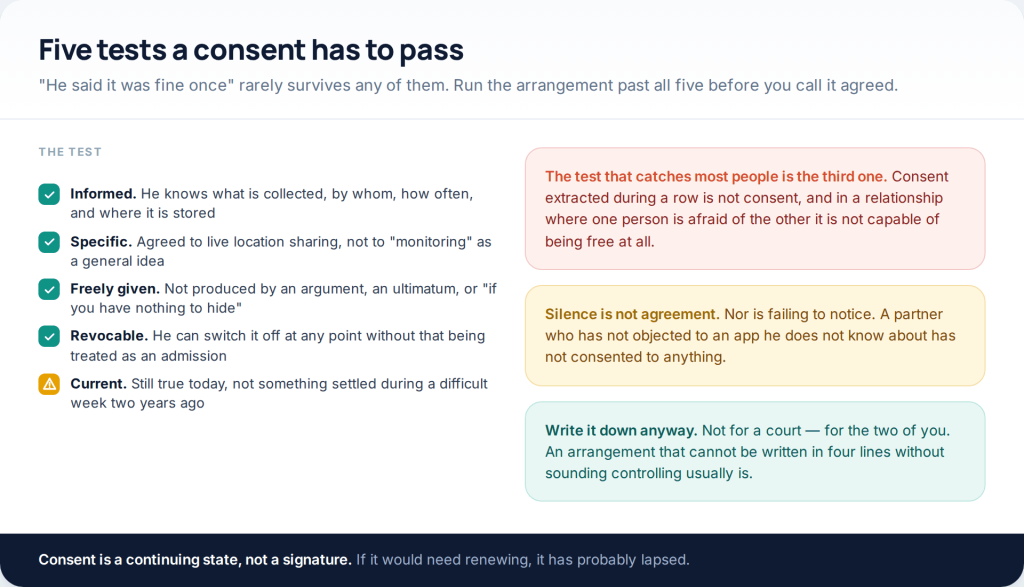
If you are trying to work out how to track my husband’s phone, the useful distinction is not technical but legal: there is a version of phone location that is entirely lawful, and a version that can be a criminal offence, and the only difference between them is whether he agreed. This page sets out what consent actually requires, what courts have said about covert tracking, and how couples who want location sharing set it up.
Nothing here is legal advice. The rules differ between countries, and within the United States and Australia between individual states. What follows describes published statutes and guidance we have read directly. If this matters to a decision you are making, speak to a solicitor, an attorney, or a domestic abuse adviser where you live.
What this page used to be. It promised covert tracking, and described three things: pages that take a phone number and quietly text it a link, subscription funnels that charge before showing a map, and monitoring software that has to be installed by hand on the handset. The first two take money and return nothing. The third works, and it is the one with the legal consequences attached.
Consent is the whole of the dividing line
Every mainstream location feature is built around the other person knowing. Apple notifies when sharing starts. Google Maps shows a permanent indicator and lists everyone who can see you. Mobile networks that sell family locators text the line being located; T-Mobile’s own support documentation states that those notifications cannot be disabled, because regulation and its privacy policy require them. Even Bluetooth tags now raise an alert on a stranger’s phone — Google and Apple shipped cross-platform “tracker travelling with you” warnings in May 2024, on Android 6.0 and later and on iOS 17.5.
That consistency is not an accident. The industry designed consent into these features because the alternative is a surveillance product, and surveillance products aimed at adults sit on the wrong side of several laws at once.
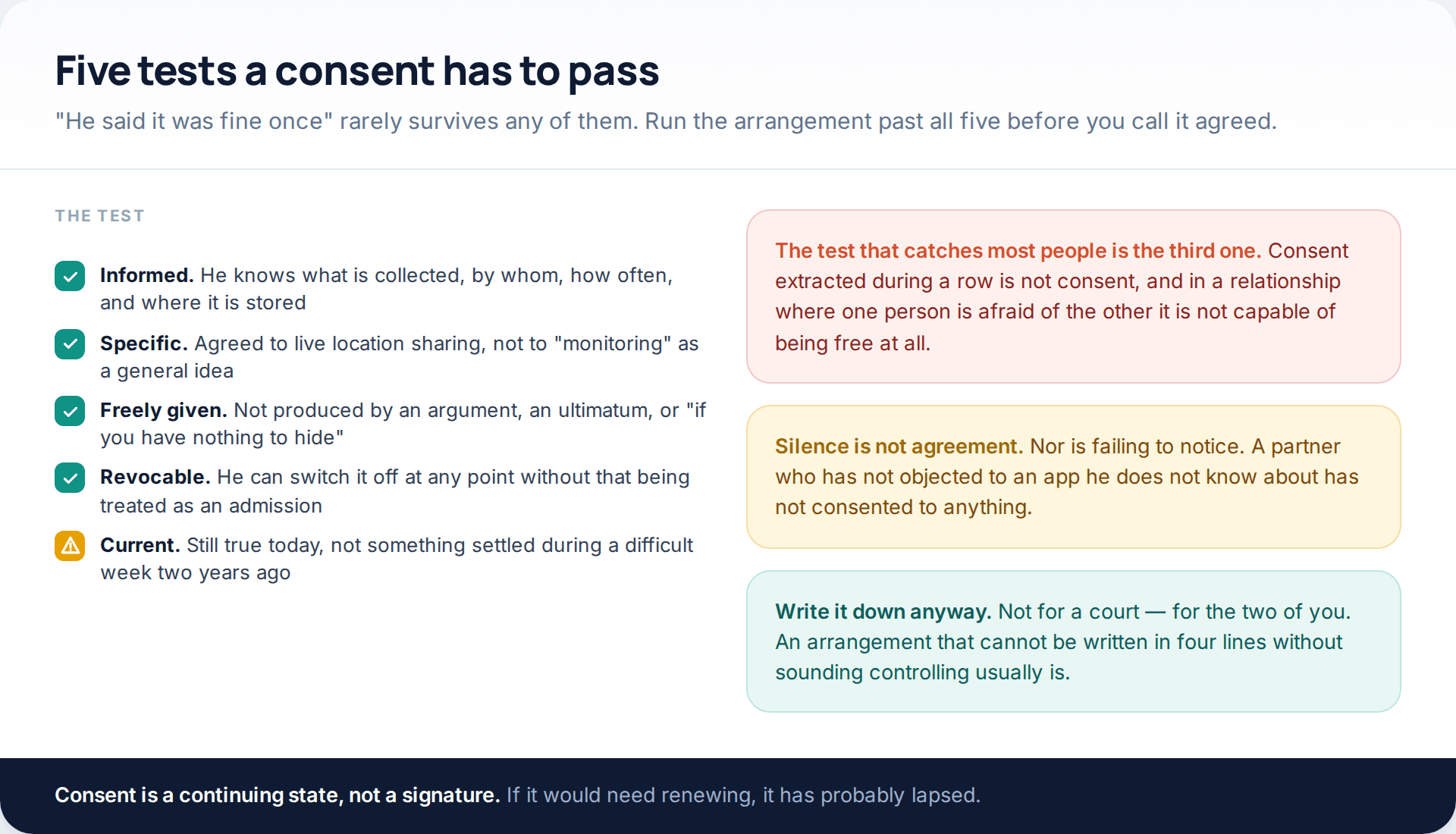
The four bodies of law in play
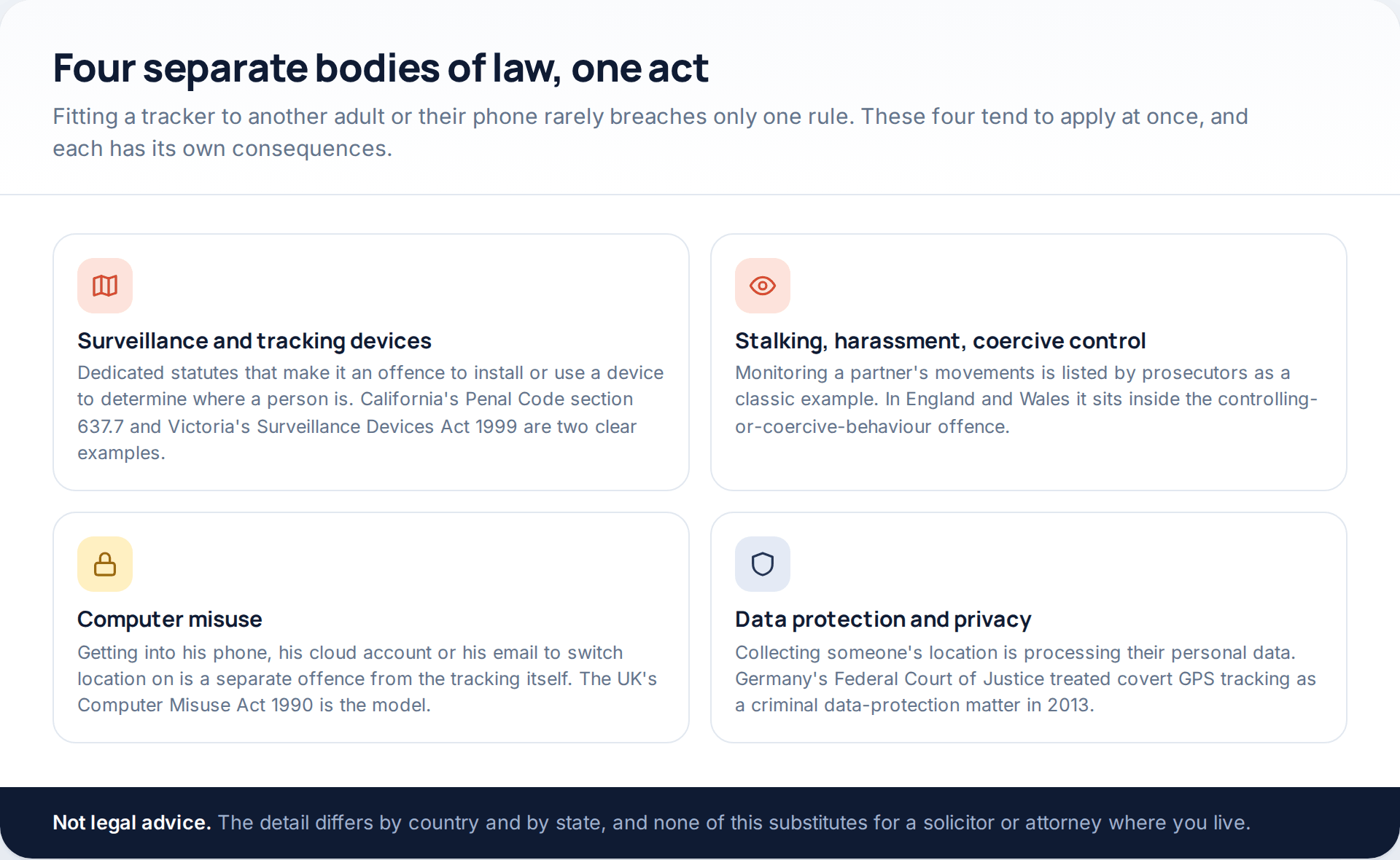
Two things are worth noticing about that grid. First, the computer-misuse limb is independent of the tracking: signing into his cloud account to switch location sharing on is an offence on its own, whether or not you ever look at the map. Second, the data-protection limb applies even where no criminal surveillance statute exists, because position over time is personal data about an identifiable person.
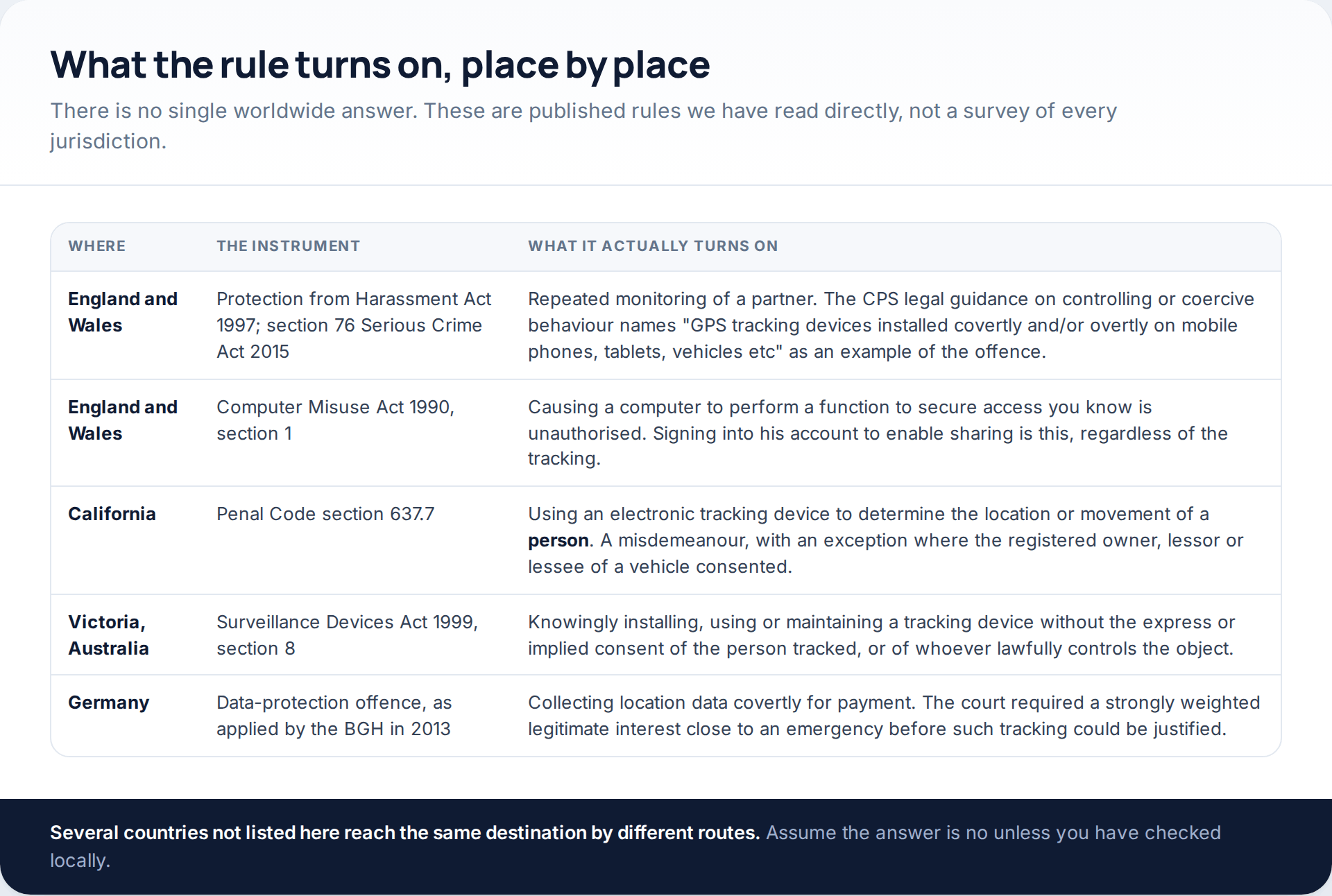
The English position is the most explicit about partners. Crown Prosecution Service legal guidance on controlling or coercive behaviour — the offence in section 76 of the Serious Crime Act 2015 — lists “GPS tracking devices installed covertly an/or overtly on mobile phones, tablets, vehicles etc” among the behaviours the offence covers, and records that monitoring a person’s movement may constitute both stalking and controlling or coercive behaviour. Section 68 of the Domestic Abuse Act 2021 removed the requirement that the parties live together, widening the offence to non-cohabiting intimate relationships from 5 April 2023.
In the United States there is no single answer, because the tracking statutes are state law. California is the clearest drafted example: Penal Code section 637.7 provides that no person or entity shall use an electronic tracking device to determine the location or movement of a person, makes a violation a misdemeanour, and exempts the case where the registered owner, lessor or lessee of a vehicle consented. Federal stalking law adds a separate layer: 18 U.S.C. 2261A reaches conduct intended to place a person under surveillance with intent to harass or intimidate, including conduct carried out through an electronic communication service, where it causes or would be expected to cause substantial emotional distress.
Why “it is half my car” is a weaker argument than it sounds
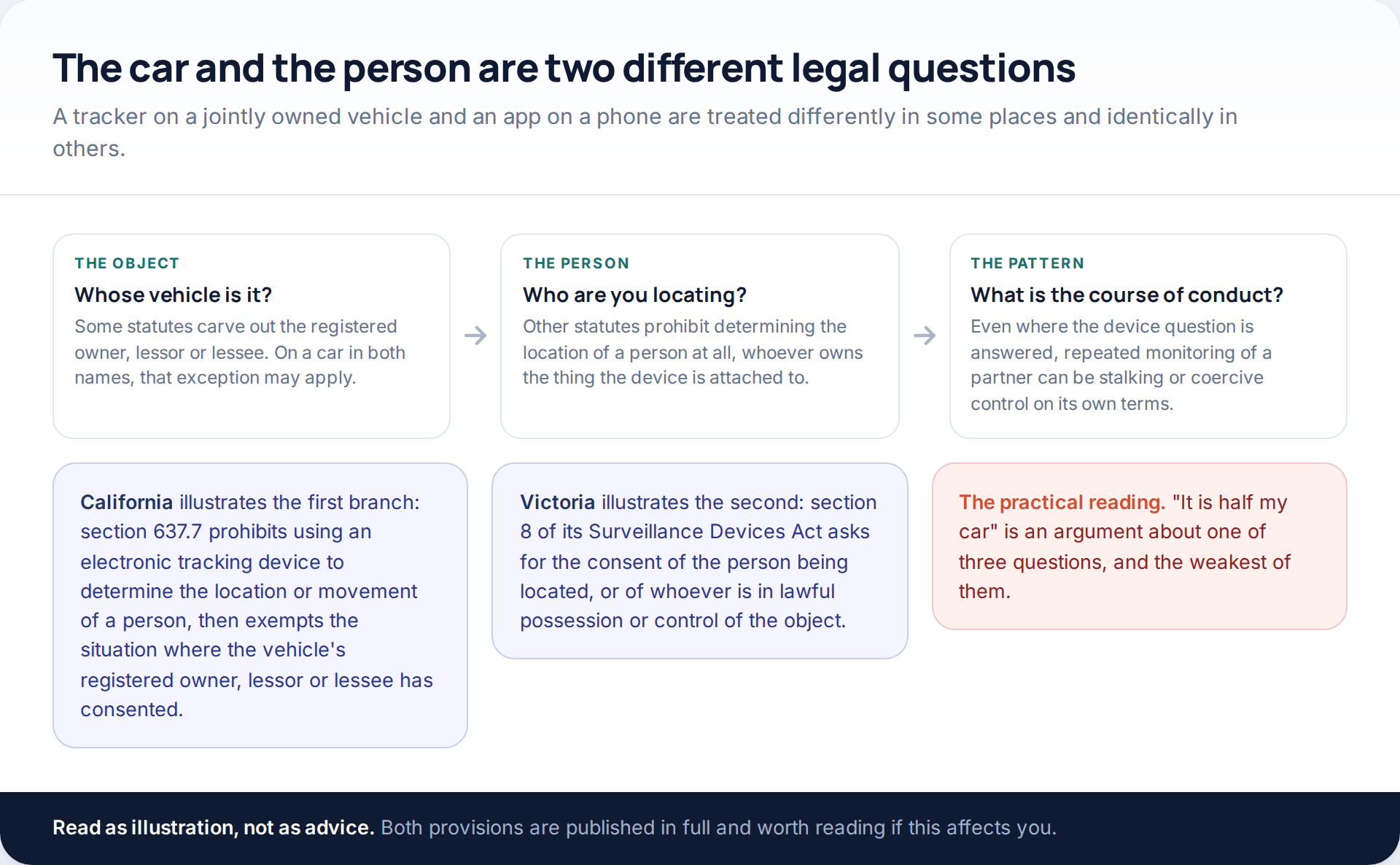
The vehicle-owner exception is real, and it is narrow. It answers a question about a device fitted to an object. It says nothing about statutes drafted around locating a person — Victoria’s Surveillance Devices Act 1999, section 8, prohibits knowingly installing, using or maintaining a tracking device to determine the geographical location of a person without their express or implied consent — and nothing at all about whether a sustained pattern of monitoring amounts to harassment or coercive control.
What courts and prosecutors have actually said
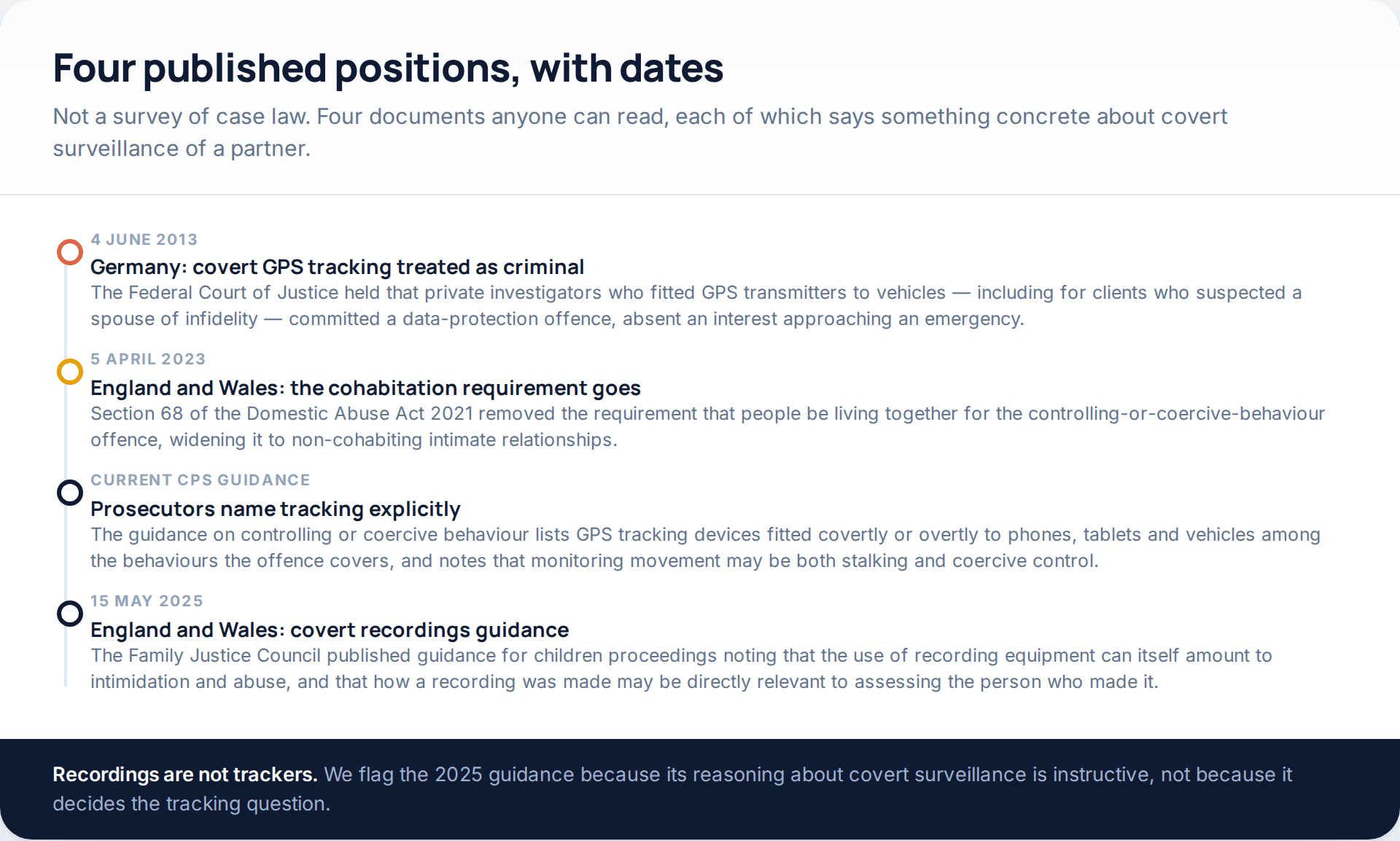
The German decision is the one people find most surprising, because it concerned professionals rather than spouses. On 4 June 2013 the Federal Court of Justice upheld convictions against private investigators who had fitted covert GPS transmitters to the vehicles of people they were investigating — among them spouses suspected of infidelity. The court treated the covert collection of location data as a criminal data-protection matter and said only a strongly weighted legitimate interest, approaching an emergency, could justify it. Hiring the work out, in other words, does not reliably make it lawful.
If the marriage ends up in court, covert material cuts both ways
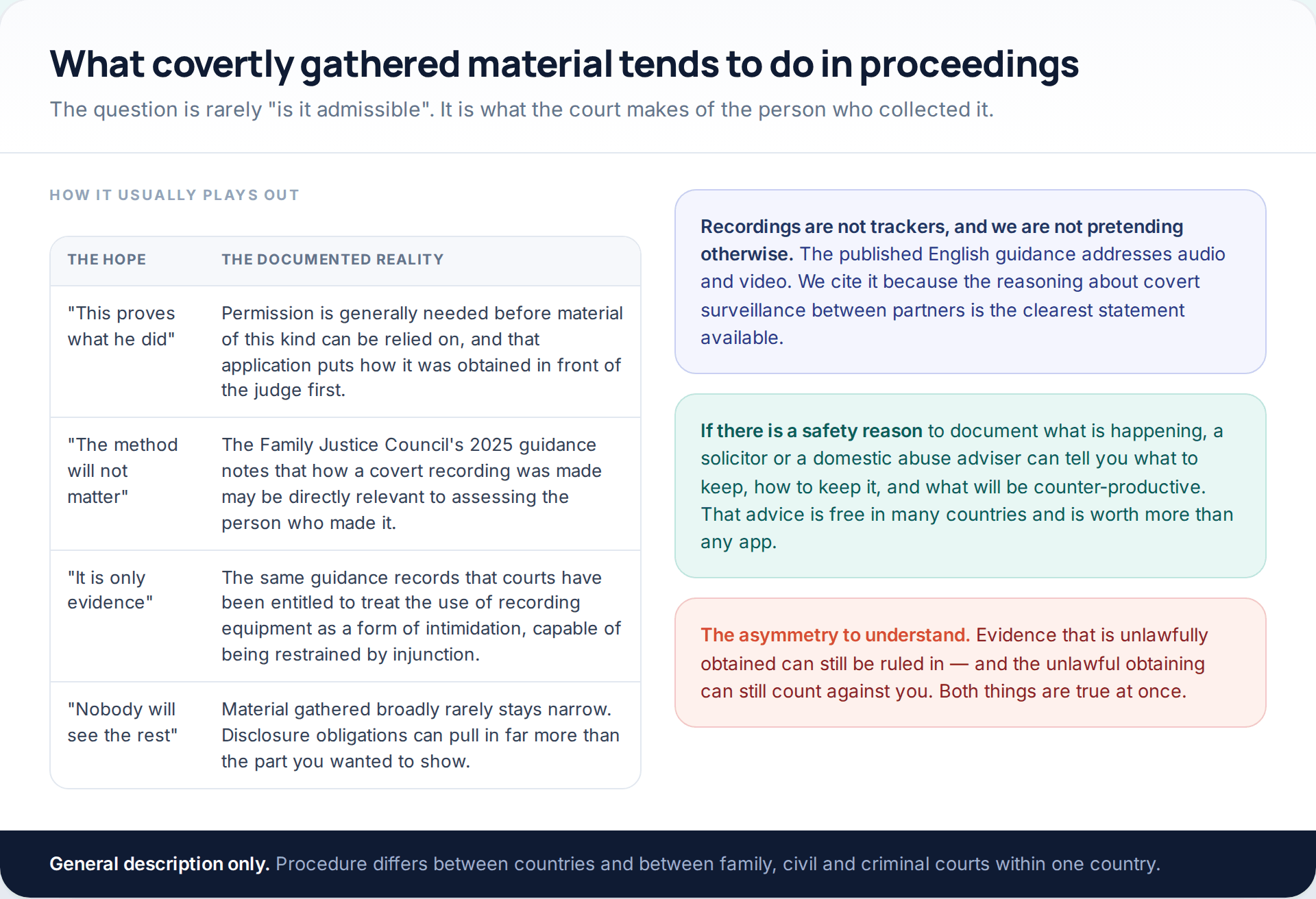
The clearest published English guidance on this concerns covert recordings rather than trackers, and we are not going to pretend the two are the same. It is still worth reading. The Family Justice Council’s guidance of 15 May 2025, on covert recordings in children proceedings, records that courts have been entitled to conclude that the use of recording equipment amounted to a form of intimidation and was abusive, and noted that the manner in which recordings were made may be directly relevant to assessing the parenting offered by the person who made them.
Translate that into the situation at hand. A tracker discovered during a separation does not arrive as neutral evidence of where somebody was. It arrives as evidence of what the person who fitted it was prepared to do, and it is usually the first thing the other side raises.
The setup you can both agree to
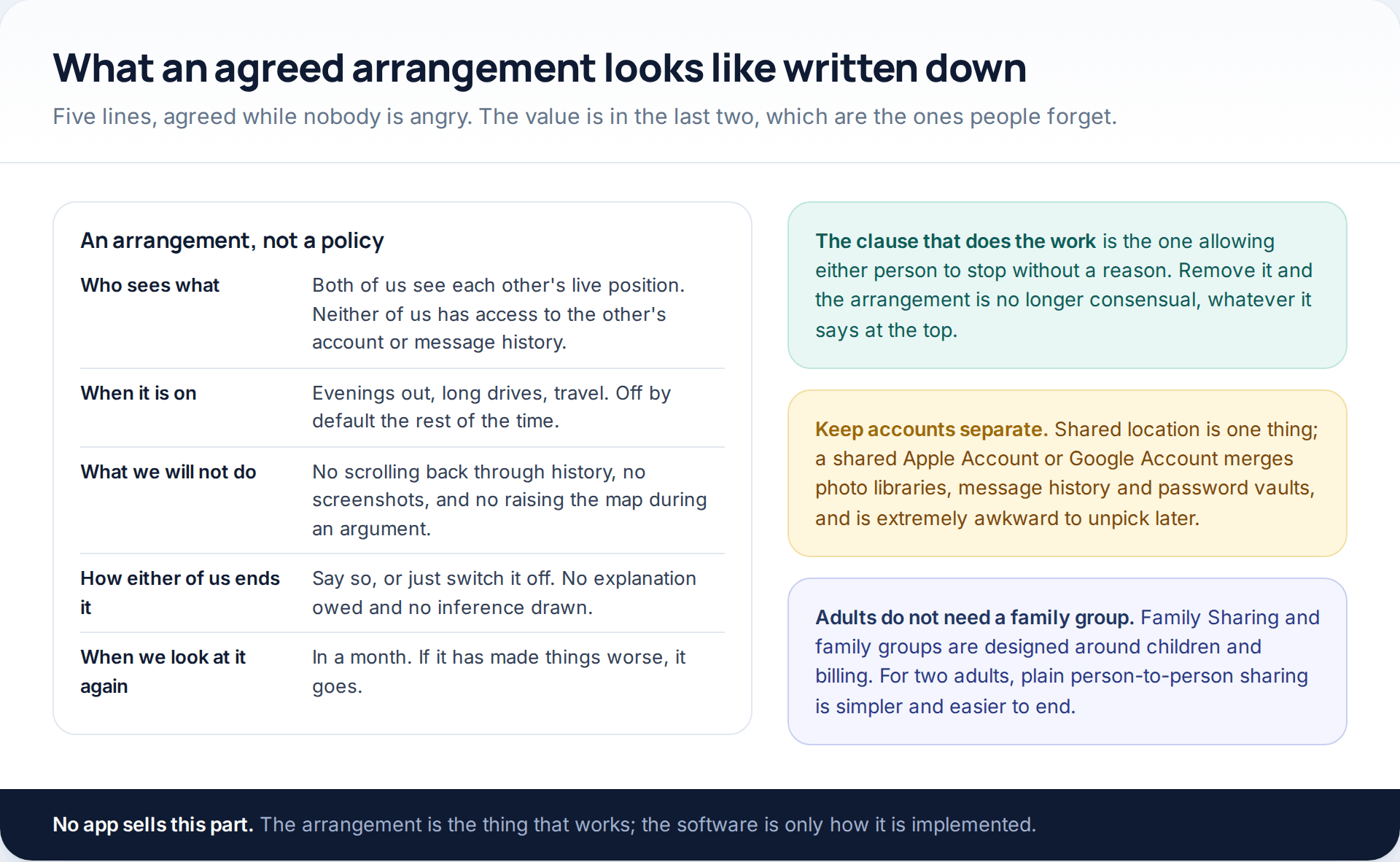
None of this means couples cannot share locations. Large numbers do, cheerfully, for years. What distinguishes the version that works is that it is mutual, time-boxed, visible and easy to end.
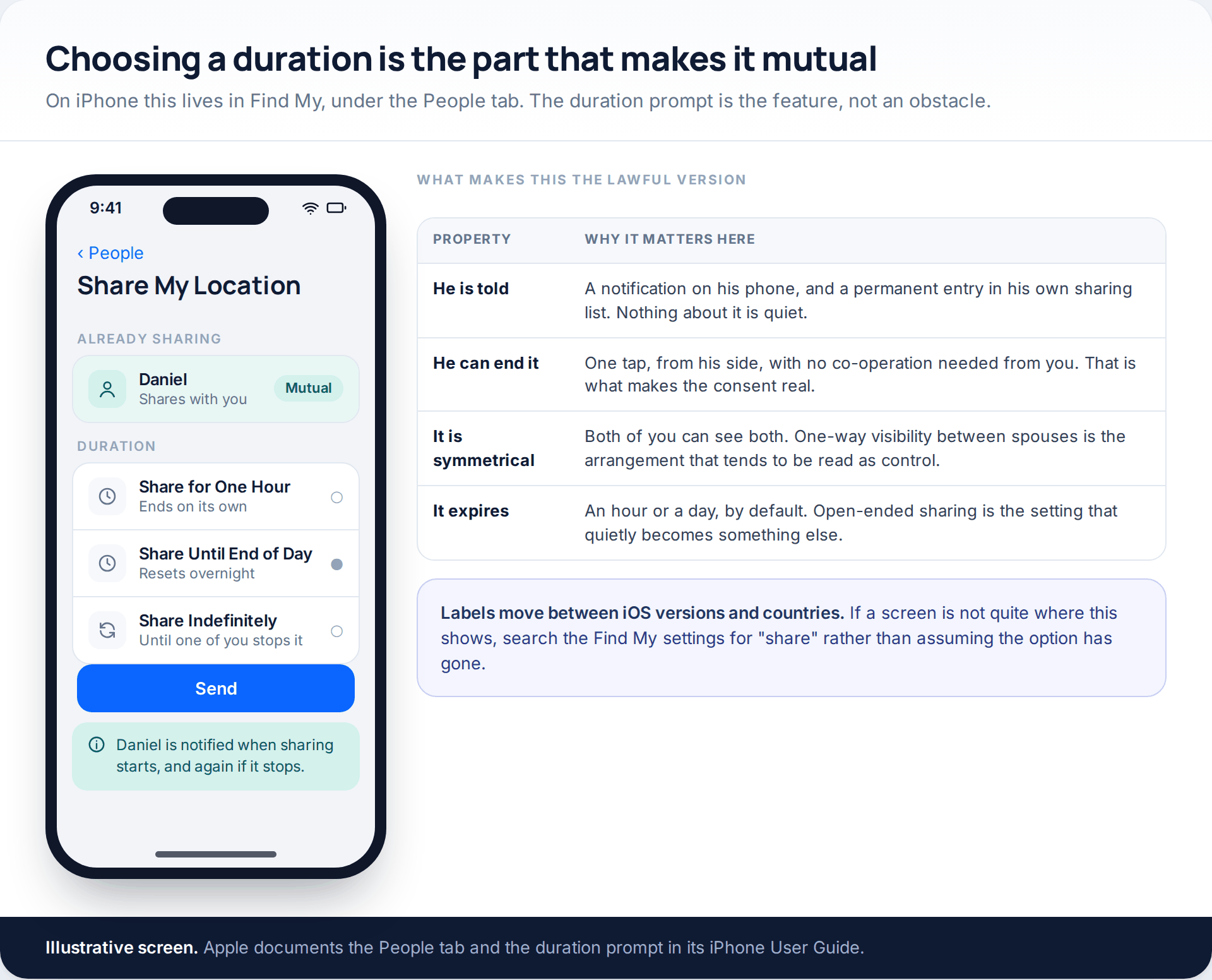
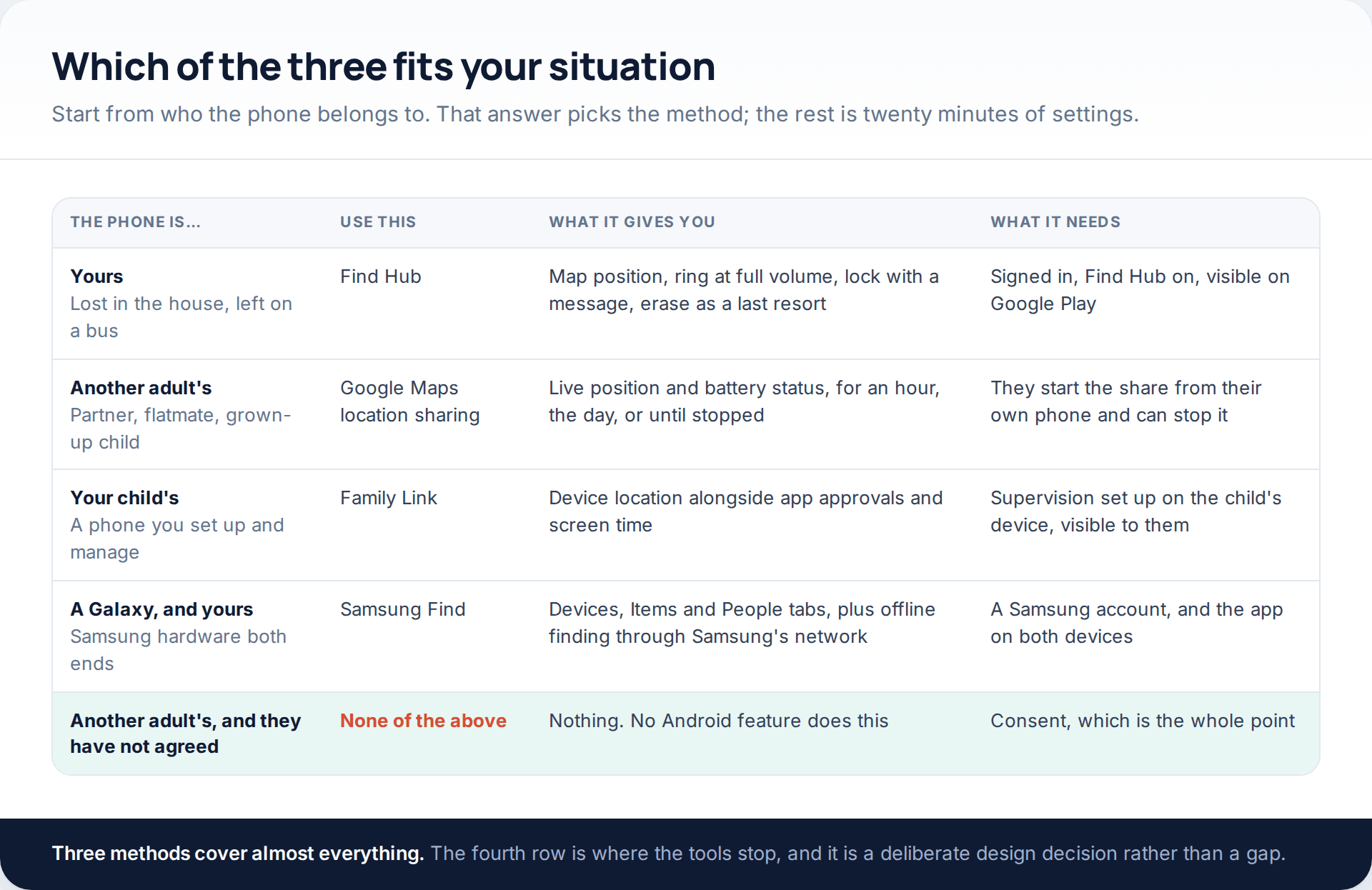
On iPhone, sharing lives in Find My under the People tab: pick the person, then pick how long. Apple documents three choices — roughly an hour, until the end of the day, or indefinitely — and the recipient is notified when sharing starts. On Android, Find Hub now does people as well as devices, with the same three durations; Google renamed Find My Device to Find Hub in 2025, so older articles will send you looking for the wrong icon.
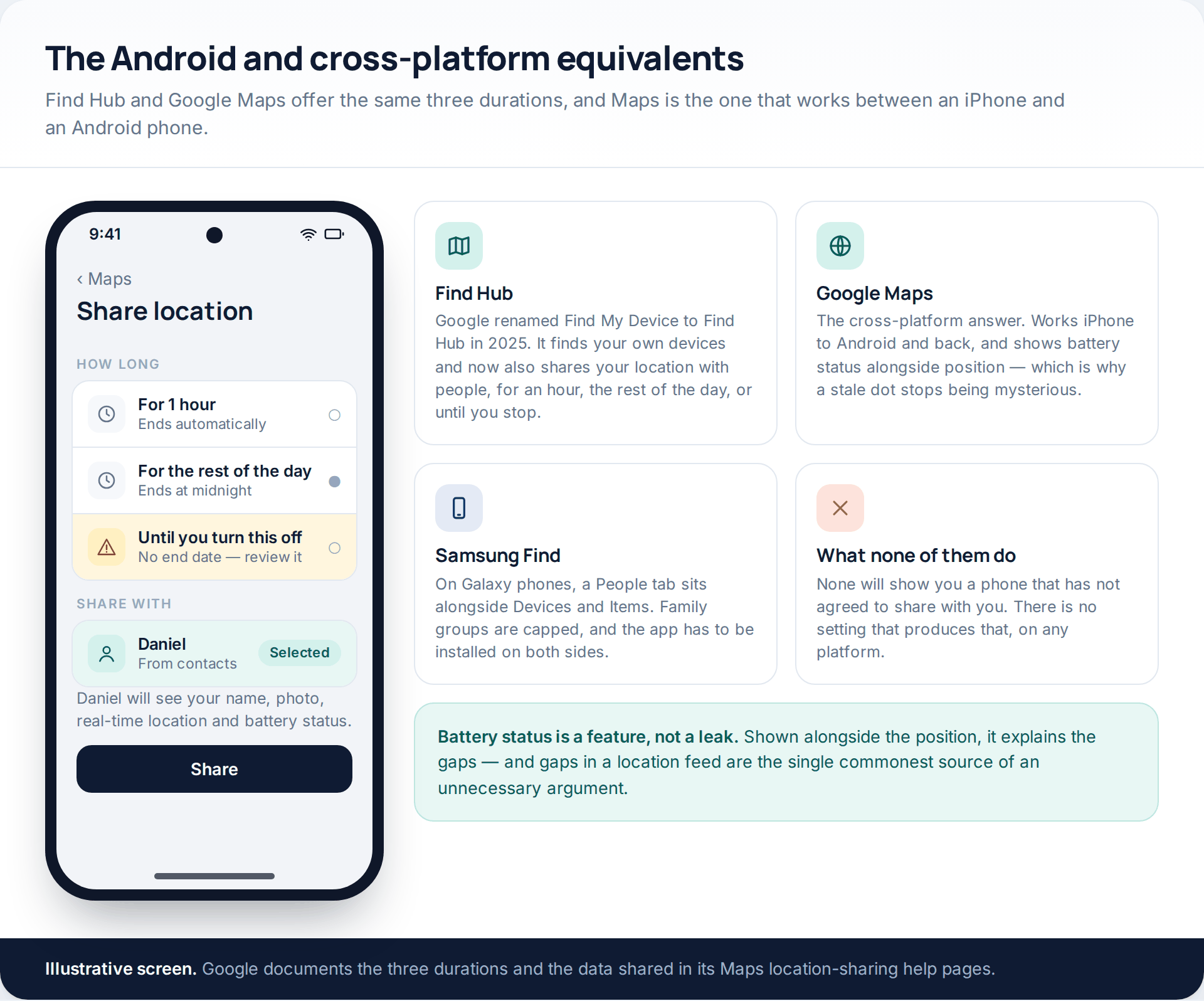
For a couple on different platforms, Google Maps location sharing is the straightforward answer: it runs on both, and Google documents what the other person receives — your name, profile picture, real-time location and battery status. Galaxy owners also have Samsung Find, which keeps a People tab beside Devices and Items, though it needs the app on both sides and caps the size of a family group.
If you want the mechanics in more depth — adding people, naming places, what to do when a dot goes stale — we set those out in the guide to setting up family location sharing.
Why the covert products never delivered anyway
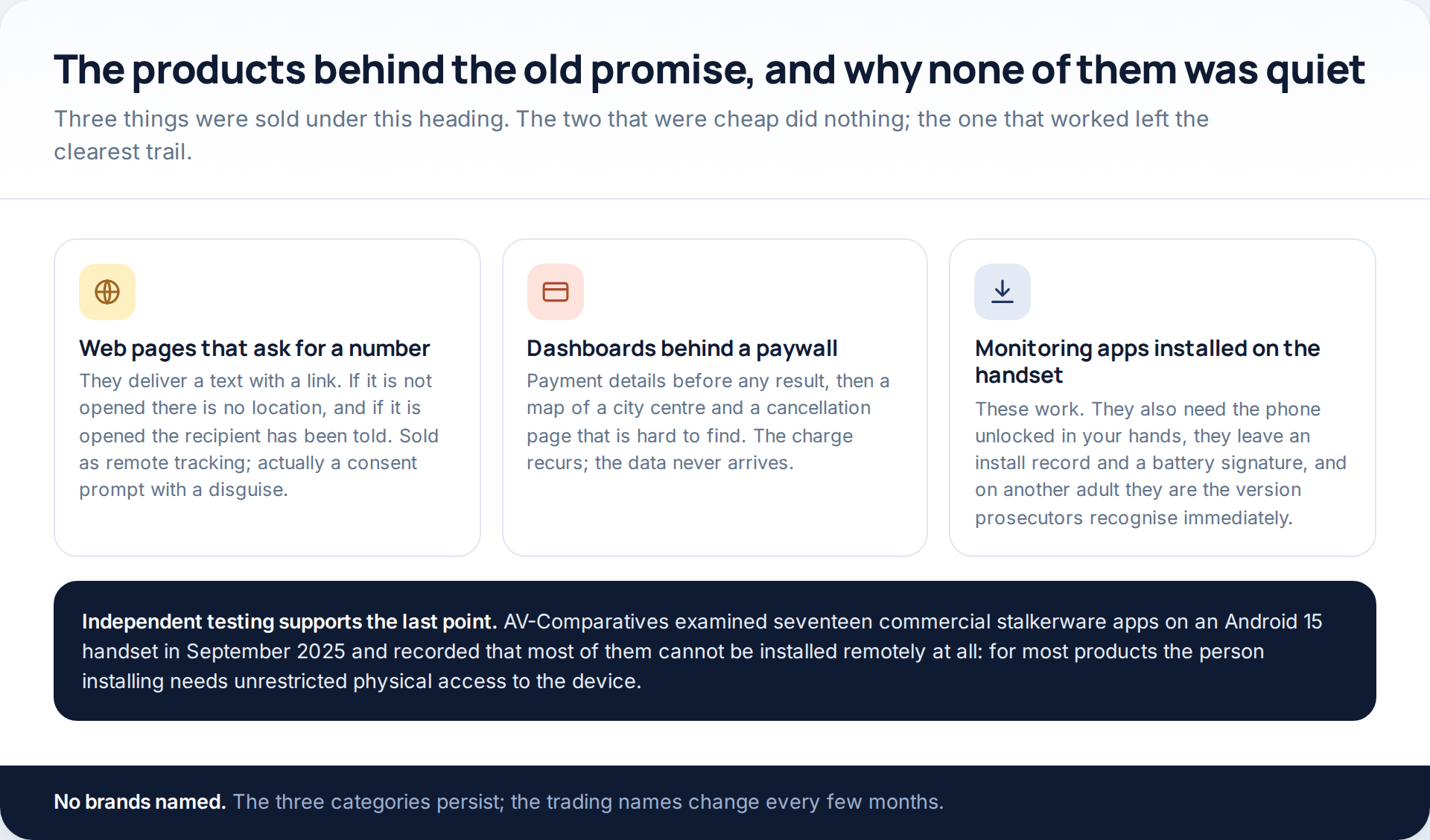
Set the law aside for a moment and the commercial picture is still poor. A page that asks for a mobile number has no route to that handset’s position; what it has is the ability to send that number a message containing a link, and a position arrives only if someone opens it. Subscription dashboards take card details first and show a generic map afterwards. The only category that performs is software installed physically on the phone — and AV-Comparatives, testing seventeen commercial stalkerware products on Android 15 in September 2025, recorded that most of them cannot be installed remotely at all.
If the real question is safety
Some people arrive at this subject because they are frightened rather than suspicious — wanting to know where someone is in order to avoid them, or to know when they are coming home. That is a different problem and surveillance is a poor and risky answer to it, because discovery tends to escalate rather than resolve.
Domestic abuse services operate in most countries, and most will talk to someone who is not sure whether their situation qualifies. They can help with safety planning, with what to document and how, and with the order in which to do things. We deliberately publish no helpline numbers, because they differ by country and change; search for a national organisation where you live, ideally from a device the other person cannot reach. Our guide to protecting your phone in an abusive situation covers the device side of that plan.
How this page was put together
The legal material was read at source in October 2026: the Crown Prosecution Service’s legal guidance on controlling or coercive behaviour and on stalking and harassment, section 1 of the Computer Misuse Act 1990, California Penal Code section 637.7, section 8 of the Surveillance Devices Act 1999 (Victoria), 18 U.S.C. 2261A, and reporting of the German Federal Court of Justice’s judgment of 4 June 2013 in case 1 StR 32/13. The family-proceedings section draws on the Family Justice Council’s guidance of 15 May 2025 on covert recordings in children proceedings, which concerns recordings rather than tracking devices — a distinction we have flagged in the text rather than glossed over.
Platform behaviour was checked against Apple’s iPhone User Guide, Google’s Maps location-sharing and Find Hub help pages, Samsung’s Find documentation and T-Mobile’s published FamilyWhere support article. We have given no penalties in money terms, because the figures circulating online for Australian surveillance offences come from commercial vendors rather than the statutes, and we could not verify them at source. We have not named any covert-tracking product, and we have not tested any.
If what you need is less the law and more the decision — whether to raise it at all, and how — the companion piece on what suspicion does to a relationship works through that side of it.
Common questions
Can I track my husband’s phone if we are still married?
Marriage does not supply consent. The statutes that criminalise tracking devices generally ask whether the person being located agreed, not what their relationship to the tracker is. In England and Wales, prosecutors specifically list GPS tracking of a partner as an example of controlling or coercive behaviour, an offence that exists precisely because it happens inside relationships.
What if I pay the phone bill or the car finance?
Paying for something is not the same as consenting on another adult’s behalf. A vehicle-owner exception, where one exists, addresses a device attached to a car; it does not address statutes about locating a person, and it does not address a pattern of monitoring that amounts to harassment.
Is it different if I only check occasionally?
For offences built on a course of conduct — stalking, coercive control — frequency is part of what is assessed, so less is better than more. For a tracking-device statute, a single unconsented use can be enough. Infrequency is a mitigation argument, not a defence.
Can I use what I find in a divorce?
Possibly, and it may cost you more than it gains. Reliance on material of this kind usually needs the court’s permission, which puts the method of collection in front of the judge first. Published English guidance on covert recordings records that the way such material was obtained can be directly relevant to how the person who obtained it is assessed.
Would hiring an investigator make it lawful?
Not reliably. In 2013 the German Federal Court of Justice upheld criminal convictions of investigators who had fitted covert GPS trackers to vehicles, including in infidelity cases, holding that only an interest approaching an emergency could justify it. Delegating an act does not change its legal character.
He already shares his location with me. Can I look whenever I want?
Technically yes; practically, this is where agreed sharing turns into something else. If you would not be comfortable describing your checking habits to him, the arrangement needs a conversation. Sharing that one person monitors and the other has forgotten about is not really mutual any more.
What if I think he has put something on my phone?
Check your location-sharing lists, the devices signed into your accounts, app permissions and any device-administrator entries, and photograph what you find before removing it. Do it when you are somewhere safe: whoever set it up generally notices when it stops reporting. If you live together, take specialist advice on the timing before you change anything.
Using a monitoring app for this? GuestSpy is parental monitoring for Android that stays visible on the child's phone and runs from any browser. If it fits your family, see the Location & Places feature.
Related guides
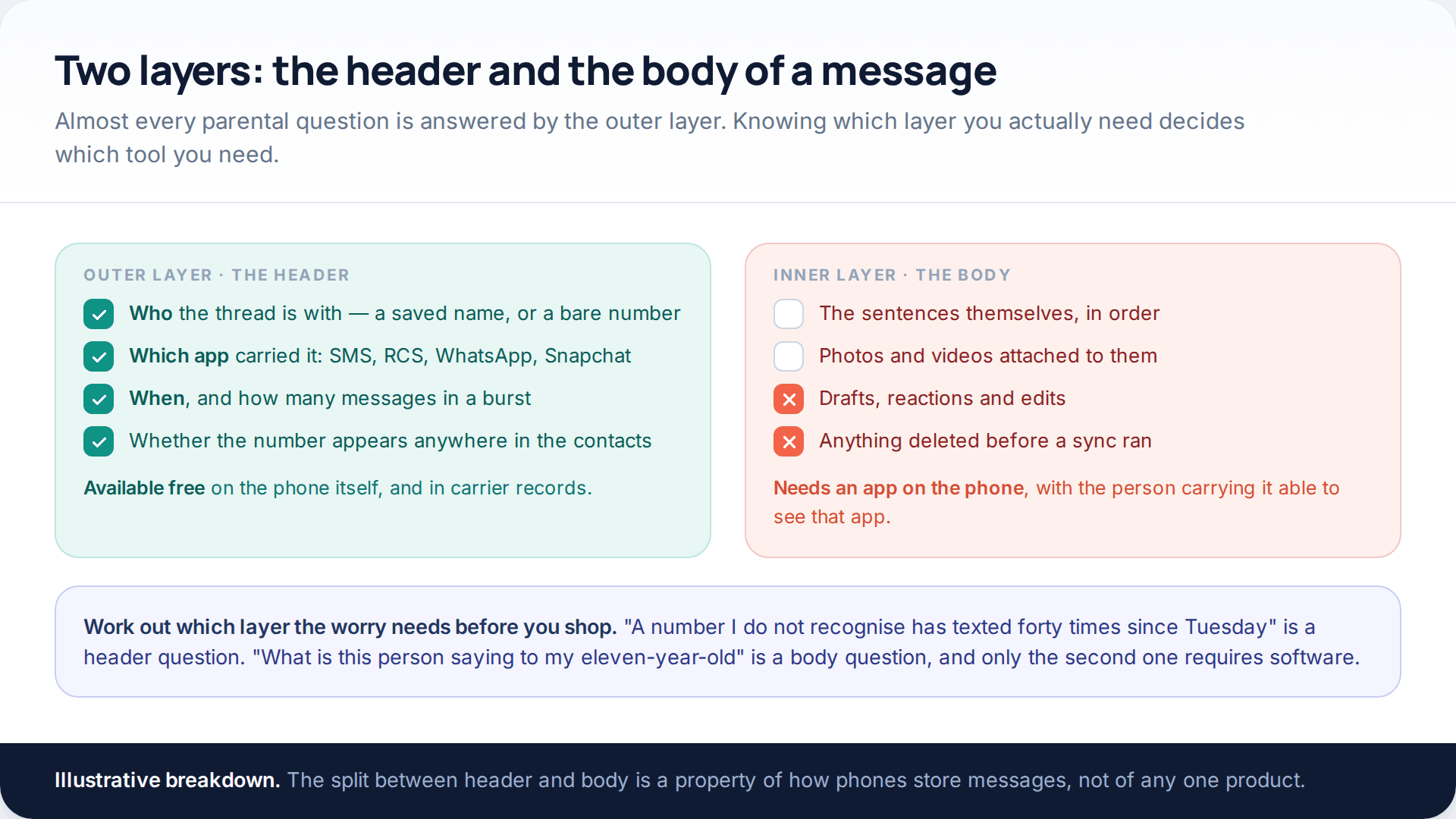
Track SMS Messages: Free SMS Monitoring Apps for Parents, Compared
You cannot track SMS messages on a child’s phone from your own phone alone, and no free app changes that.…
Track an Android Phone From Another Android Phone: Three Family-Safe Methods
To track an Android phone from another Android phone, you need one of three things arranged in advance. Find Hub…

Best 10 Free SMS Tracker for Android and iPhone
Earlier, when there we no messenger apps, people used to rely on text messages. Although time and technology are changing,…
Monitoring your child can see.
Location, screen-time budgets, routines, app and website blocking and the alerts that matter, run from any browser and visible on the phone. Pair an Android phone in about fifteen minutes.