Monitoring vs. Spying: Where Parents Should Draw the Line
Two households, one fifteen-year-old, and a monitoring app that only one parent knew was running. That single scenario contains most of the monitoring vs spying question in miniature — because the software involved was identical either way. What made it one thing or the other was who knew, who agreed, and whether there was ever going to be an end to it.
This is the article for working out that line, generally, before you’re in the middle of a specific situation trying to reason it out under pressure. It’s a framework, not a single rule, because the honest answer to “where’s the line” changes depending on whose phone it is and how old they are — but the questions that get you to a good answer don’t change at all.
- Why the same software can be either
- The four-question test
- Case by case: the common grey areas
- The legal backdrop, in plain terms
- When parents disagree with each other
- Adult children still living at home
- When “protecting” tips into control
- Applying the framework to something new
- Questions people actually ask
Why the same software can be either
Monitoring and spying are not two different products. They are the same capability — knowing where a phone is, what it’s doing, who it’s talking to — used in two different ways. That’s genuinely unsettling to sit with, because it means the software itself tells you almost nothing about whether a given situation is fine. The context does all the work.
That’s also why “is this legal” and “is this okay” don’t always give the same answer. Something can be entirely legal — you own the phone, you pay the bill, the law in your country doesn’t require you to say anything — and still be a bad idea that damages a relationship for years. This guide treats both questions, because a parent weighing this up needs both.
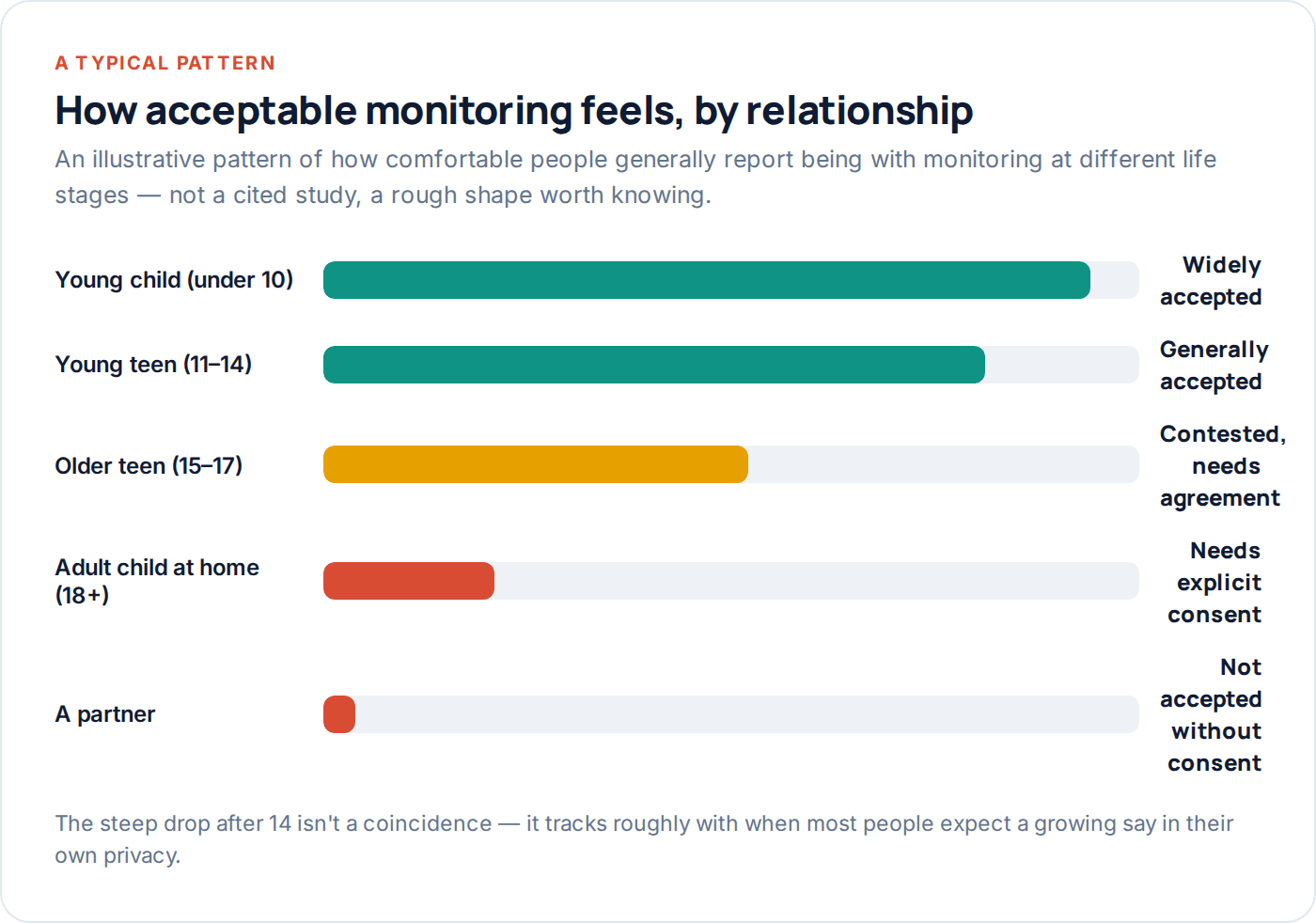
The gradient above is roughly the shape of the whole question. There is no single age or single moment where monitoring flips into spying — it’s a slope, and where a specific household sits on it depends on the four questions below, applied honestly, rather than on the software involved.
The four-question test
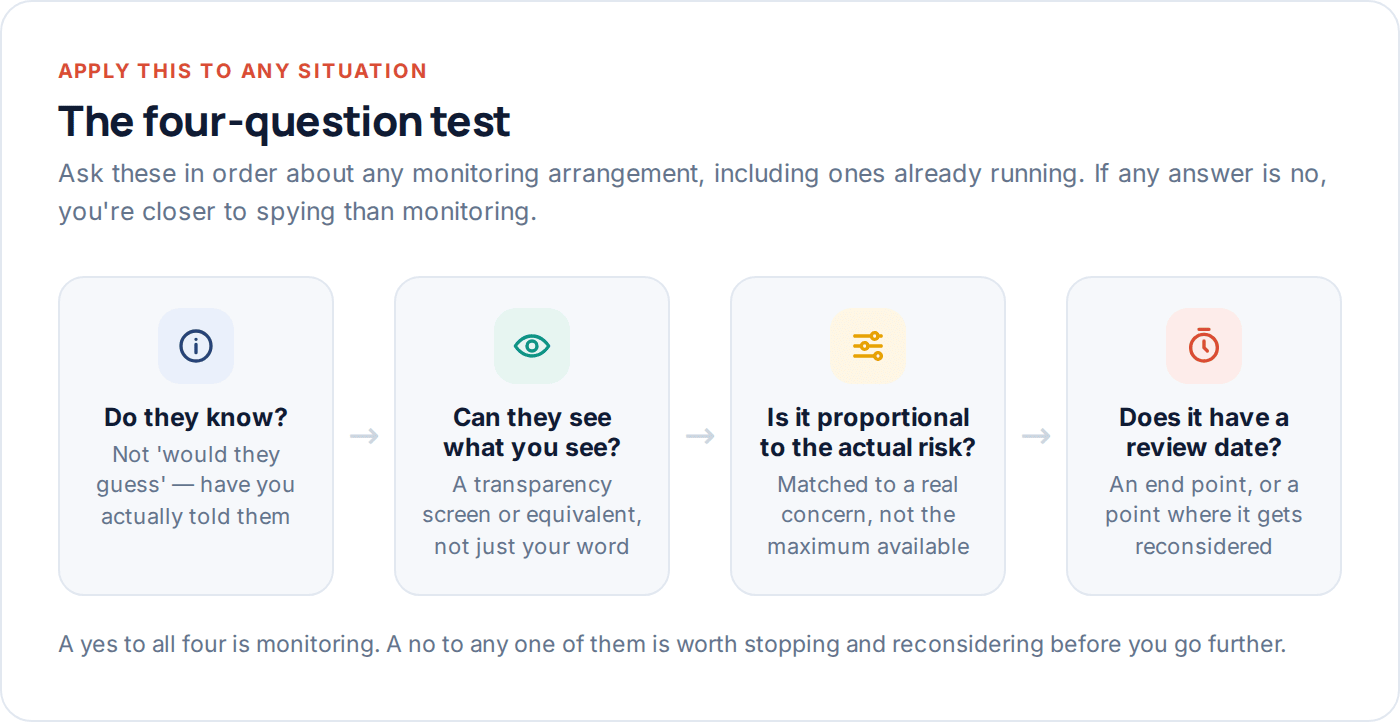
Four questions, applied in order, do most of the work of separating monitoring from spying in almost any situation you’ll encounter. They’re deliberately simple enough to run through quickly, including on an arrangement you already have running.
1. Do they know?
Not “would they probably guess” — have you actually told them, in words, that this exists and roughly what it covers.
2. Can they see it too?
A transparency screen, a shared dashboard, or some equivalent way to check what’s being shared — not just your account.
3. Is it proportional?
Matched to an actual, specific concern — not switched to maximum because maximum was available.
The fourth question doesn’t fit neatly in a three-card row, so it’s worth stating on its own: does it have a review date — some point, stated in advance, where the arrangement gets reconsidered rather than running indefinitely by default. Monitoring with no exit condition drifts into something closer to permanent surveillance, even when it started with good intentions and full knowledge.
Case by case: the common grey areas
The test is simple to state and genuinely harder to apply to a real household, because real households are messier than any single rule. Here’s how it tends to play out across the situations that actually come up.
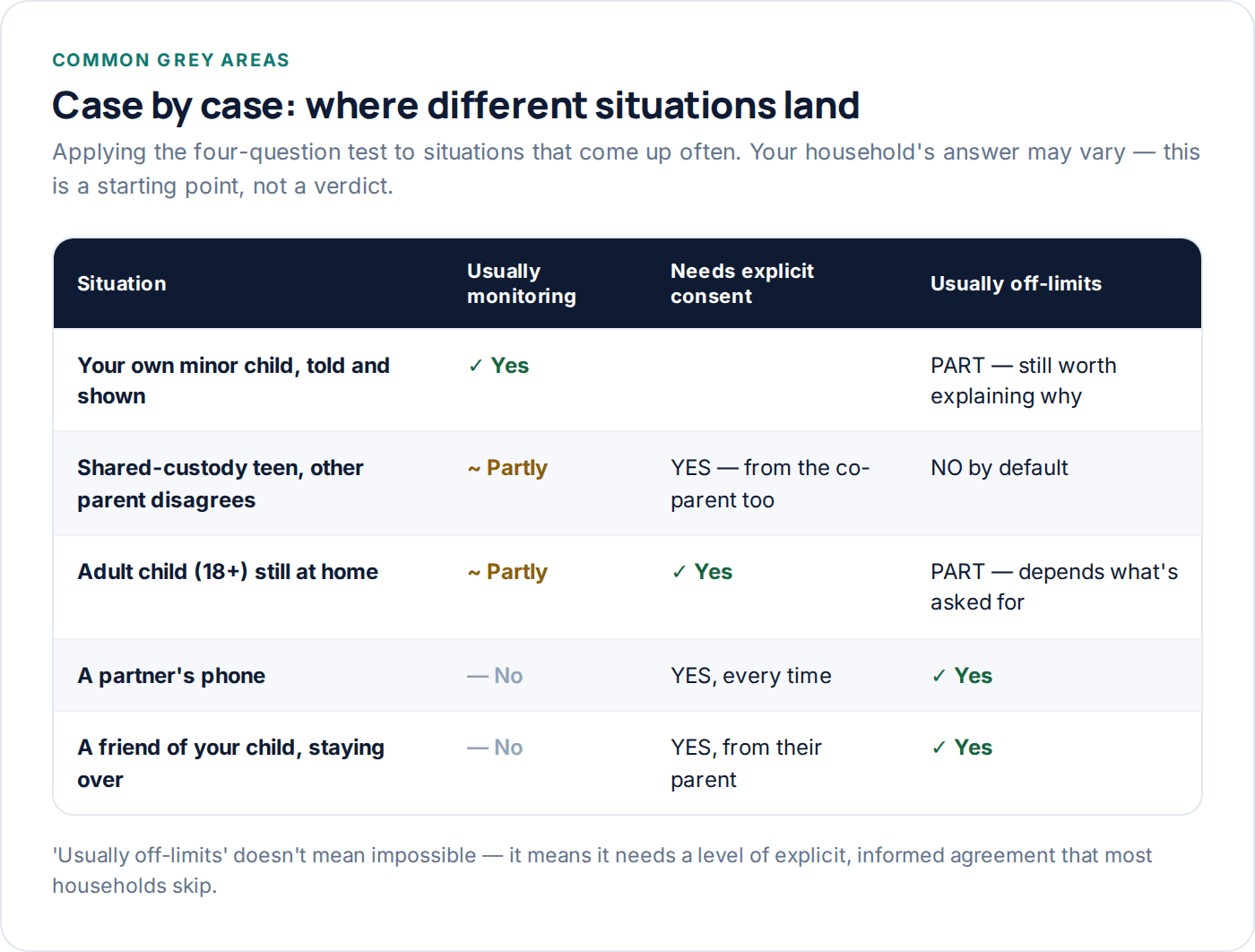
Notice the pattern in that table: it isn’t really about the technology at any point. It’s about age, agreement, and whether the person has a meaningful say in their own life yet. A ten-year-old doesn’t get much of a vote and that’s broadly appropriate. A partner gets a full vote and no software changes that.
The legal backdrop, in plain terms
Laws vary enormously by country and, within countries like the US, by state — this isn’t legal advice, and a genuinely uncertain situation deserves an actual lawyer, not a blog post. That said, some broad patterns hold in most places worth knowing.
Monitoring your own minor child on a device you own and are legally responsible for is permitted essentially everywhere. Beyond that, the picture narrows quickly. Installing monitoring software on another adult’s device without their knowledge is a criminal offence in a large number of jurisdictions, marriage or relationship status included — being someone’s partner does not create an exception. Recording phone calls has its own, separate body of law that frequently requires every party’s consent, not just yours, and varies by exactly where each person is when the call happens. And an older teenager, even a minor, often has legal protections around their own communications that surprise parents who assumed ownership of the phone settled the question.
When parents disagree with each other
This is where “is this even legal” questions come up most often in practice, and it’s worth treating separately because the ethics get complicated by a second adult with a legitimate stake, not just the child.
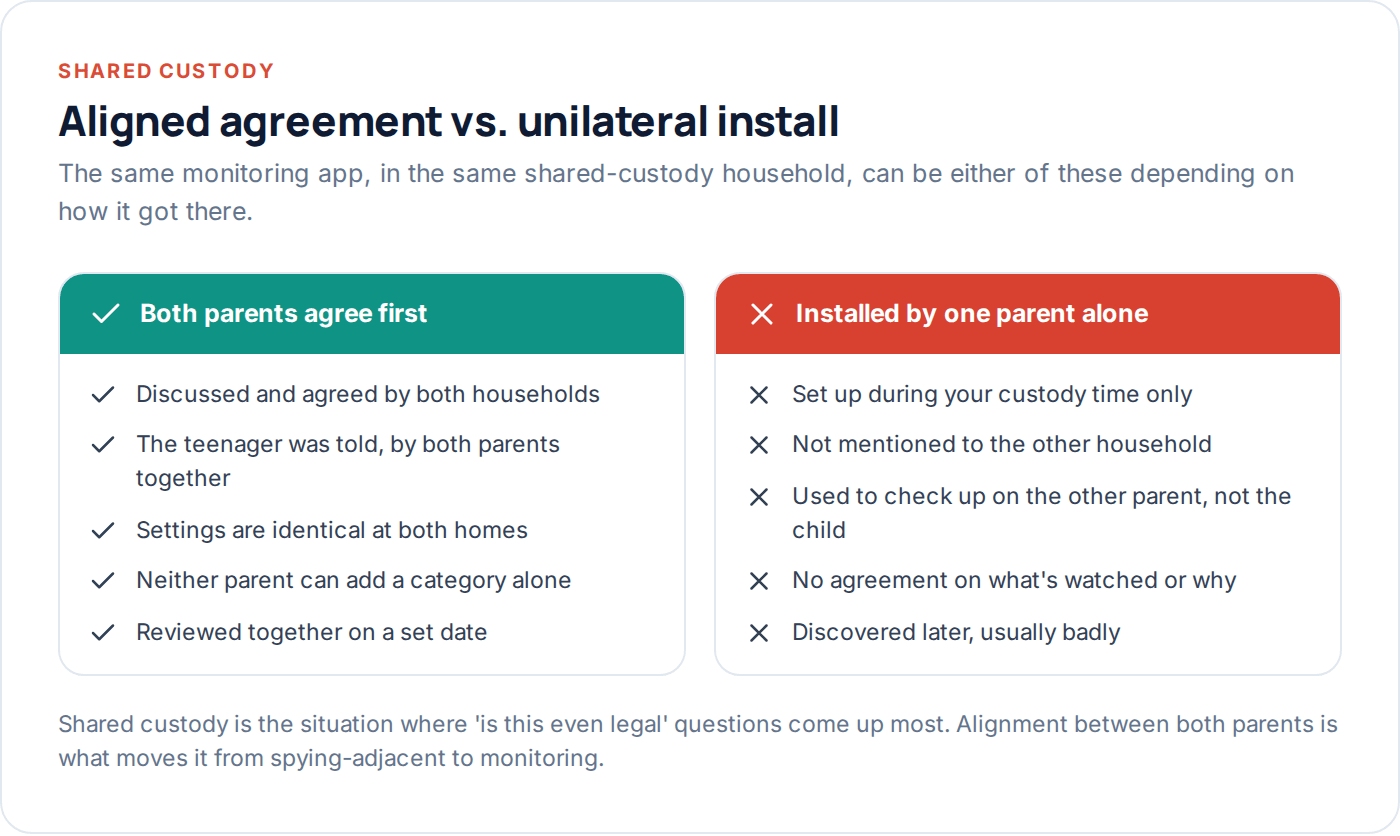
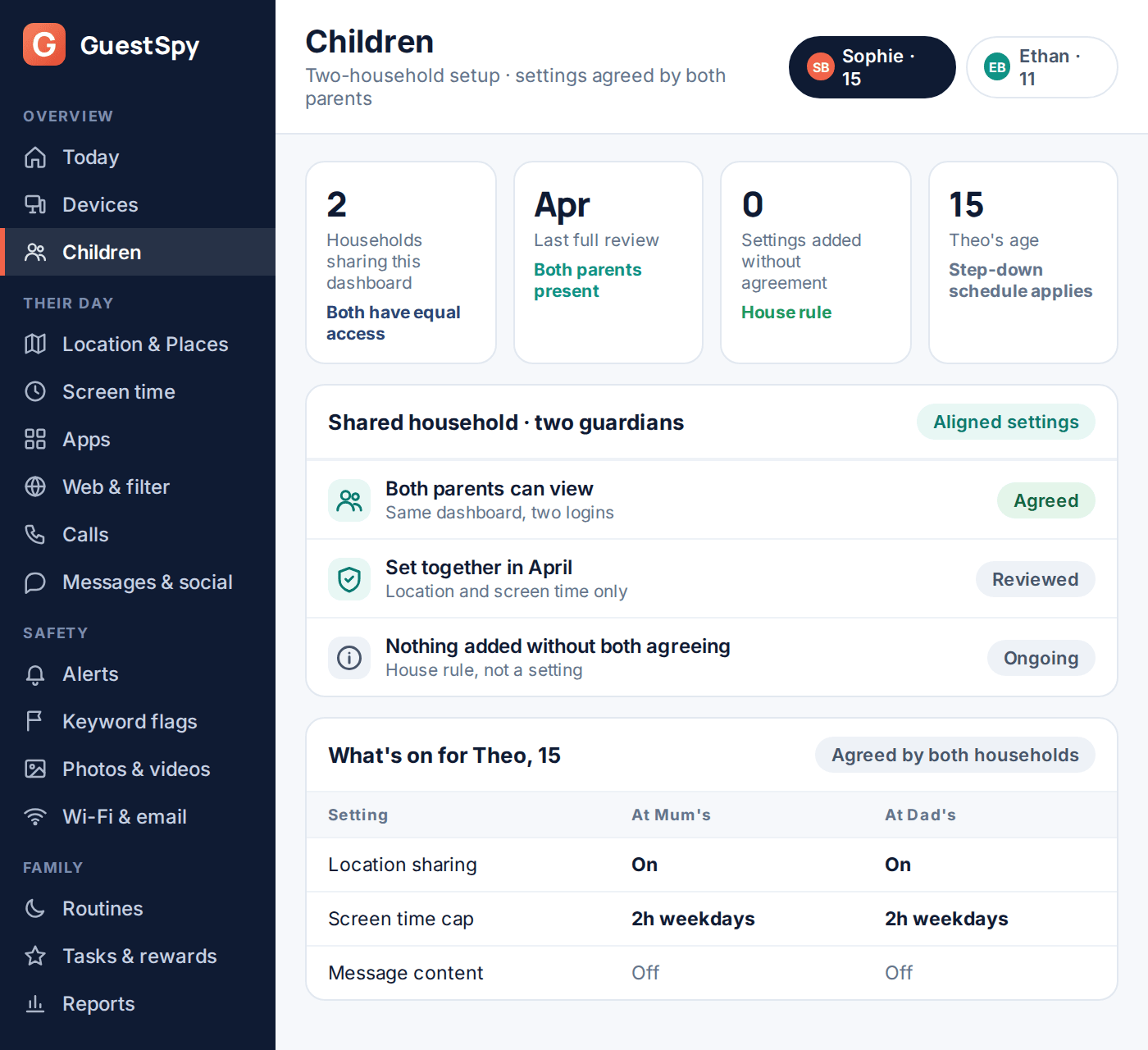
The cleanest version of shared custody monitoring has both households seeing the same settings and the same data, with neither parent able to add a category unilaterally. The messiest version — and the one that tends to end up in front of a mediator or a court — is monitoring set up by one parent, during their custody time, not disclosed to the other household, sometimes aimed less at the child’s safety and more at keeping tabs on the other parent’s home. That second version is a serious problem regardless of what the software’s marketing calls it, and it tends to backfire badly once discovered, which it usually is.
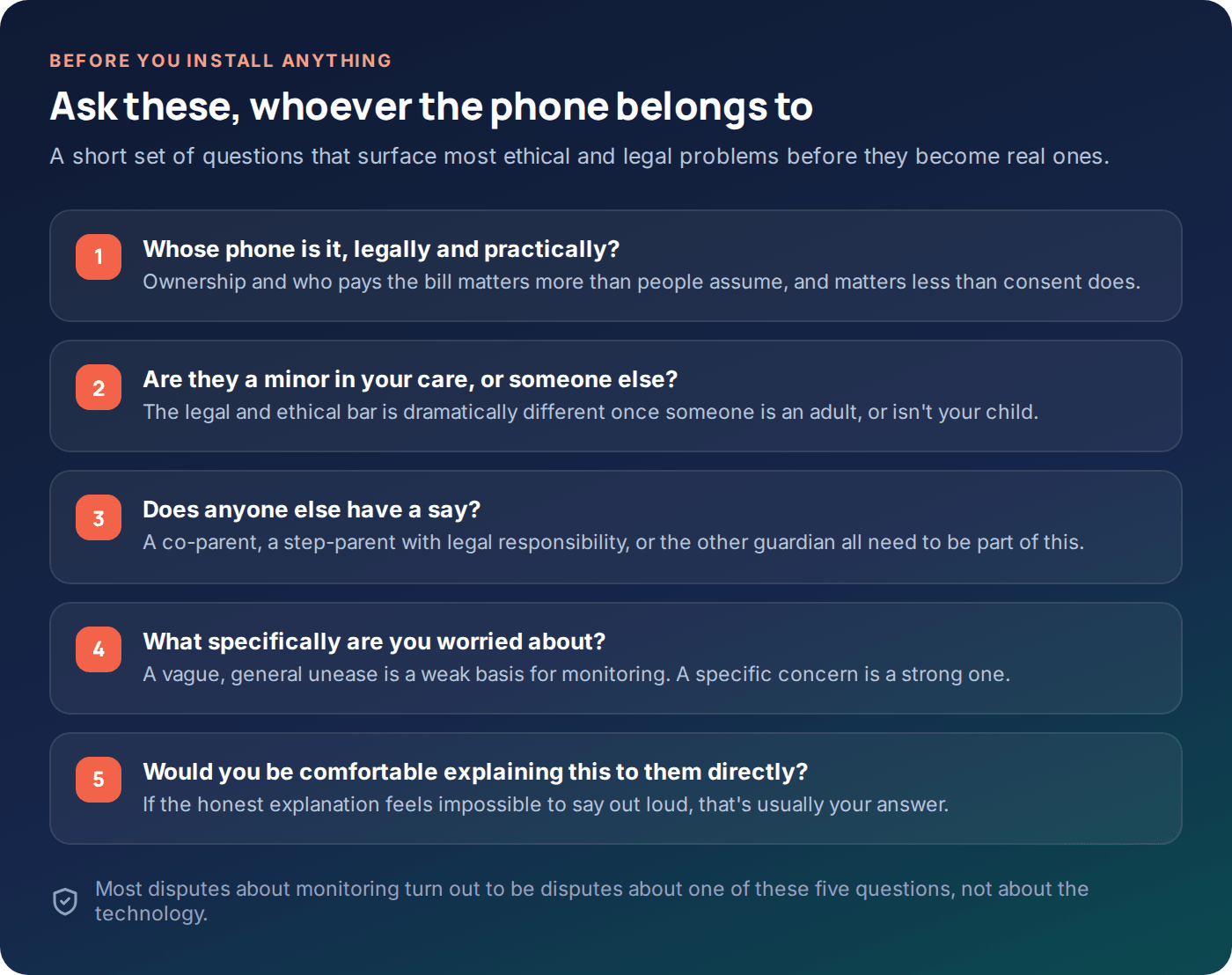
If you’re in a shared custody situation and considering monitoring for the first time, raise it with the other parent before you set anything up, not after. It’s a harder conversation than installing an app quietly, and it’s the one that actually holds up.
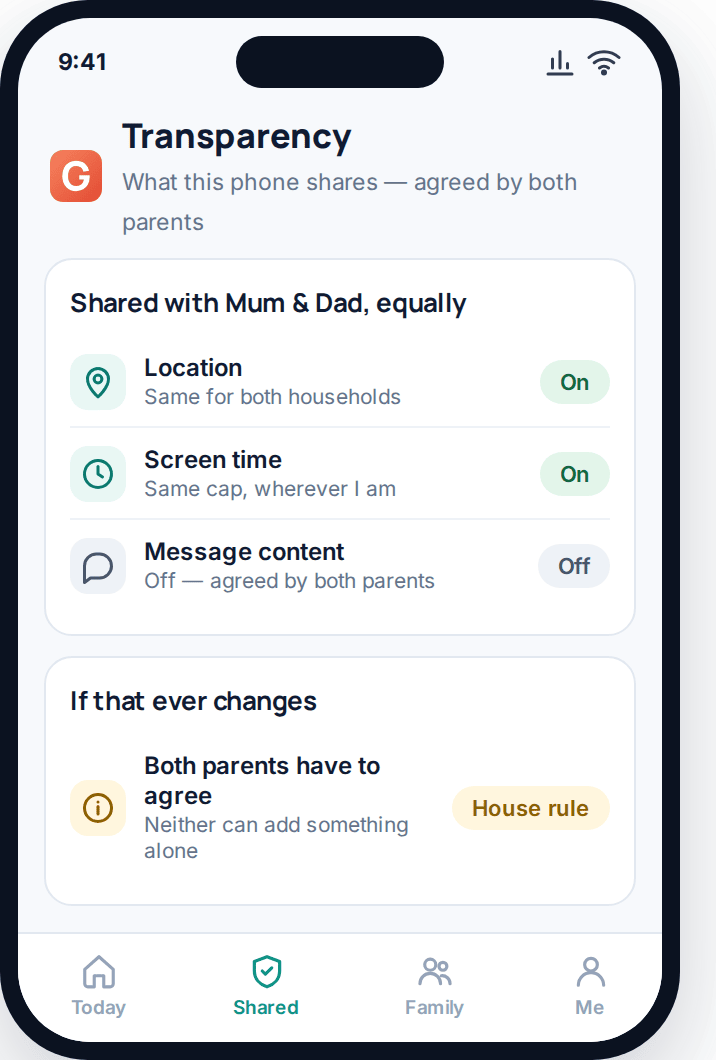
The practical version of alignment is often simple: the same settings, visible to both households, with nothing added by one parent alone. That single design choice — a shared dashboard rather than two separate ones — removes most of the opportunity for the arrangement to quietly become about something other than the child.
Notice what’s been deliberately switched off in that example, not just what’s on. A household that’s actually applying the four-question test tends to remove settings on a schedule, the same way it added them — proportionality cuts in both directions, and a shared-custody household that only ever adds monitoring, never subtracts it, is usually a sign the review step got skipped.
| Signal | Points toward monitoring | Points toward spying |
|---|---|---|
| Who set it up | Both households, together | One parent, without telling the other |
| What it’s used for | The child’s safety, specifically | Checking on the other parent’s home |
| Who can see it | Both parents and the teenager | Only the parent who installed it |
| How it’s discussed | Openly, including with the child | Not mentioned unless discovered |
Adult children still living at home
Eighteen doesn’t instantly change a living situation, but it does change the legal and ethical position substantially. An adult child living at home is, legally, an adult — owning the roof over their head does not create a right to their phone data. Monitoring an adult child without their explicit, ongoing agreement sits closer to the spying end of the spectrum than most parents in this situation initially expect.
Where it’s genuinely reasonable — location sharing between adults who both want it, for instance, or a temporary arrangement during a documented mental health crisis with the adult’s knowledge and involvement — the same four-question test still applies, just with a much higher bar for “do they know” and “did they actually agree,” rather than “did I tell them and move on.”
When “protecting” tips into control
Almost nobody sets out to control rather than protect. The drift is usually gradual: a monitoring arrangement started for one specific, real worry stays running long after that worry resolved, because removing it never became anyone’s priority, and the parent doing the watching finds it quietly reassuring in a way that has stopped being about the child.
A few honest signals that a monitoring arrangement has drifted past protecting: you’re checking it because you’re anxious, not because something prompted you to. You’ve stopped being able to say, out loud, what specific risk it’s addressing. Removing a setting feels difficult to imagine even though nothing has ever been flagged. Any of those is worth sitting with — not as an accusation, but as the same four-question test, applied to yourself this time.
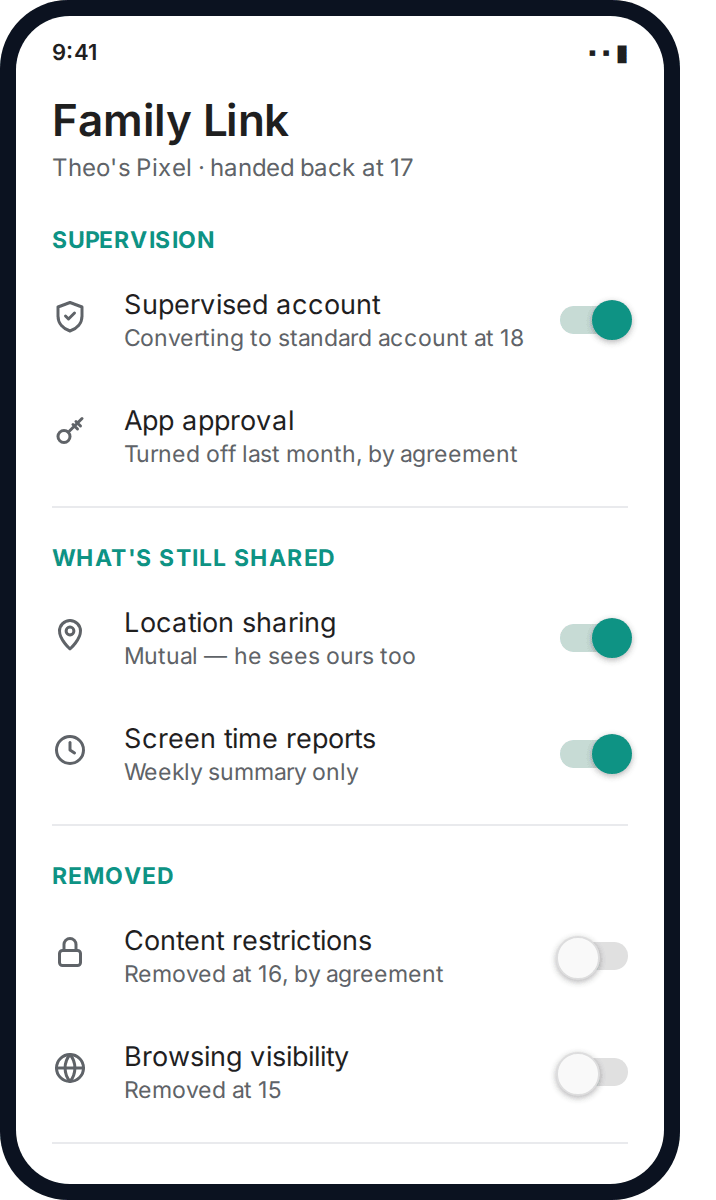
Arrangements that stay on the right side of that line tend to share one visible trait: the person being monitored can check exactly what’s shared, whenever they want, without asking. That single feature does more to keep a household honest about proportionality than any policy written down separately from it — it’s much harder to quietly over-collect when the collection is sitting in front of the person it’s about.
Applying the framework to something new
New situations come up that don’t map neatly onto any case above — a child’s friend who’s often at your house and on your Wi-Fi, an au pair, a young adult with a disability who lives semi-independently. The framework holds regardless: work out whose responsibility this person legally is, whether they can meaningfully consent, who else has a say, and run the four questions honestly. If the honest answer to any of them makes you uncomfortable to say out loud to the person involved, that discomfort is information, not an obstacle to work around.
It’s worth trying the test on a situation from the other direction too — imagine someone else applying it to you. Would you accept a household router logging every site you visited without being told? Would a mutual, disclosed location share between two adults bother you the way a one-directional, undisclosed one would? Running the four questions against your own life, not just your child’s, is usually the fastest way to notice where an arrangement has quietly drifted further than you’d have agreed to if asked directly.
Questions people actually ask
Is it illegal to monitor my own child’s phone?
No — monitoring your own minor child, on a device you’re responsible for, is legal essentially everywhere, provided you’re not violating any separate law such as call-recording rules that need multi-party consent. Once they’re an adult, the legal footing changes substantially.
Can I legally monitor my partner’s phone if I pay for it?
Paying the bill doesn’t create a right to install monitoring software without their knowledge and agreement. In many places doing so without consent is a criminal offence, regardless of the relationship or who owns the account.
What if my co-parent refuses to agree to monitoring?
That’s a genuine disagreement worth resolving through conversation or, if it’s serious, mediation — not a reason to install something quietly during your own custody time. A teenager who discovers unilateral monitoring set up around a custody dispute tends to lose trust in both households, not just one.
Is there an age where monitoring becomes illegal, not just unwise?
Not a single clean age in most places — it’s more that the legal and ethical bar for consent rises steadily through the teenage years and becomes essentially the same as for any adult at eighteen. Treat 16 to 18 as a genuine transition zone, not a cliff edge.
Does the child’s consent actually matter legally, or just ethically?
It varies significantly by jurisdiction and by the specific right in question — communications privacy, in particular, is protected in ways many parents don’t expect for older teenagers. Ethically, though, consent matters well before it becomes a strict legal requirement, because a monitoring arrangement without it tends to fail on its own terms regardless of legality.
What should I do if I realise I’ve drifted into spying territory?
Tell them. It’s an uncomfortable conversation and a much better one than being found out later. Explain what was on, why, and change it going forward — including, if appropriate, actually removing what shouldn’t have been there.
Using the framework going forward
Keep the four questions somewhere you’ll actually see them again — do they know, can they see it too, is it proportional, and is there a review date. Applied honestly and regularly, on a genuine schedule rather than only when something goes wrong, they cover nearly every situation this guide didn’t have room to name individually. For the practical side of setting monitoring up on this basis, our acceptable use page and FAQ go further, and GuestSpy’s transparency tools are built specifically to make questions one and two easy to answer honestly, every time.
The line between monitoring and spying was never really about the app. It’s about whether the person on the other end of the phone would recognise your description of what you’re doing as accurate.
Keep reading
How to Tell Your Child You’re Monitoring Their Phone
Word-for-word scripts for telling a child their phone is monitored, by age, plus how to handle the most common pushback…
The Complete Guide to Monitoring a Teen Respectfully
A step-down approach to monitoring a teenager's phone: what to negotiate, what to drop by 15 and 17, and how…
What to Do When You Find Something Worrying on Your Child’s Phone
A calm, practical playbook for the moment you see something worrying: what to do first, what not to do, and…