What to Do When You Find Something Worrying on Your Child’s Phone
A calm, practical playbook for the moment you see something worrying: what to do first, what not to do, and when to bring in the school, the platform or the police.
 By GuestSpy Editor · Founder and editorPublished August 23, 2026Updated September 14, 202611 min read
You’re scrolling through an alert on a Tuesday evening and there it is — a message that stops you. Maybe it’s a stranger asking your daughter to keep a secret. Maybe it’s your son telling a friend he “can’t do this anymore.” Whatever it is, the next ten minutes matter more than most parents realise, and almost none of the instinctive reactions are the right ones.
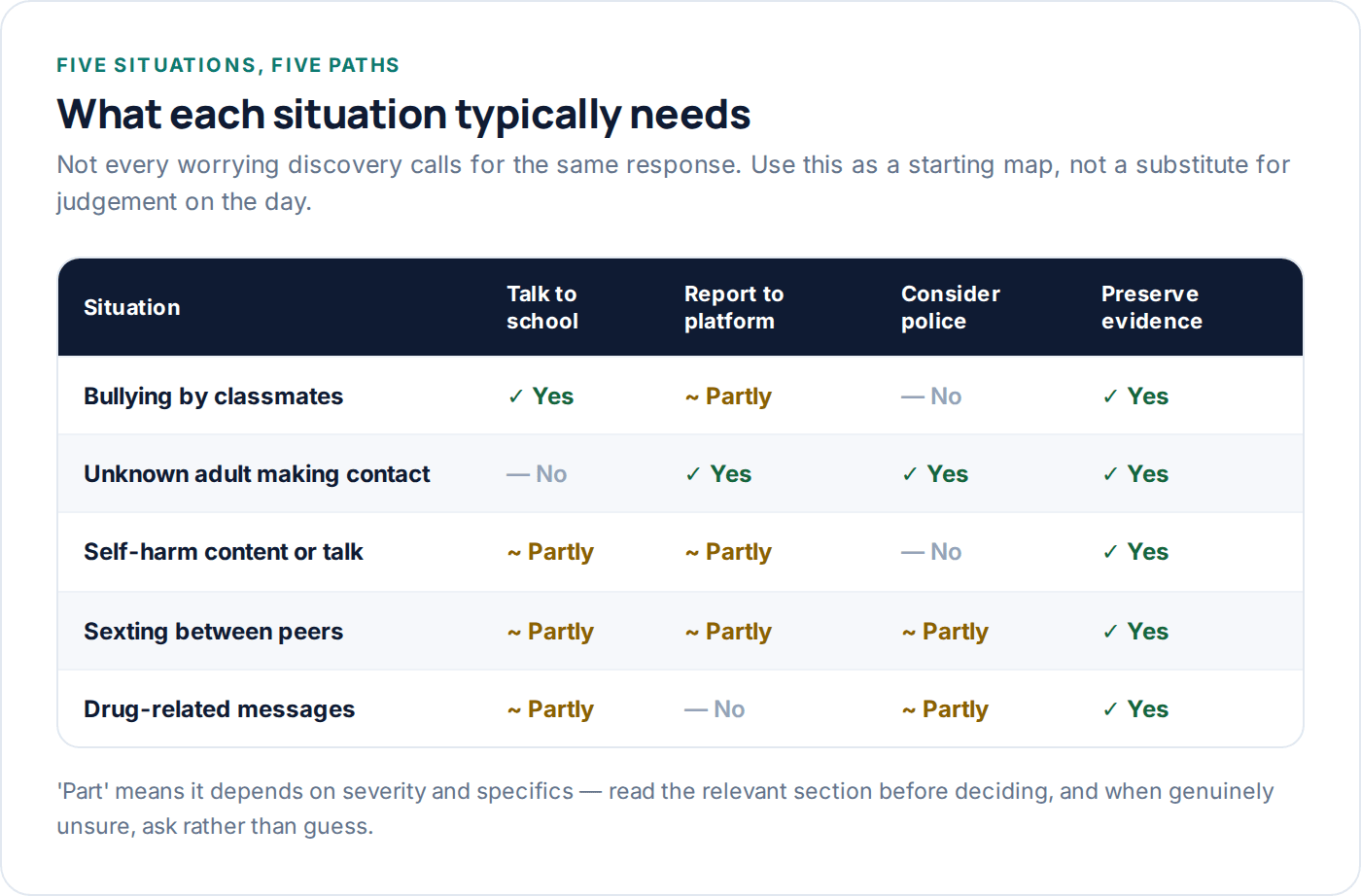
This is a playbook for that moment: what to do first, what to actively avoid doing, and when the right move is to bring in the school, the platform, or the police. It covers five situations separately — bullying, a stranger making contact, self-harm content, sexting, and drug-related messages — because they genuinely need different responses, and treating them all the same is how well-meaning parents make things worse.
The first ten minutes, whatever the situation
Before you decide anything about what to do, there’s a short list of things worth doing regardless of what you’ve found. They cost you almost nothing and they keep every option open for later.
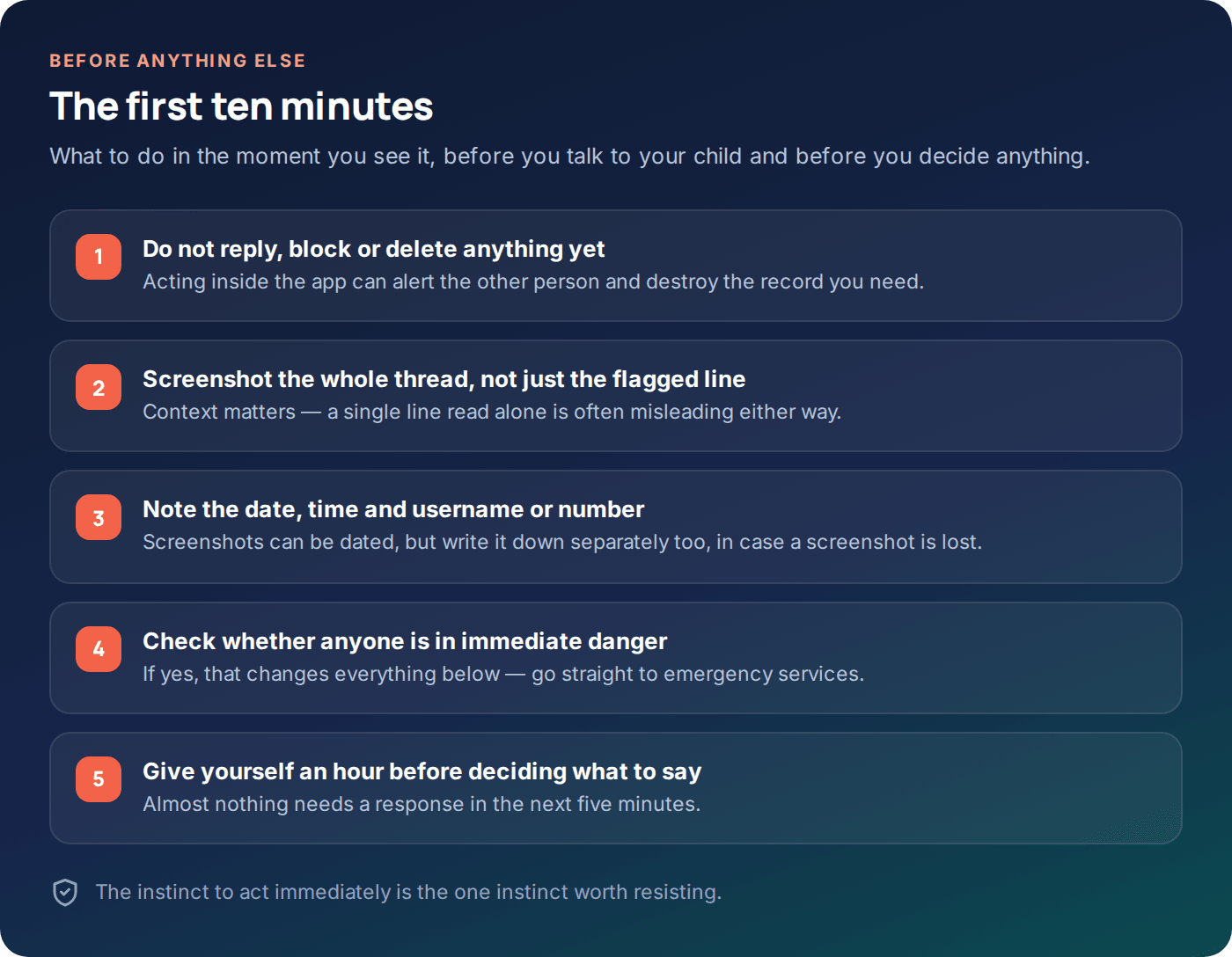
The single most common mistake is acting inside the app straight away — replying, blocking, or deleting the conversation out of an urge to make it stop existing. Blocking a contact can prompt them to create a new account and approach again from an angle you’re not watching. Deleting a thread, even accidentally, can remove the one piece of evidence a school or the police would need later. None of that is obvious in the moment, which is exactly why it’s worth having decided in advance.
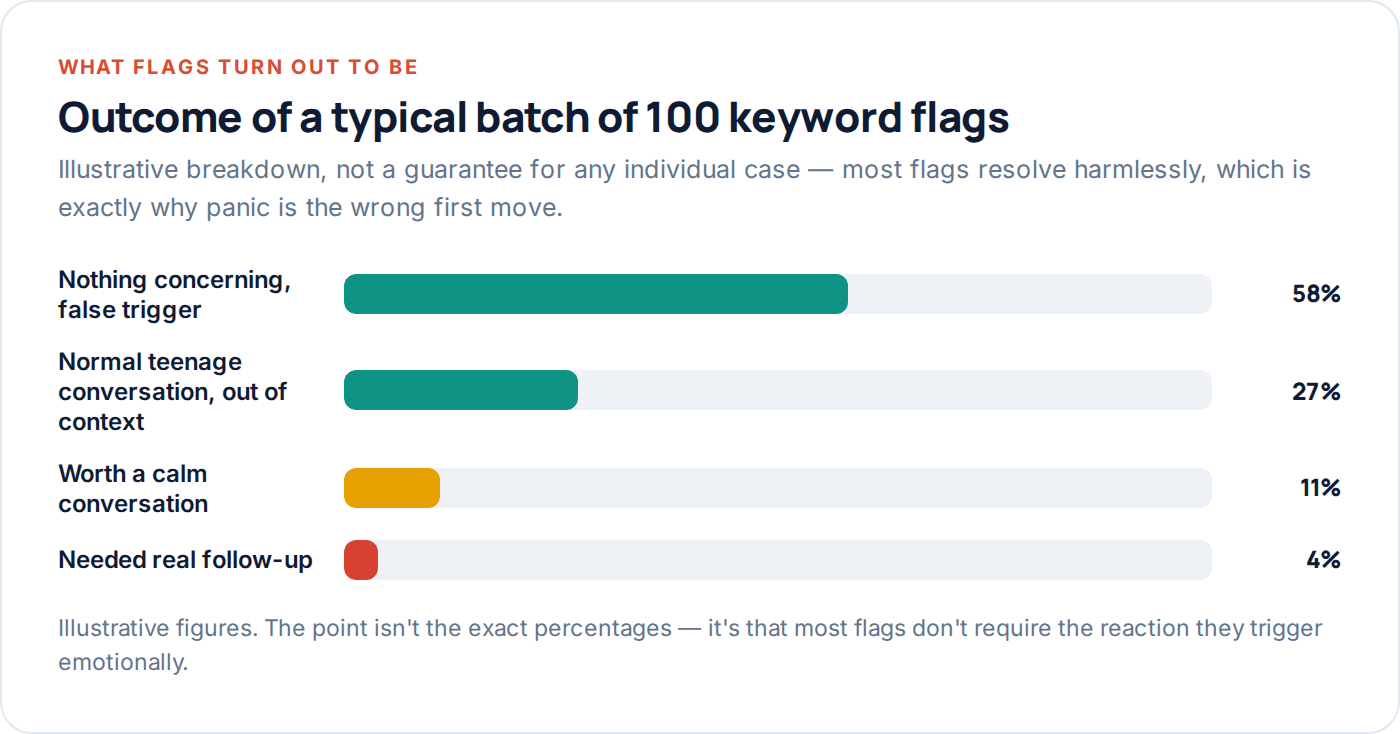
It helps to know the odds before the first alert ever arrives. Most flagged messages turn out to be nothing much — a word used in an entirely ordinary way, a joke, a line quoted from a show. Knowing that in advance is what makes it possible to read a flag calmly instead of reacting to it as if it’s already an emergency.
Having the conversation itself
How you open this conversation shapes whether your child tells you the next thing that goes wrong, or quietly decides not to. That’s the real stake, more than whatever the current situation turns out to be.
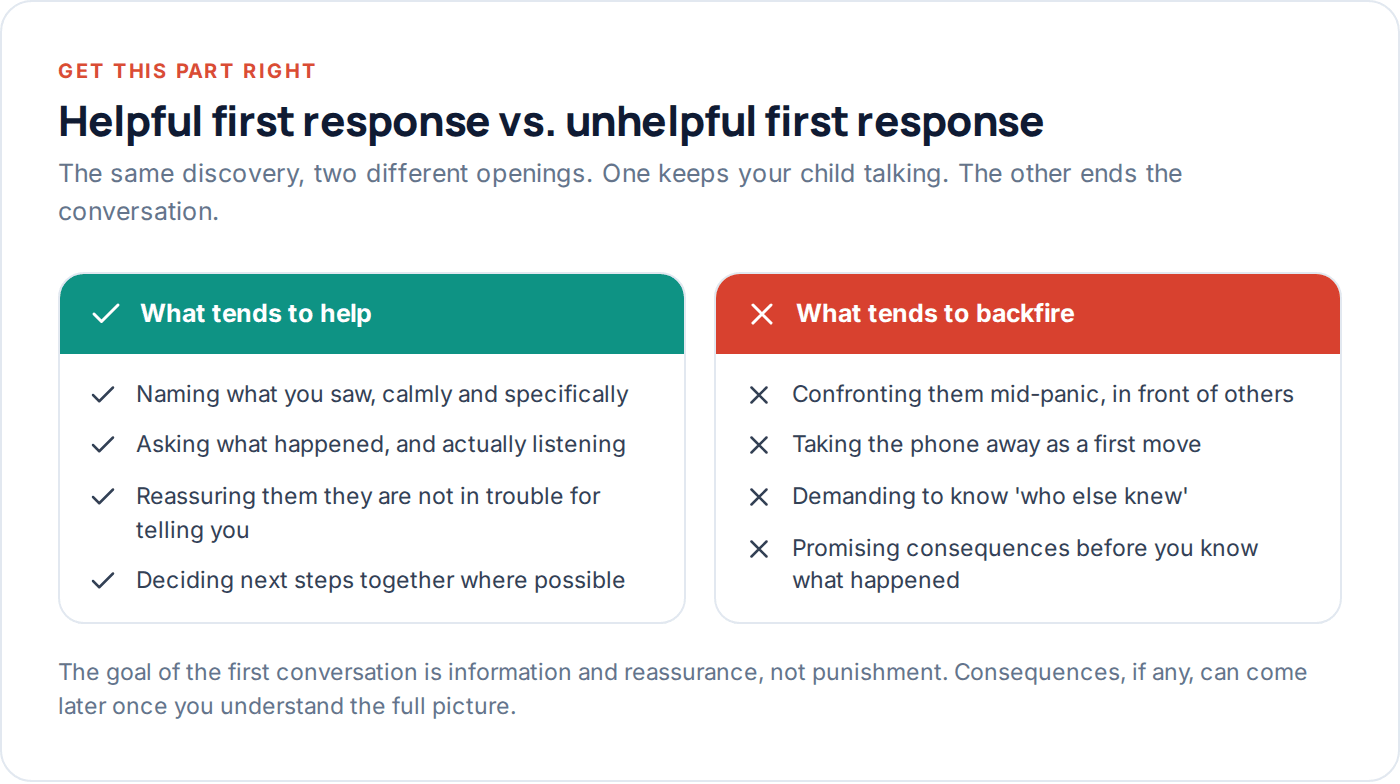
Lead with honesty about how you found out. “I saw a message that worried me” is straightforward and keeps the agreement you made when you set up monitoring in the first place. Pretending you found out some other way turns one problem into two, and most children work out the real source anyway.
Ask before you assume. A flagged word rarely tells the whole story — “meet up” might mean an adult stranger, or it might mean two twelve-year-olds planning a bike ride to the park that they’d already told you about. Read the full thread first, then ask an open question rather than stating a conclusion. “Can you tell me about this conversation?” gets you further than “who is this person and why are they talking to you.”
Pick your moment as carefully as your words. A car journey or a walk, where you’re side by side rather than facing each other, tends to produce a more honest conversation than sitting your child down at the kitchen table with the phone between you. Something about not having to hold eye contact for the whole thing makes it easier for a child to say the awkward part out loud.
If it’s bullying
Bullying is usually the easiest of these five to spot and the hardest to know how hard to push on, because the wrong level of intervention can make a child’s social situation worse rather than better.
Screenshot first
Get the full exchange, including anything that happened before the part that got flagged — bullying rarely starts with the worst message.
Ask what they want
A child who’s being bullied often wants it handled quietly, not with a dramatic school meeting. Ask before you escalate on their behalf.
Involve the school early
Most schools have an anti-bullying policy that covers behaviour outside school hours if it involves pupils from the same school — even in a group chat, not just on school grounds.
Resist the urge to message the other child’s parents directly before speaking to the school, however tempting. It can escalate quickly and put your child in the middle of an adult conflict they didn’t ask for. The school, or the platform’s reporting tool for anything happening in an app, is almost always the better first step.
If a stranger has made contact
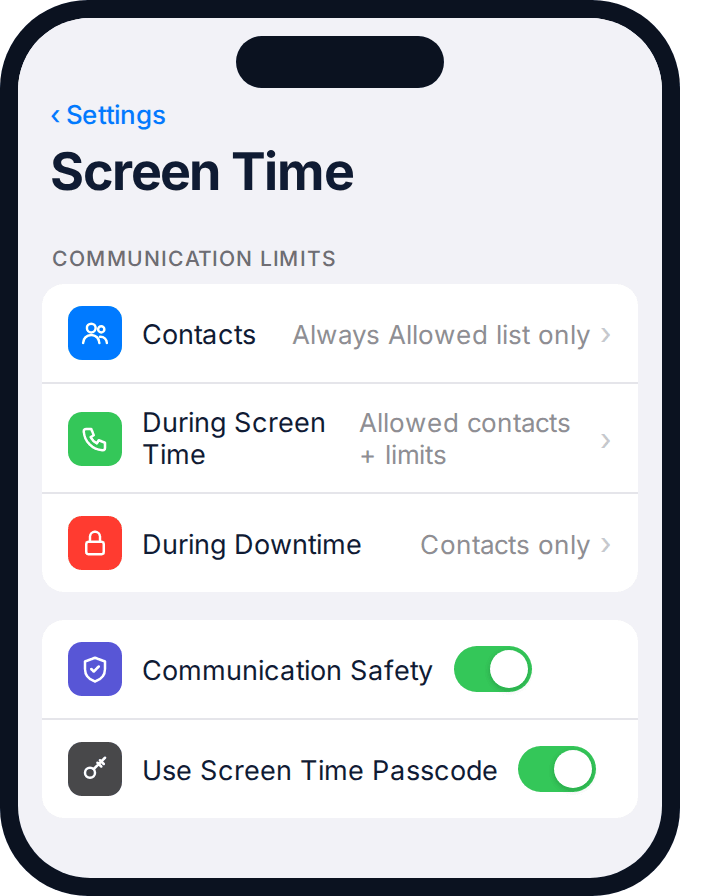
This is the situation most parents fear, and it’s also the one where the usual advice to “talk first, act later” gets reversed. Evidence disappears fast here — a stranger who realises they’ve been noticed will often delete their account within minutes — so capturing everything comes before the conversation with your child, not after. If you need to buy time immediately, a platform-level or device-level contact restriction like the one above can cut off further messages within a minute, without you having to reply to anyone.
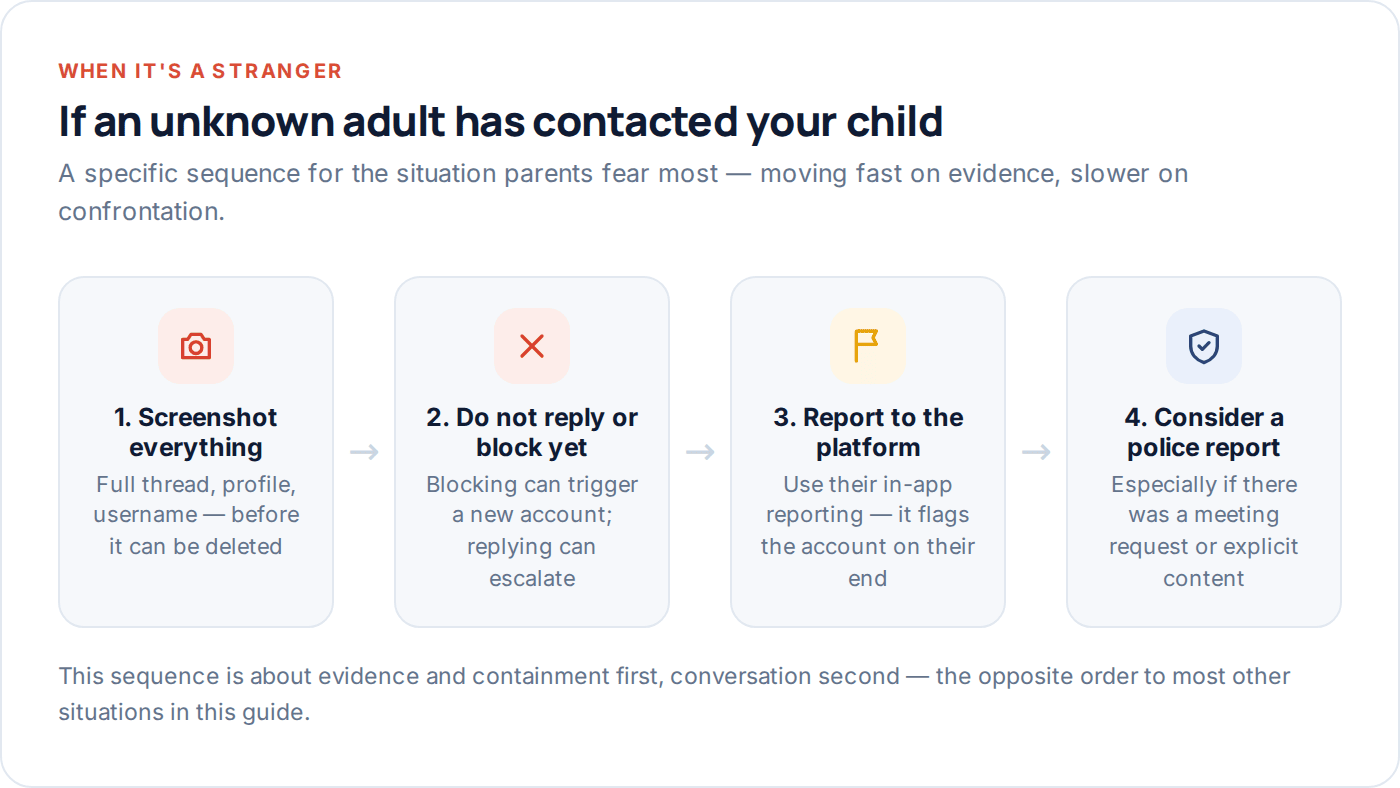
Screenshot the full profile, the whole thread, and the username, then use the platform’s own reporting tool rather than just blocking. Reporting flags the account on the platform’s side even if it later gets deleted or renamed; blocking alone doesn’t. If there’s been any request to meet in person, any explicit content, or any attempt to move the conversation to a different, less-supervised app, that’s worth a police report — most areas have a route for reporting suspected grooming or online exploitation, and it’s better to file a report that turns out to be unnecessary than to skip one that wasn’t.
If it involves self-harm
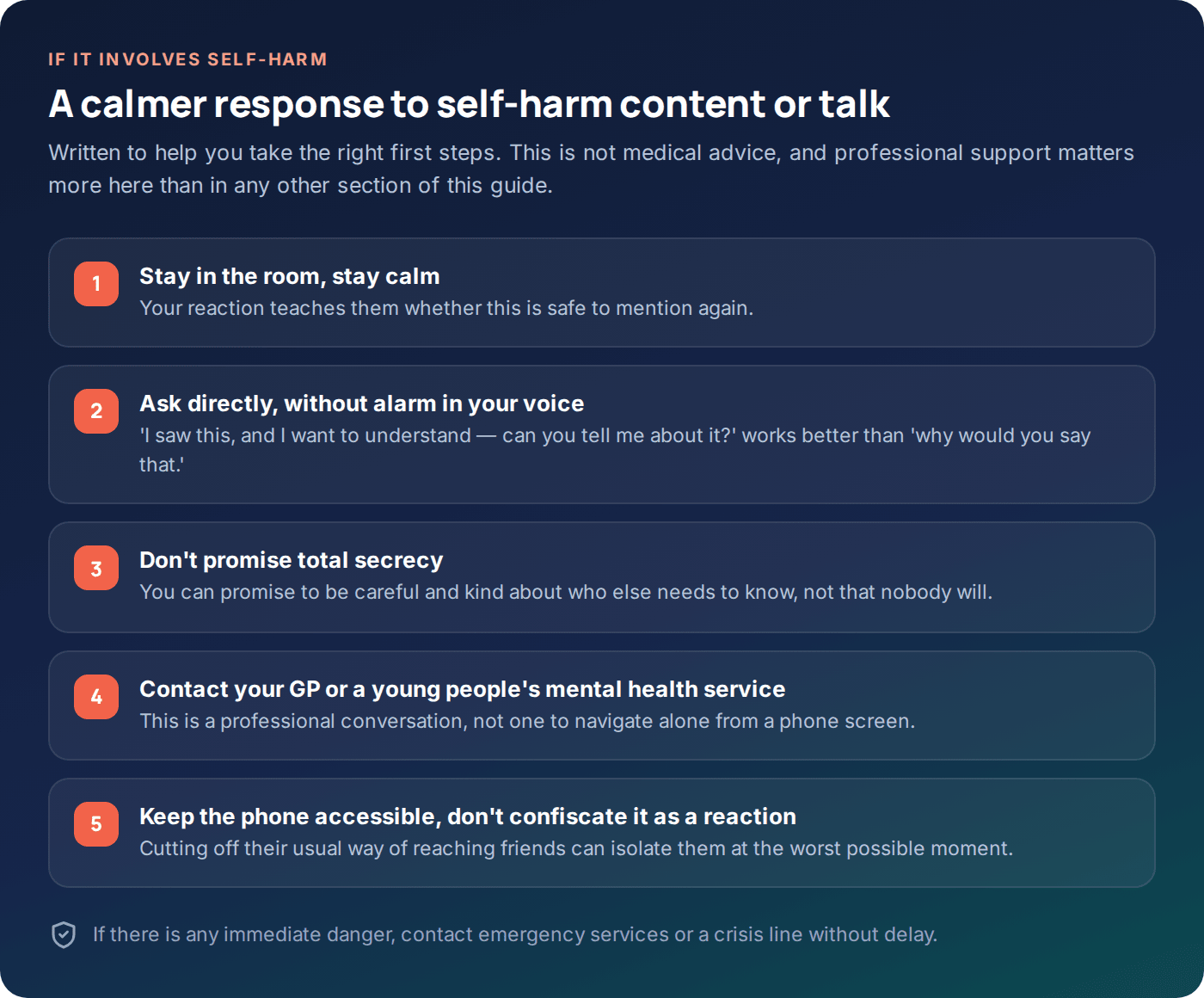
Finding self-harm content, or a message where your child talks about wanting to hurt themselves, is frightening in a different way to the other situations here — the urgency is real, but the right response is rarely dramatic. This section is deliberately limited to practical first steps; it is not medical advice, and what your child needs most is professional support, not a parent trying to manage it alone from what a phone shows.
Stay calm in how you raise it — your face and your voice in that first minute tell your child whether this is a safe thing to have mentioned. Ask directly rather than dancing around it; research consistently used by mental health professionals suggests that asking directly about self-harm does not put the idea there or make it more likely, and avoiding the subject tends to make a child feel more alone with it, not less. Contact your GP, a school counsellor, or a young people’s mental health service as the next step — this is a conversation worth having with a professional, not a decision to make alone based on a screenshot.
If it involves sexting
This is a common situation and one many parents feel unprepared for. A useful starting fact: sharing or possessing an explicit image of someone under eighteen can be a criminal offence in many places, even when it’s two teenagers of a similar age and the image was shared willingly — which means the legal reality and the social reality your child is living in are often quite different, and worth understanding before you react.
| Who’s involved | Typical first step | Worth knowing |
|---|---|---|
| Your child sent an image | Calm conversation, no shaming — ask what happened and how they’re feeling now | Some platforms and hotlines can help get an image removed even after it’s been shared |
| Your child received one, unsolicited | Don’t forward or share it further, even to show another adult — screenshot the surrounding conversation instead | Forwarding it, even innocently, can itself be an offence in some jurisdictions |
| An adult is involved on either side | Treat as stranger contact — see that section — and involve the police | This moves out of “peer situation” territory entirely |
Where the school needs to know depends on whether other pupils are involved in the wider circulation of an image — ask the school directly what their safeguarding process involves rather than guessing, since most have a specific, practised procedure for exactly this.
If it involves drugs
Messages about drugs range enormously in seriousness — a joke between friends reads very differently from messages that look like they’re arranging a purchase, and it’s worth reading the full context before deciding how seriously to take any single line.
- Read the whole thread, not just the flagged message — tone and context change the picture more here than almost anywhere else.
- Have the conversation without leading with punishment — a child who expects immediate consequences will tell you less, not more, the next time.
- Consider what’s actually being discussed — occasional mention among peers is a different conversation to messages that suggest supply or regular use.
- Involve the school if other pupils are named — schools generally have safeguarding processes for this that don’t require you to name your source.
- Consider a GP conversation if use looks regular — this is a health conversation as much as a discipline one.
Worth remembering: a teenager mentioning drugs in a chat is not the same as a teenager using them, and treating the two identically tends to close down the exact conversation that would tell you which one you’re actually dealing with. A curious, non-alarmed question usually gets you more real information than an accusation does.
Preserving evidence properly
Across every situation above, evidence has the same basic requirements: it needs to be screenshotted in full, dated and timestamped in your own notes as well as the screenshot itself, and left alone until you’ve decided what to do with it. A single flagged line, taken out of context, has misled more parents than it’s helped — the full thread is what actually tells you what happened.
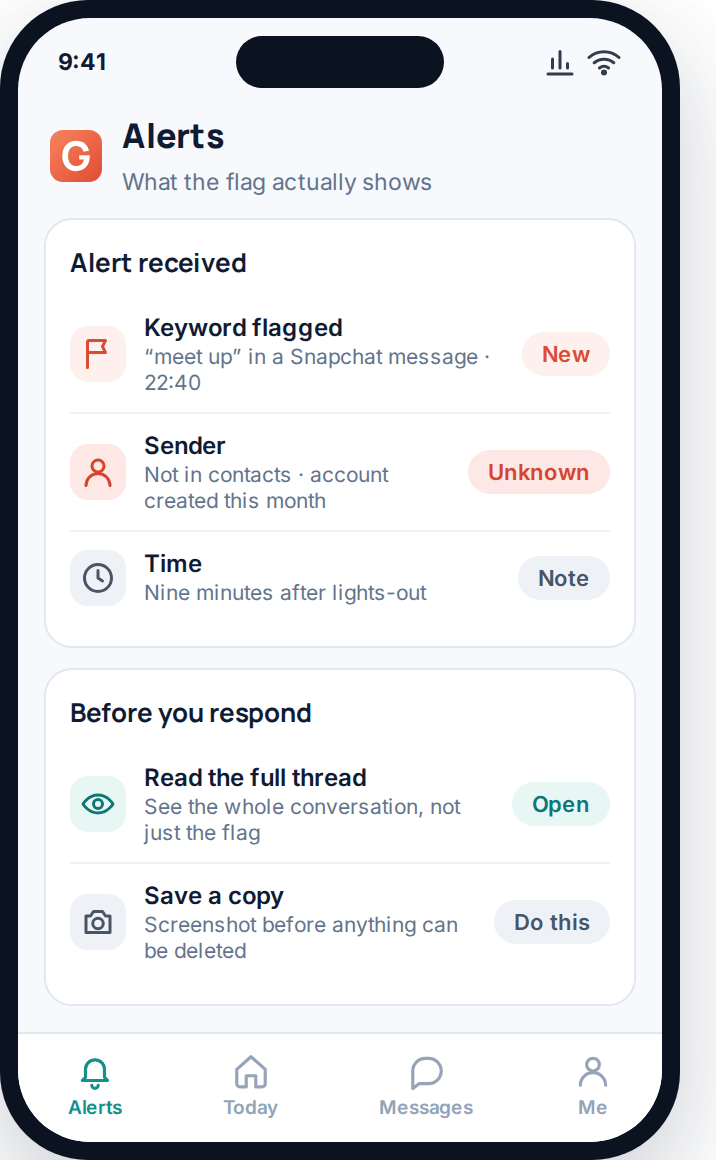
If you’re using a dashboard like GuestSpy’s keyword alerts, the alert itself is usually enough to preserve a record, but it’s still worth saving a screenshot independently in case the conversation is deleted from the child’s device afterwards. The activity reports feature keeps a dated history, which matters if you end up needing to show a school or the police when something happened, not just what was said.
Questions parents actually ask
Should I confront my child immediately after seeing an alert?
Give yourself at least an hour, ideally until you can talk somewhere private and unhurried. Confronting a child mid-panic, especially in front of siblings or friends, tends to shut the conversation down rather than open it. The exception is immediate danger — then act straight away.
What if my child deletes the conversation before I can screenshot it?
A monitoring app’s own alert or activity log usually preserves a record independent of what happens on the child’s device afterwards, which is one reason it’s worth checking the alert itself rather than only the live conversation on the phone.
Should I tell the school about something that happened outside school hours?
Often yes, if pupils from the same school are involved — most schools’ safeguarding policies cover behaviour between their pupils regardless of where or when it happened, particularly for bullying and image-sharing situations.
When does something actually need the police, rather than just the platform?
Consider the police when an adult stranger has made contact, especially with any request to meet or send images; when there’s a specific threat of violence; or when an explicit image of a minor has been shared. Reporting something that turns out not to need police involvement costs little; not reporting something that did can cost a lot.
My child says I’m not allowed to look at their messages. What do I say?
Go back to whatever agreement you set up when you started monitoring — most families agree that a genuine safety concern, not idle curiosity, is what justifies looking closer. If that agreement was clear from the start, this moment is far easier to explain.
How do I stop this from happening again?
Rarely by tightening every setting at once — that reads as punishment and teaches better hiding, not better judgement. A specific change, explained plainly (“I’m keeping flags on for this one word because of what happened”), tends to hold up better than a general crackdown.
Where to start
If you’re reading this because something has already happened tonight, start with the first-ten-minutes checklist above, then find the section that matches your situation. If you’re reading this ahead of time, the useful thing to do now is decide, calmly, how you’d want to handle each of these five situations before you’re in the middle of one — that decision is much easier to make well when nothing is actually wrong yet. GuestSpy’s keyword alerts and activity reports are built to surface the moment that matters without needing you to read everything else, and the FAQ covers more of the questions that come up once you’re actually in one of these conversations.
Whatever the situation turns out to be, the thing that matters most by the end of the conversation is the same: does your child still feel able to tell you the next time something goes wrong. Get that part right and the rest is usually manageable.
Using a monitoring app for this? GuestSpy is parental monitoring for Android that stays visible on the child's phone and runs from any browser. If it fits your family, see what the app does.
Related guides
The Complete Guide to Child Phone Monitoring (iPhone and Android)
What you can actually see on each platform, how to set it up in an afternoon, and the one conversation…
The Complete Guide to Monitoring a Teen Respectfully
A step-down approach to monitoring a teenager's phone: what to negotiate, what to drop by 15 and 17, and how…

The Honest Parent’s Guide to Phone Monitoring
What phone monitoring actually delivers versus what the marketing promises, five claims worth being sceptical of, and a straight framework…
Monitoring your child can see.
Location, screen-time budgets, routines, app and website blocking and the alerts that matter, run from any browser and visible on the phone. Pair an Android phone in about fifteen minutes.