How to Write an Employee Monitoring Policy Your Team Accepts
A practical, template-driven guide to writing a monitoring policy staff read and accept rather than resent — with a worked section-by-section outline.

Two companies can install identical monitoring software, write policies that say almost the same thing on paper, and end up in completely different places six months later — one with a team that shrugged and moved on, the other with resignations and a grievance letter. The difference is almost never the tool. It’s how the policy was written and introduced.
This is a practical, template-driven guide to writing an employee monitoring policy — what clauses it needs, how to consult staff before finalising it, how to communicate it so people actually read it, and how to keep it current. It assumes you’ve already worked out what’s legally required where you operate; if you haven’t, our companion piece on the legal side of employee monitoring is worth reading first, since the two go hand in hand.
Why two similar policies land so differently
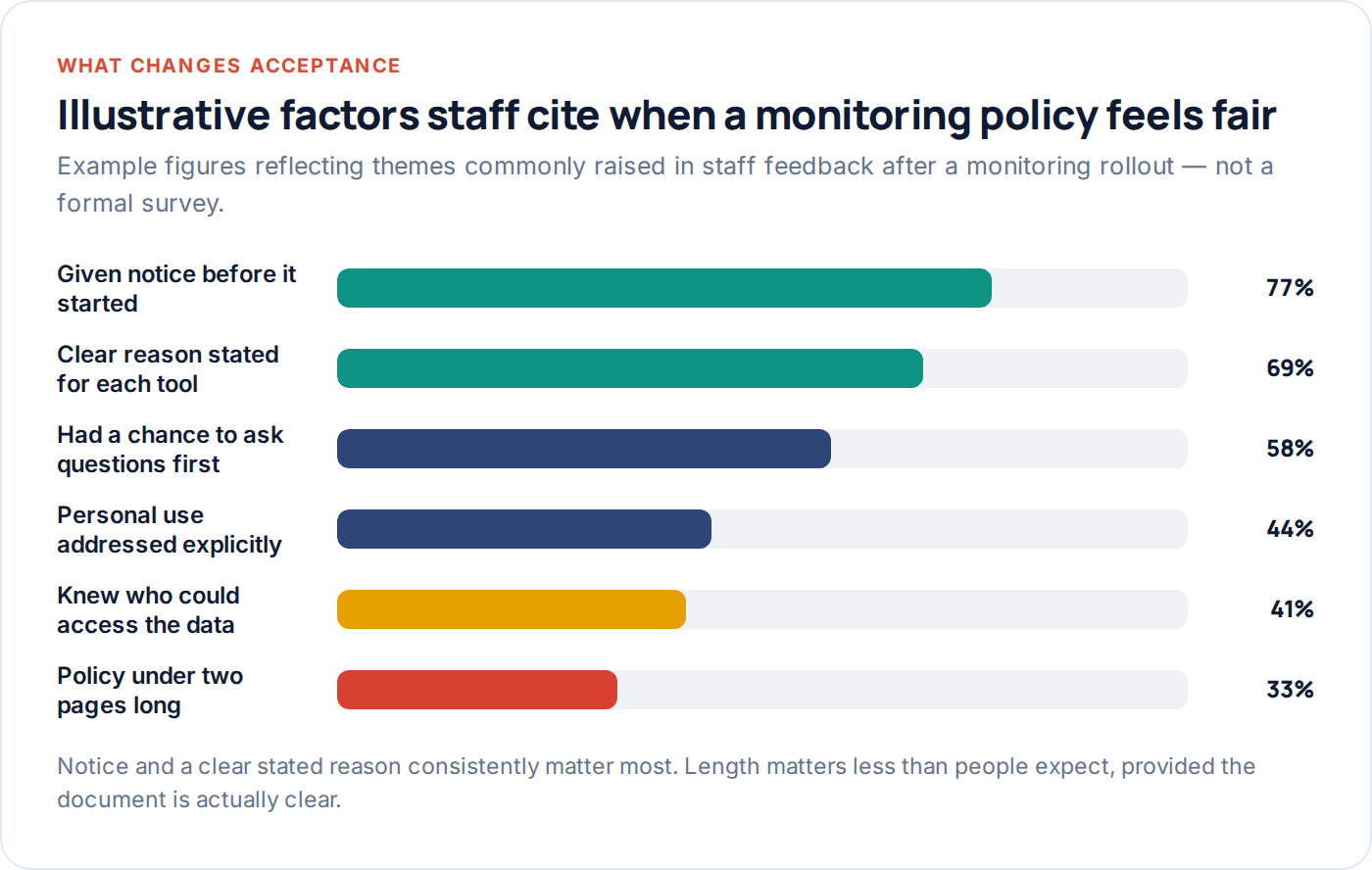
Staff generally accept oversight of their work. What they resist is surveillance of themselves as people, and a policy’s wording is often the only signal they get about which one they’re actually receiving. A document that names the specific business reason for each tool, states plainly what isn’t monitored, and arrived with notice reads as the former. A vague policy that appeared without warning reads as the latter, even when the underlying monitoring is identical.
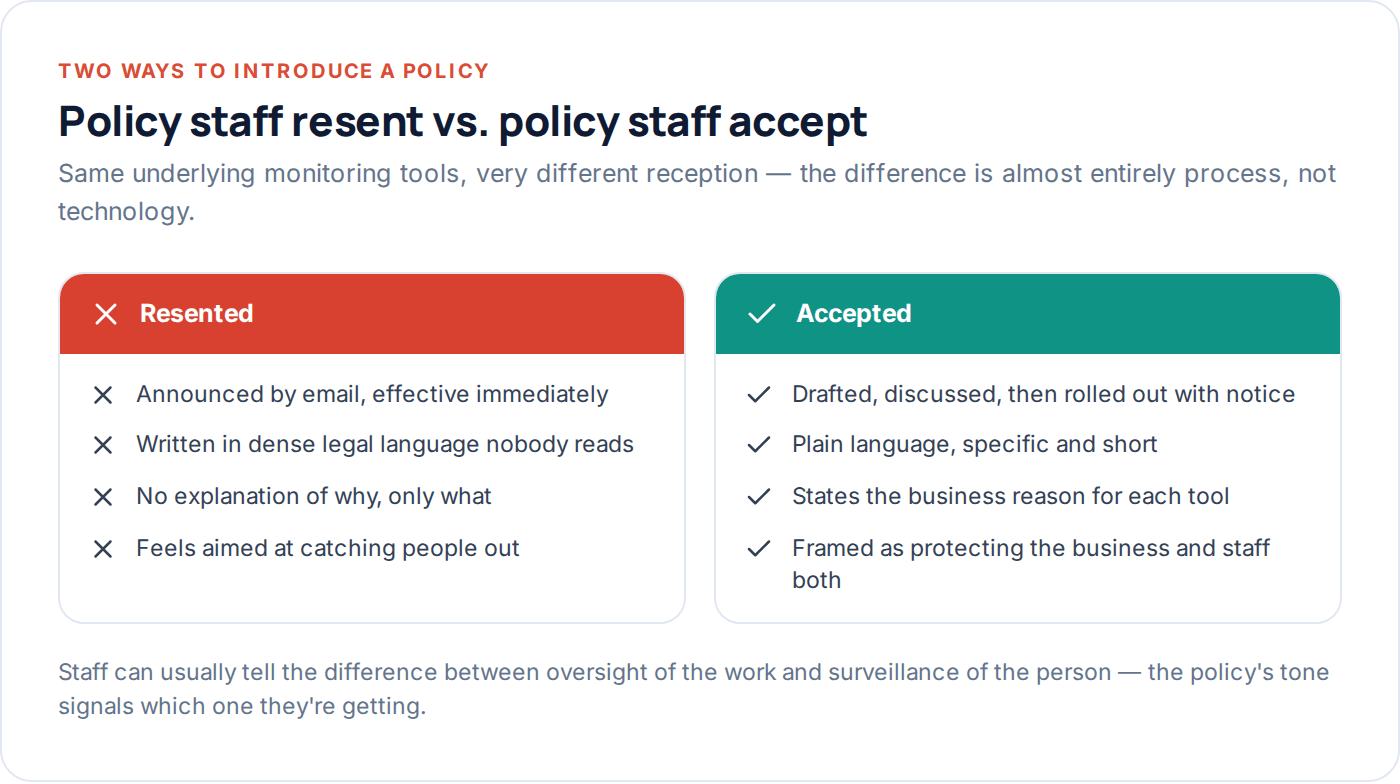
The rest of this guide is built around that distinction — every recommendation below exists to make a policy read as reasonable oversight rather than blanket surveillance, because that’s what actually determines whether staff accept it.
Groundwork before you draft
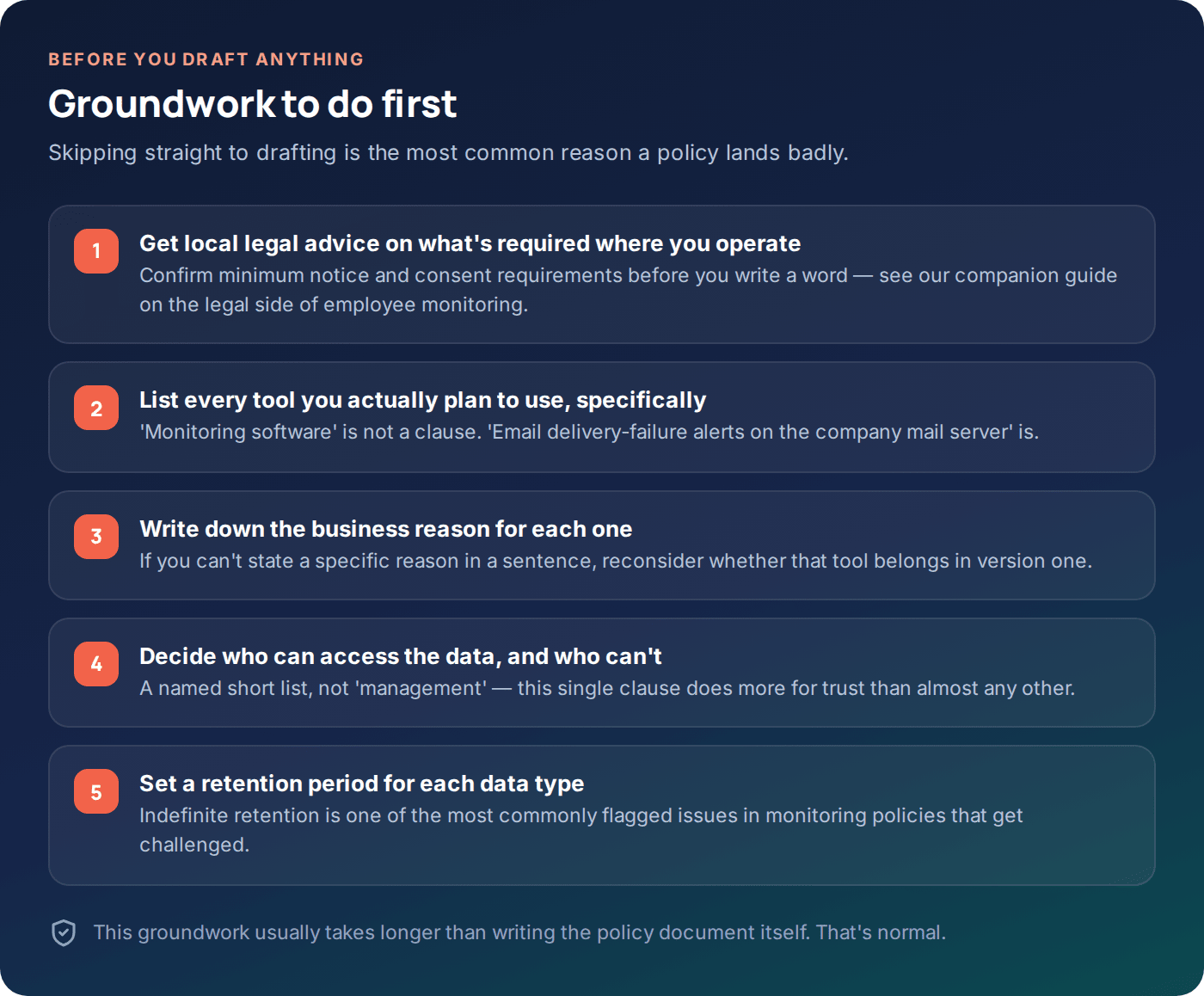
Resist starting with a template and filling in blanks. Start with three lists: every tool you actually plan to use, the specific business reason for each one, and who will have access to the data it produces. Writing these down first, before touching the document itself, is what stops a policy from becoming vague in the places that matter most.
It also surfaces problems early, while they’re still cheap to fix. If you get to the third list — who has access — and realise the honest answer is “anyone with admin rights to the dashboard,” that’s a gap worth closing before the policy goes anywhere near your team, not a detail to smooth over in the wording. A policy is only as trustworthy as the practice it describes, and drafting the groundwork lists first is what catches the mismatch before staff do.
The clauses the policy needs
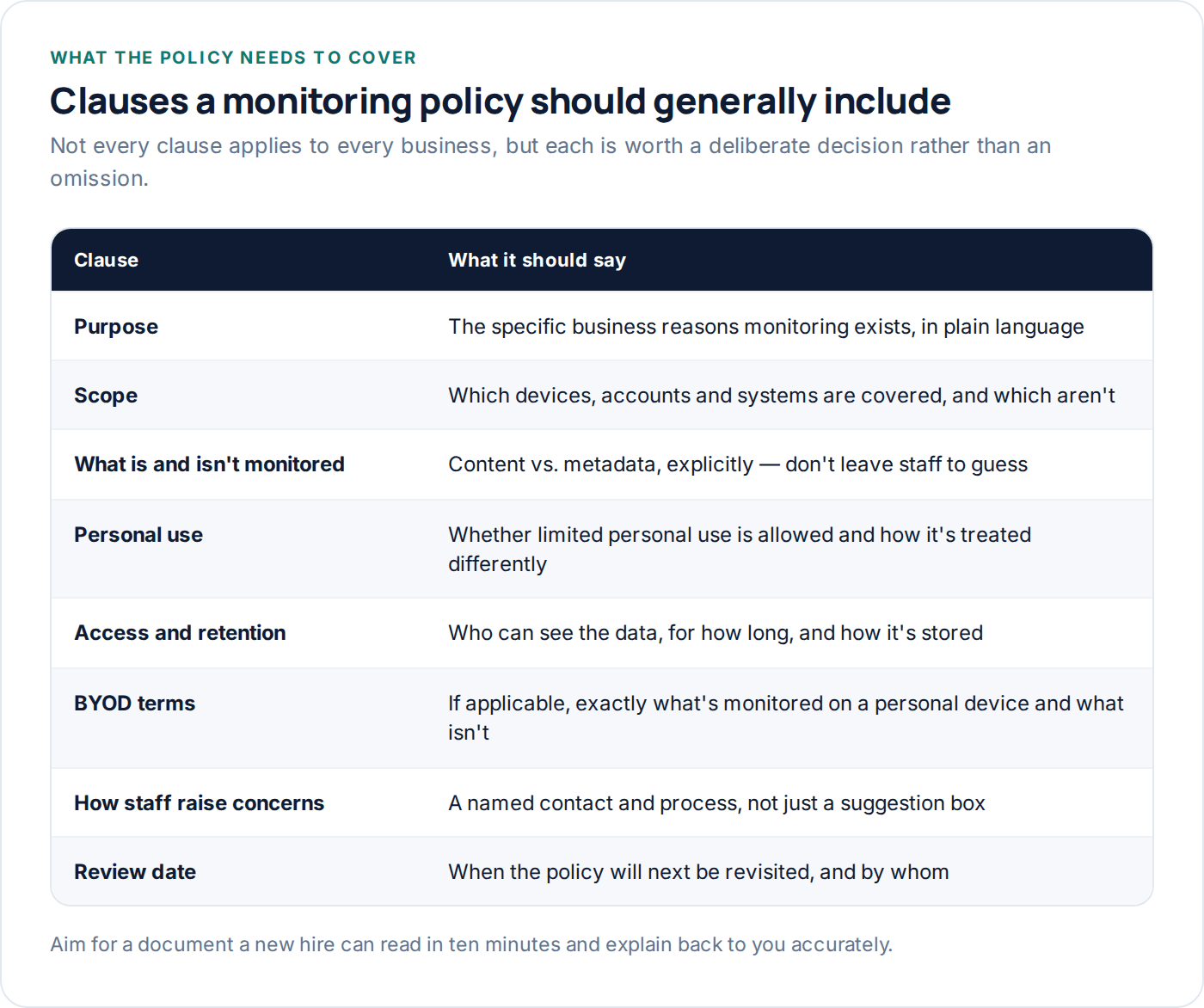
A useful monitoring policy is shorter than most people expect. Length doesn’t build trust — clarity does. The clauses below cover what most policies need; not every business needs every one, but each deserves a deliberate decision rather than a silent gap.
Purpose and scope
What’s monitored, on which devices and accounts, and — just as importantly — what explicitly isn’t. Staff read the gaps as carefully as the list itself.
Access and retention
A named short list of who can see monitoring data, and how long it’s kept. Vague answers here (“management,” “as needed”) are the most commonly flagged weakness.
How to raise a concern
A specific person or channel, separate from a general HR inbox if possible. A policy with no way to ask questions reads as one-directional.
A worked outline, section by section
Below is a realistic outline for a small business policy — adapt the specifics to what you actually use, but the shape and order below is worth keeping, since it moves from why, to what, to how, which is roughly the order a reader wants the information in.
- Purpose. “This policy explains what workplace monitoring [Company] uses, why, and what it means for you. We monitor company systems to protect business data, meet our security obligations, and maintain reliable service — not to track individual performance minute by minute.”
- Scope — what’s covered. “This policy applies to company-owned devices, company email and messaging accounts, and the company Wi-Fi network. It does not apply to personal devices, except where noted under ‘BYOD’ below.”
- What is monitored. A specific, itemised list: “Company email — automated security scanning for malware and data-loss risk. We do not routinely read email content.” / “Company laptops — installed software inventory and security patch status. We do not log keystrokes or take screen recordings.” Specificity here is what separates a real policy from a placeholder.
- What is not monitored. Explicitly state the boundaries: personal devices without a separate agreement, personal social media, and anything outside company systems and working hours unless a documented exception applies (e.g. an on-call vehicle).
- BYOD, if applicable. “If you use a personal device for work email via our managed work profile, only the work profile is monitored, on the same terms as company devices. Your personal apps, photos and messages are never visible to us.”
- Access and retention. Name the roles (not just “management”) who can access monitoring data, and state a specific retention period for each data type, after which it’s deleted.
- Personal use. State plainly whether limited personal use of company systems is permitted, and how it’s treated — most policies that skip this clause end up handling the question inconsistently later.
- Raising concerns. A named contact or role, and a commitment to respond within a stated timeframe.
- Review. The date this policy will next be reviewed, and who’s responsible for it.
A note on tone as much as content: each clause above is written in the first person plural (“we monitor,” “we do not”) rather than the passive, impersonal voice common in longer corporate policies (“monitoring may be conducted as deemed necessary”). The difference sounds small on the page but reads very differently to the person receiving it — the first version sounds like a company explaining itself, the second like a company covering itself. Staff notice which one they’re being given, usually within the first paragraph.
Consulting staff without stalling
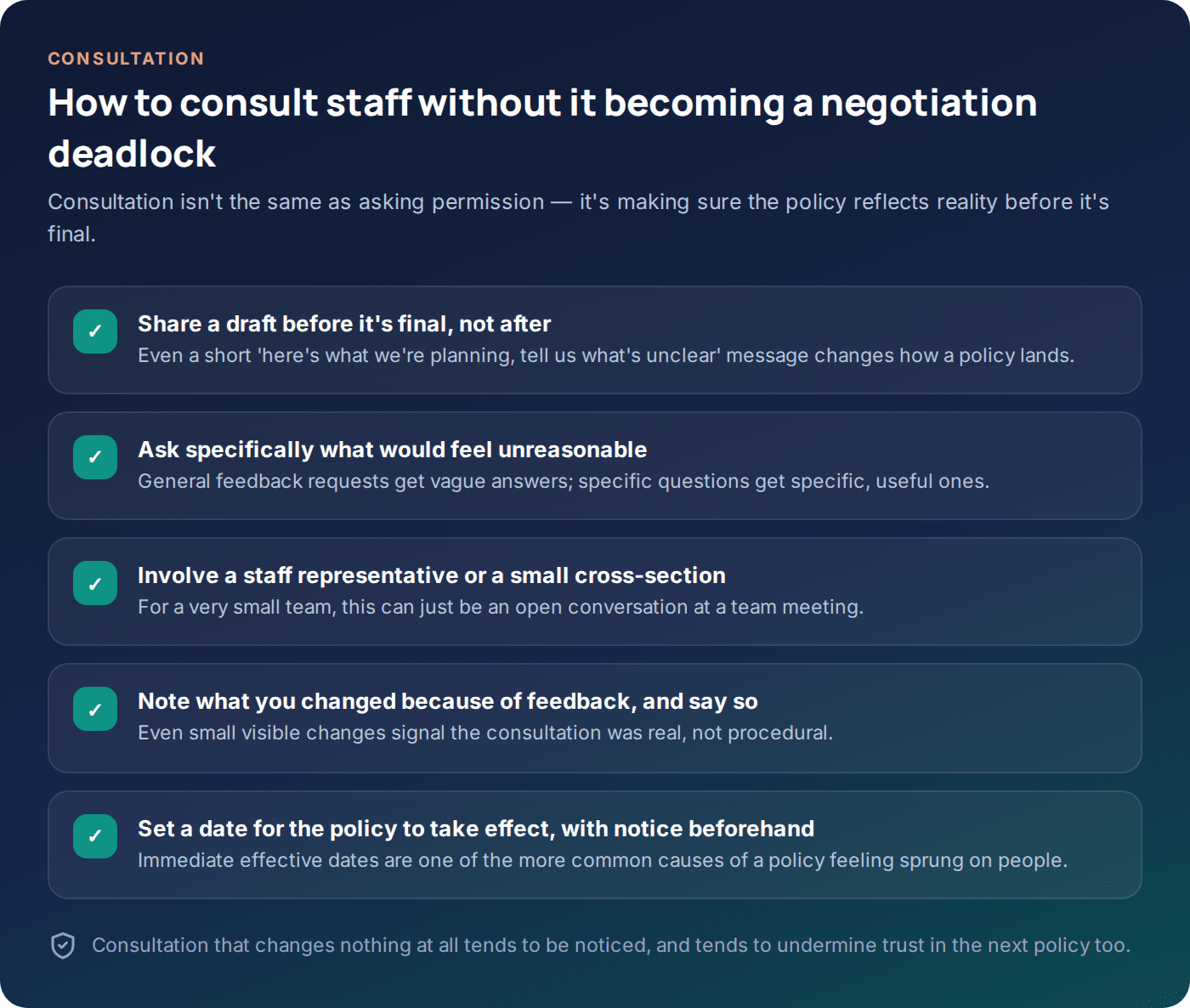
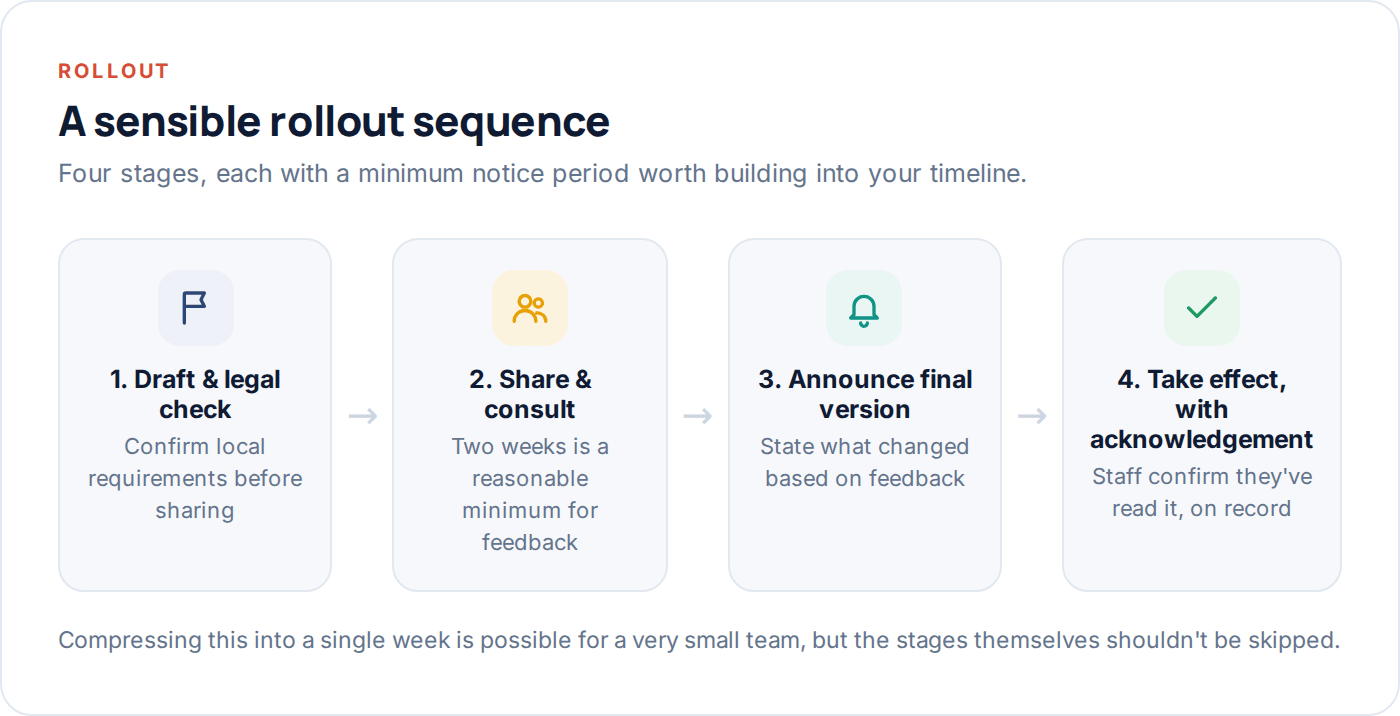
Consultation is not the same as asking permission, and it doesn’t need to become an open-ended negotiation. The useful version is narrower: share a draft, ask a specific question (“is anything in here unclear, or does anything feel disproportionate to you?”), give a real deadline for feedback, and then finalise.
For a small team, this can be genuinely informal — a team meeting agenda item and a week to send written thoughts is often enough. What matters more than the format is that staff see the draft before it’s final and that at least some visible adjustment happens as a result, even a small one, so the process reads as real rather than procedural.
Larger teams sometimes worry that opening a draft up for comment invites a flood of objections that stalls the whole rollout. In practice this is rarely what happens if the questions asked are specific rather than open-ended — “is anything here unclear” tends to produce a short, manageable list of genuine points, while “what do you think of this policy” invites a much broader and harder-to-resolve conversation. Narrowing the question is usually enough to keep consultation useful without it becoming a bottleneck.
Communicating the finished policy
How the finished policy is delivered matters almost as much as what it says. A policy buried in a fifty-page handbook update, announced by a single email nobody reads in full, tends to get discovered later rather than absorbed upfront — and “discovered later” is exactly the scenario that generates the most friction.
| Approach | Typical result |
|---|---|
| Buried in a general handbook update | Missed by most staff; resurfaces as a surprise later |
| Single email, effective immediately | Technically delivered, poorly received, low genuine understanding |
| Short standalone document, discussed at a team meeting, notice period before it takes effect | Actually read, questions surface early, fewer disputes later |
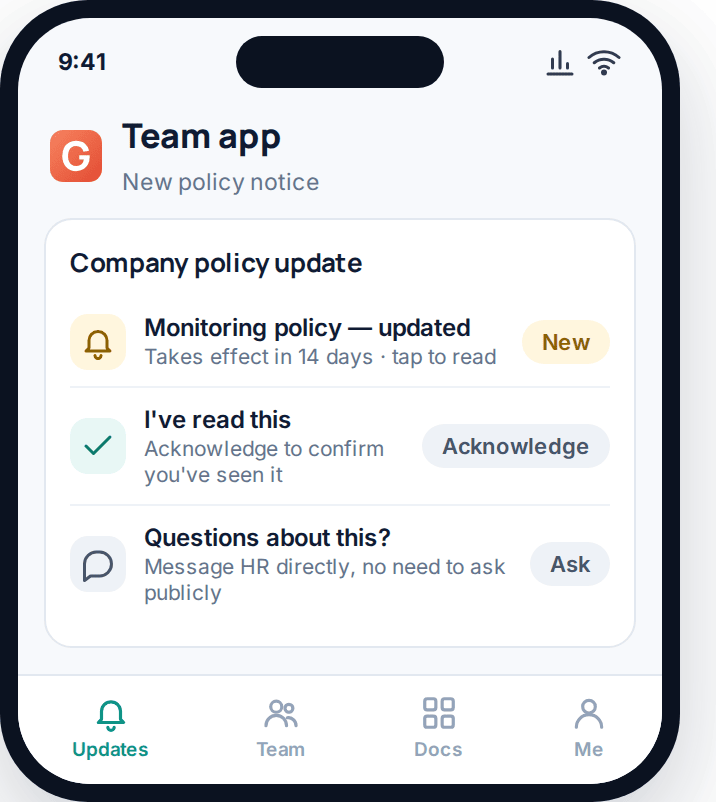
| Standalone document plus individual acknowledgement | As above, with a clear record that each person saw it — useful if a dispute arises later |
A short standalone document beats a clause buried in a longer one almost every time, and a brief live conversation — even five minutes at a team meeting — does more for genuine understanding than any amount of additional written detail.
What makes teams resent a policy
A few patterns show up again and again in teams that push back hard against monitoring, even when the underlying tools are fairly ordinary:
- No stated reason, or a reason that doesn’t match the tool. “For security” attached to something that clearly measures productivity reads as evasive, even when it isn’t intended that way.
- Monitoring that quietly expanded since the policy was written. A new tool added without updating or re-communicating the policy is discovered eventually, and it’s discovered as a broken promise, not a technical oversight.
- No visible route to ask a question or raise a concern. Silence from staff after a rollout isn’t the same as acceptance — it’s often just nowhere obvious to say anything.
- Selective enforcement. A policy applied strictly to some staff and loosely to others undermines the whole document, regardless of how well it was written.
- A tone that reads as suspicion rather than oversight. A policy written entirely around what happens if something goes wrong — warnings, disciplinary language, consequences — without ever explaining the ordinary, day-to-day purpose of the monitoring tends to make staff feel pre-emptively distrusted, even before anything has happened.
None of these are technology problems, and none of them are solved by a better monitoring tool. They’re solved by the process this guide has walked through — a stated reason, real consultation, honest communication, and a policy that keeps pace with what’s actually being monitored. Get those right and the choice of software becomes a comparatively minor decision.
Keeping it current
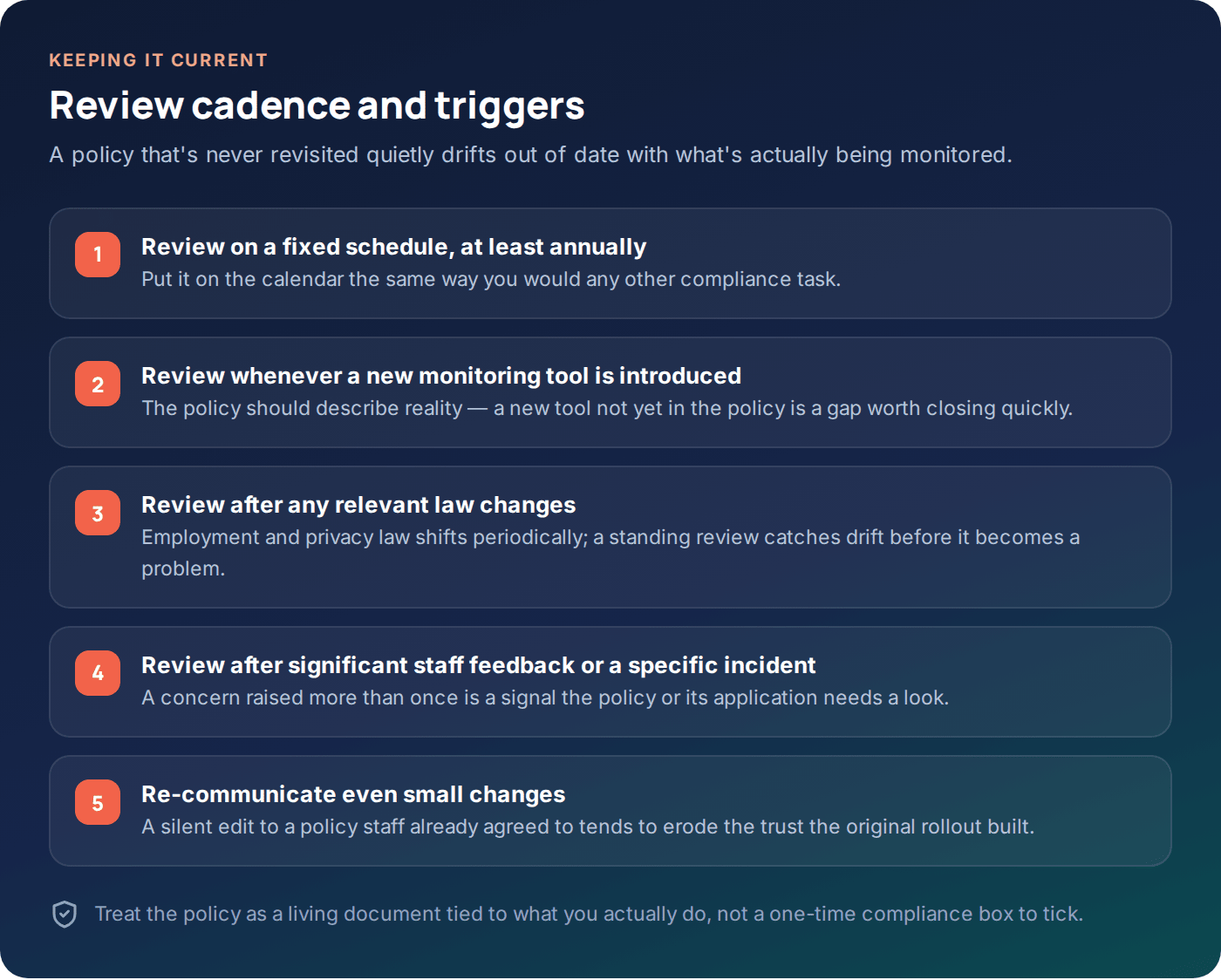
A policy is a description of what you actually do, and it drifts out of date the moment reality changes and the document doesn’t. Review it on a fixed schedule — annually is a reasonable default for most small businesses — and additionally whenever a new monitoring tool is introduced, relevant law changes, or a specific concern is raised more than once.
When you do update it, re-communicate the change, even a small one. A policy staff already agreed to that quietly changes underneath them tends to do more damage to trust than the original rollout would have, no matter how minor the actual edit was.
It helps to assign the review to a specific role rather than leaving it as a general responsibility that belongs to everyone and therefore, in practice, to no one. A named owner — often whoever owns HR or operations in a small business — with a calendar reminder is a simple enough mechanism, and it’s the difference between a policy that stays current and one that’s technically still in force but hasn’t reflected reality for two years.
Questions people ask
How long should the policy actually be?
Short enough that a new hire can read it in about ten minutes and explain it back accurately. For most small businesses that’s one to two pages covering the core clauses — length rarely correlates with how well a policy is understood or accepted.
Do we need a lawyer to write this, or can we draft it ourselves?
Drafting the document yourself using an outline like the one above is usually fine as a starting point, but have a local employment lawyer review the final version before rollout, particularly the notice, consent and retention clauses, since those are where legal requirements vary most by location.
What if staff object to monitoring during consultation?
Listen for specifics rather than treating all objections the same. A concern about a particular tool being disproportionate is worth acting on; general discomfort with any monitoring at all is worth acknowledging honestly, explaining your reasoning, and proceeding if the underlying need is genuine and proportionate.
Should contractors sign the same policy as employees?
Usually not the identical document — contractors are typically governed by their contract rather than an employee handbook, so monitoring terms for contractors are better placed in the contract itself, covering the same substance in a form that fits that relationship.
Do we need individual sign-off, or is a general announcement enough?
Individual acknowledgement — even a simple “I’ve read this” click — is worth the small extra effort. It creates a clear record and tends to prompt people to actually read the document rather than skim past a general announcement.
What’s the biggest single mistake in policies that get rejected or challenged?
Vagueness dressed up as flexibility — clauses like “monitoring may be used as needed” that don’t specify what, on what, or why. Specificity is what makes a policy defensible, both legally and to the people reading it.
Where to start
If you’re starting from nothing, the fastest honest path is: list your tools and their specific reasons, draft using the outline above, get a local legal check, share it with staff for real feedback, then roll it out with notice. Each step is small; skipping one is usually what shows up later as a dispute. For the legal groundwork this rests on, our guide to what’s legal and what isn’t in employee monitoring covers the principles worth confirming with local counsel before you finalise anything, and our contact page is there if you want to talk through how GuestSpy’s transparent approach fits into a policy like this.
Using a monitoring app for this? GuestSpy is parental monitoring for Android that stays visible on the child's phone and runs from any browser. If it fits your family, see what the app does.
Monitoring your child can see.
Location, screen-time budgets, routines, app and website blocking and the alerts that matter, run from any browser and visible on the phone. Pair an Android phone in about fifteen minutes.