Worried About Your Boyfriend? Why Secret Tracking Backfires, and What to Do

People searching for a way to track my boyfriend’s phone are usually after one of two completely different things: reassurance, or protection. A location dot is poor at the first and unnecessary for the second. It tells you where a handset was, not who held it or why — and installing something on another adult’s phone without their agreement is a criminal offence or a civil wrong across much of the world.
This page used to promise covert tracking. It no longer does, for two reasons. The services it described either took money and returned nothing, or required the phone in your hand and the passcode typed in. And the one that works is the one the law treats most seriously. What follows is about the decision itself, the conversation that replaces it, and how couples who want to share locations do it in the open.
Start with the decision, not the method
The method is the easy part and the least important. Almost everyone who arrives at a page like this has already decided that knowing would help. It is worth testing that assumption before anything gets installed, because the installation is the step that cannot be taken back.
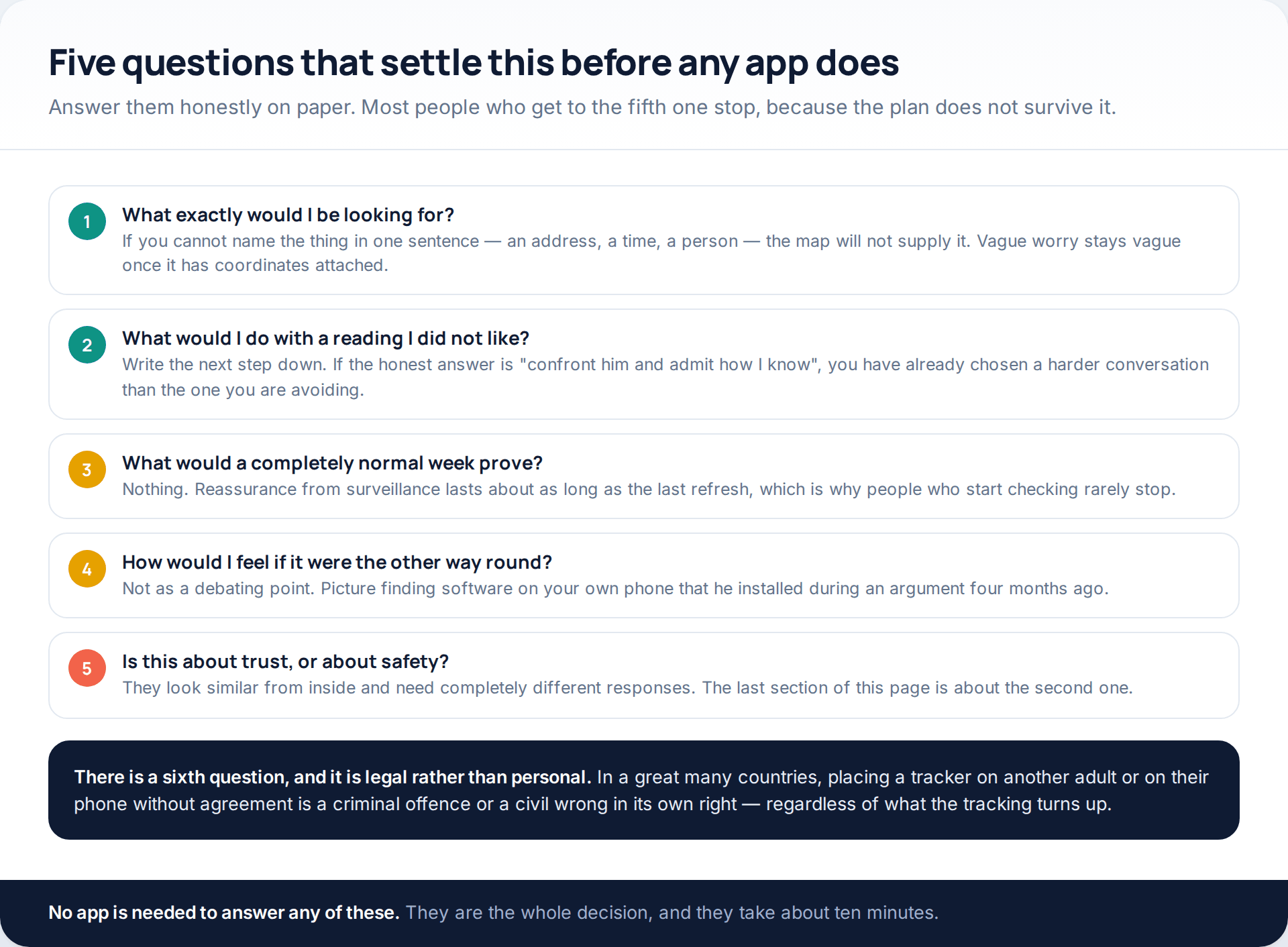
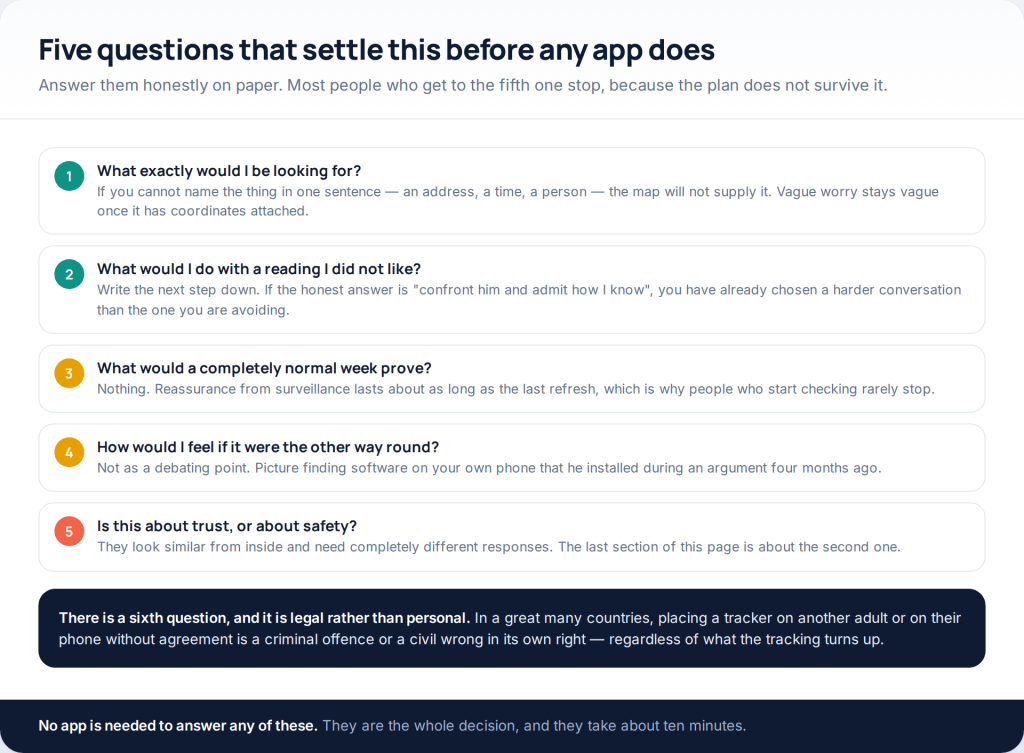
Notice what all five have in common. Not one of them is answered by better software. They are answered by deciding what you actually want, which is uncomfortable work that no app has ever done for anybody.
What a location reading would and would not tell you
Suppose, for the sake of argument, that you had perfect information: a flawless live position, updated every second, for a month. Here is the honest account of what you would have.
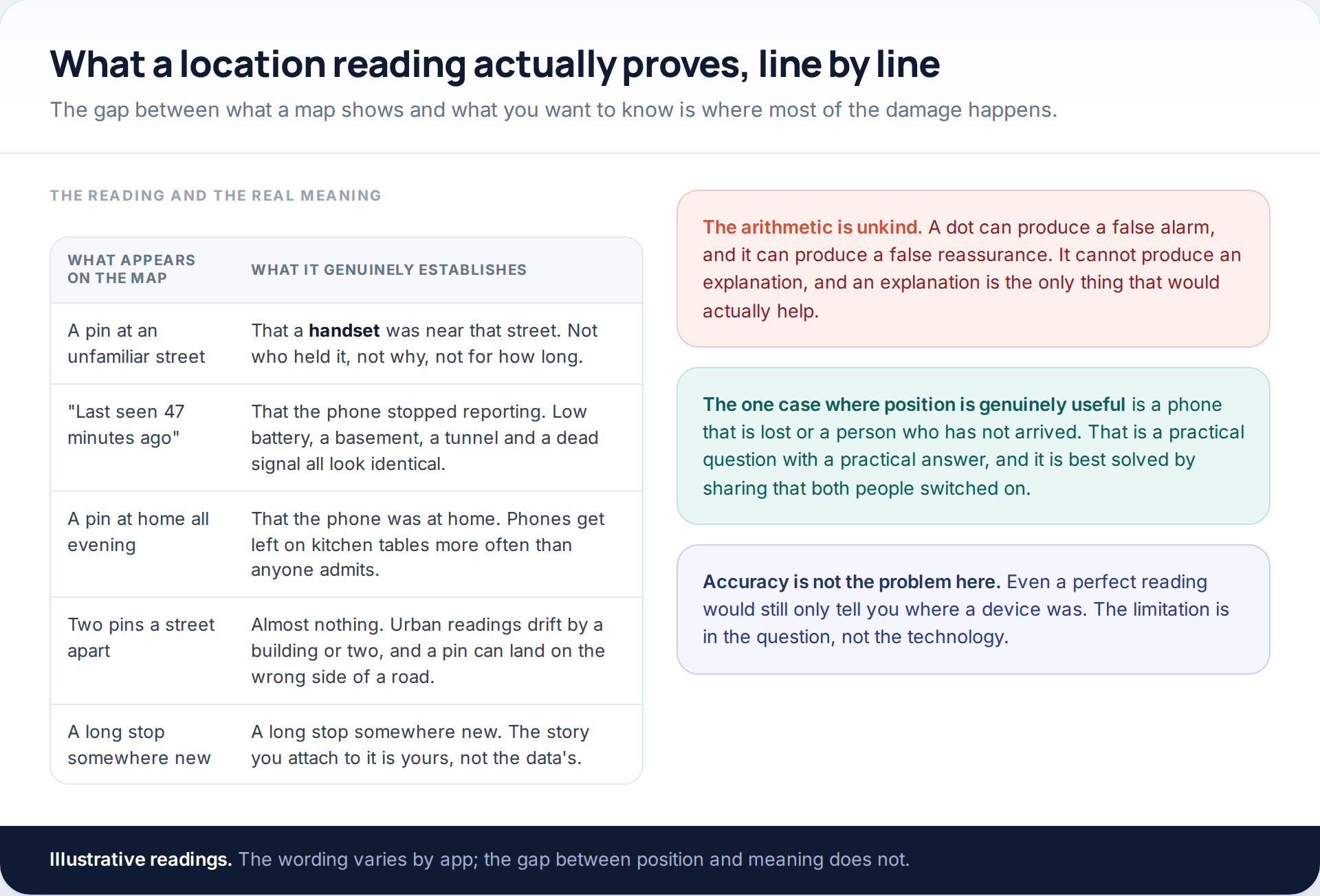
You would know where a device was. You would not know who was holding it, who he was with, what was said, or what any of it meant. Phones are left in cars, lent to friends, carried to places for dull reasons and abandoned on charge at home. A pin outside an unfamiliar building is a fact in search of a story, and in the state you would be in while reading it, you would supply the story yourself.
The reverse failure is worse. A month of ordinary readings proves nothing at all, and most people discover this the hard way: the anxiety does not lift, it simply moves to the hours the phone was not reporting. Reassurance obtained by checking has to be re-obtained constantly, which is the mechanism that turns a one-off look into a habit.
What the sites promising this actually were
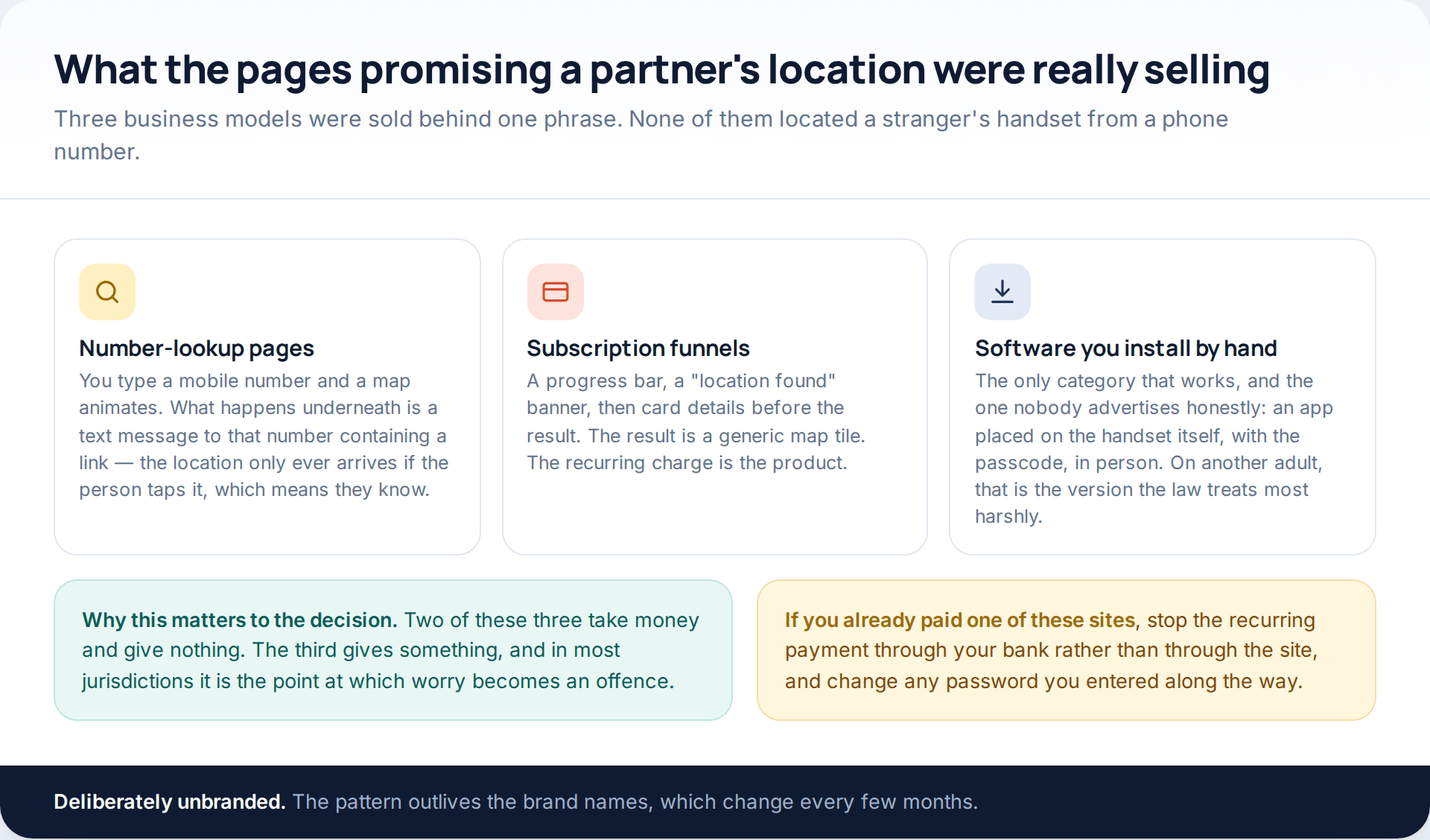
It is worth a paragraph, because the mechanics explain the legal position. A page that claims to find any handset from its number is running a different trick: it sends that number a message with a link, and the position arrives only if the recipient opens it. That is consent, obtained by misdirection, and it is visible at the other end.
Mobile networks genuinely can locate a handset, but they do it for emergency services under legal process, not for members of the public, and the family locators they sell announce themselves to the phone being located. The category that delivers what the old page promised is monitoring software installed physically on the handset. AV-Comparatives, testing seventeen commercial stalkerware apps on Android 15 in September 2025, put it plainly: most of this software cannot be installed remotely, and for most products the person installing it needs unrestricted physical access to the device.
That physical-access requirement is the whole legal problem in one line. It means there is no version of this that happens at a distance, by accident, or without a deliberate act performed on someone else’s property.
What happens in the fortnight afterwards
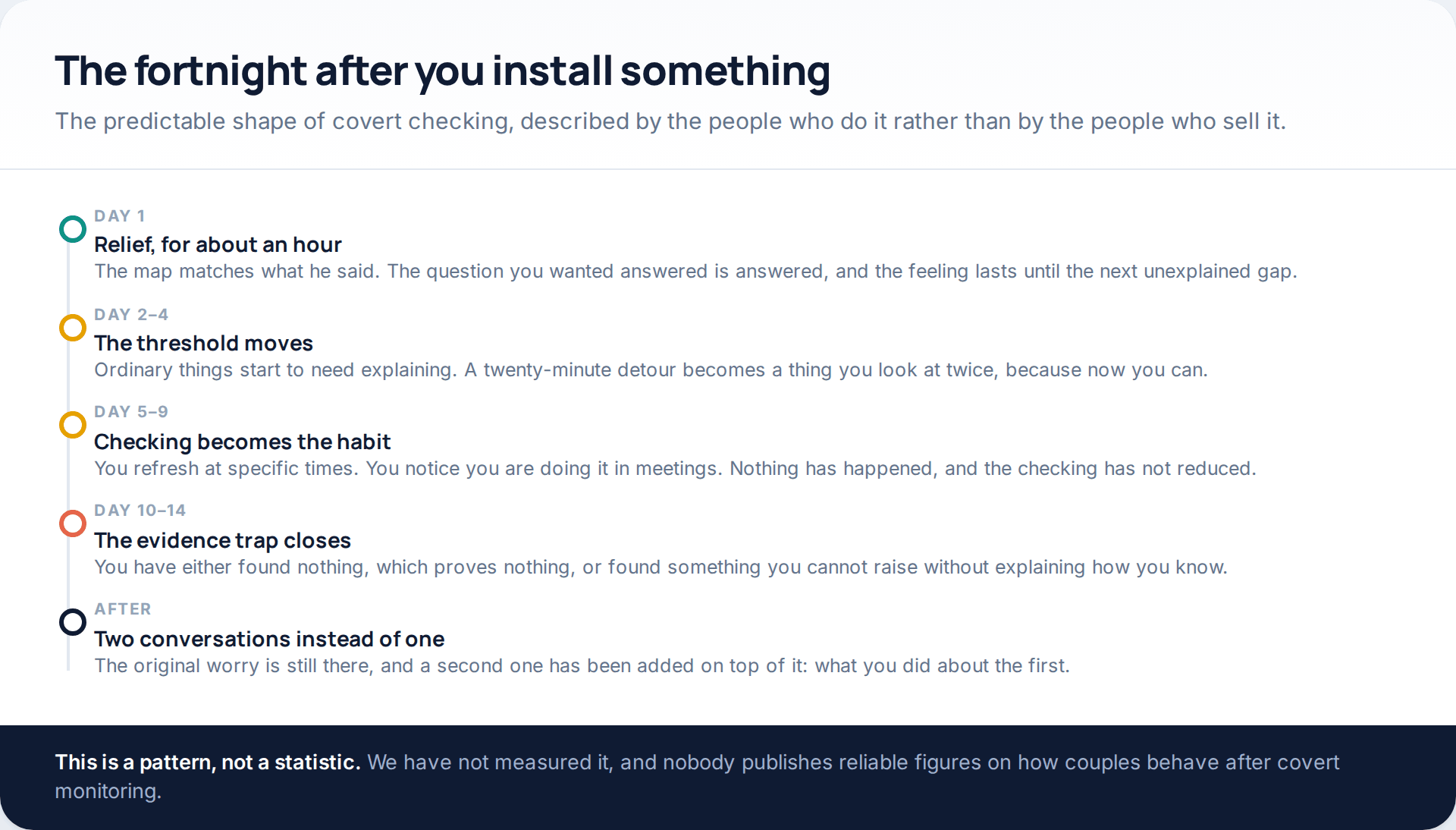
The trap at the end deserves spelling out, because it catches people who were right as often as people who were wrong. If the readings are unremarkable, you have no new information and no relief. If a reading is alarming, you cannot raise it without disclosing how you came by it — and the moment you do, the conversation stops being about his Thursday evening and becomes about your software. You will have handed over the moral high ground at exactly the point you needed it.
There is a practical version of this problem too. If a relationship is heading towards separation and children are involved, material gathered covertly has a habit of damaging the person who gathered it rather than the person it was gathered on. England’s Family Justice Council, publishing guidance on covert recordings in children proceedings in May 2025, noted that courts have treated the act of recording a partner in secret as capable of amounting to intimidation and abuse in itself — quite apart from whatever the recording showed.
The conversation that replaces it
This is the part people skip, usually because they expect it to go badly. It often goes badly when it is opened as an accusation, and much better when it is opened as a disclosure.
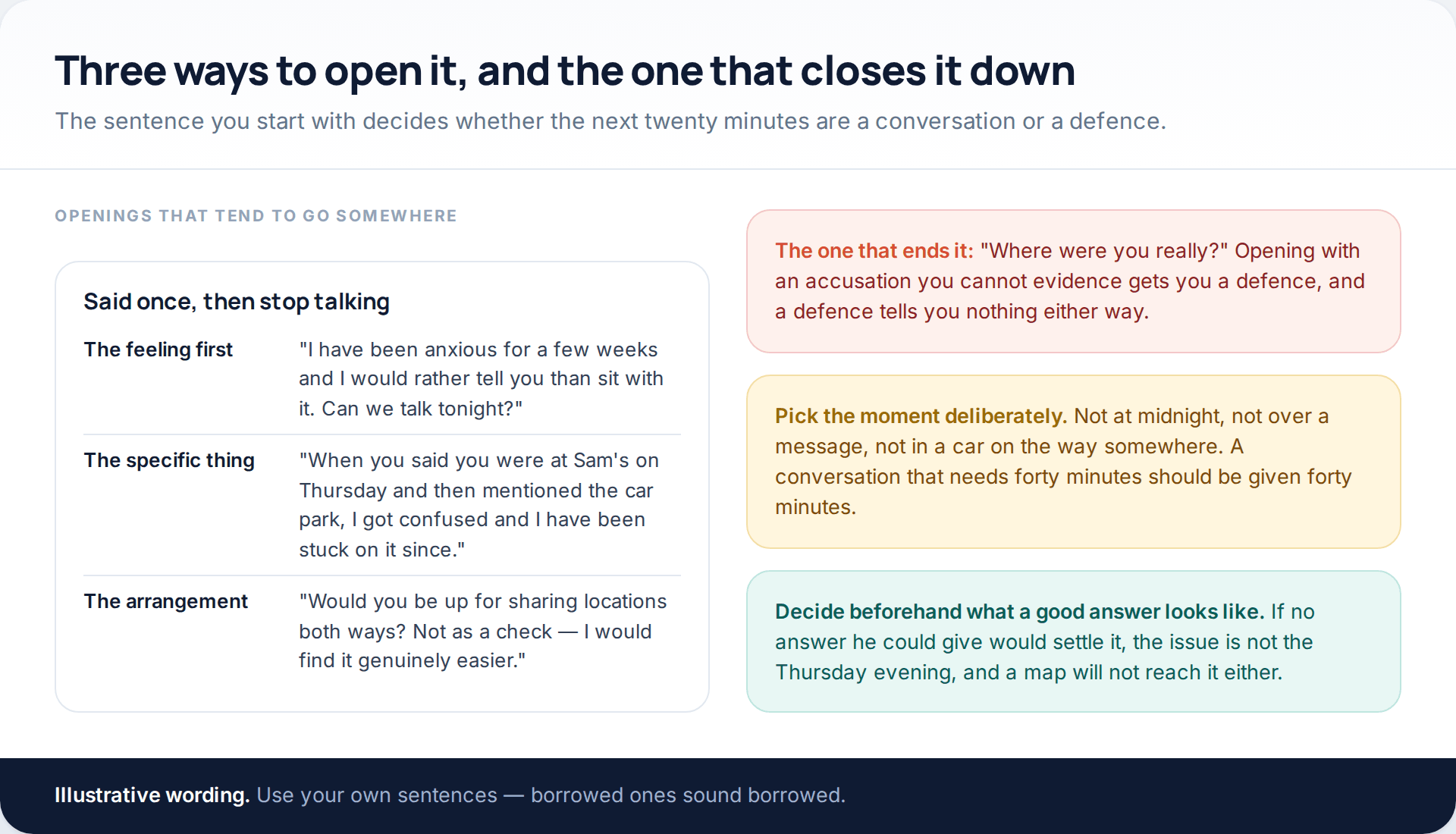
Say the thing, then stop
Name what you felt and when, in one or two sentences, and then be quiet long enough for a real answer. The urge to keep adding qualifications is strong and it converts a conversation into a case for the prosecution. If the answer is confusing, say that it is confusing rather than reaching for a theory.
Know what you are listening for
Decide in advance what would settle it. If nothing he could possibly say would make a difference, you have learned something important: the problem is not located in the facts, and a map was never going to help. That might point towards couples counselling, or towards the conclusion that this relationship has run its course — both of which are real answers, and both of which beat a fortnight of refreshing a screen.
Sharing both ways, if you both want it
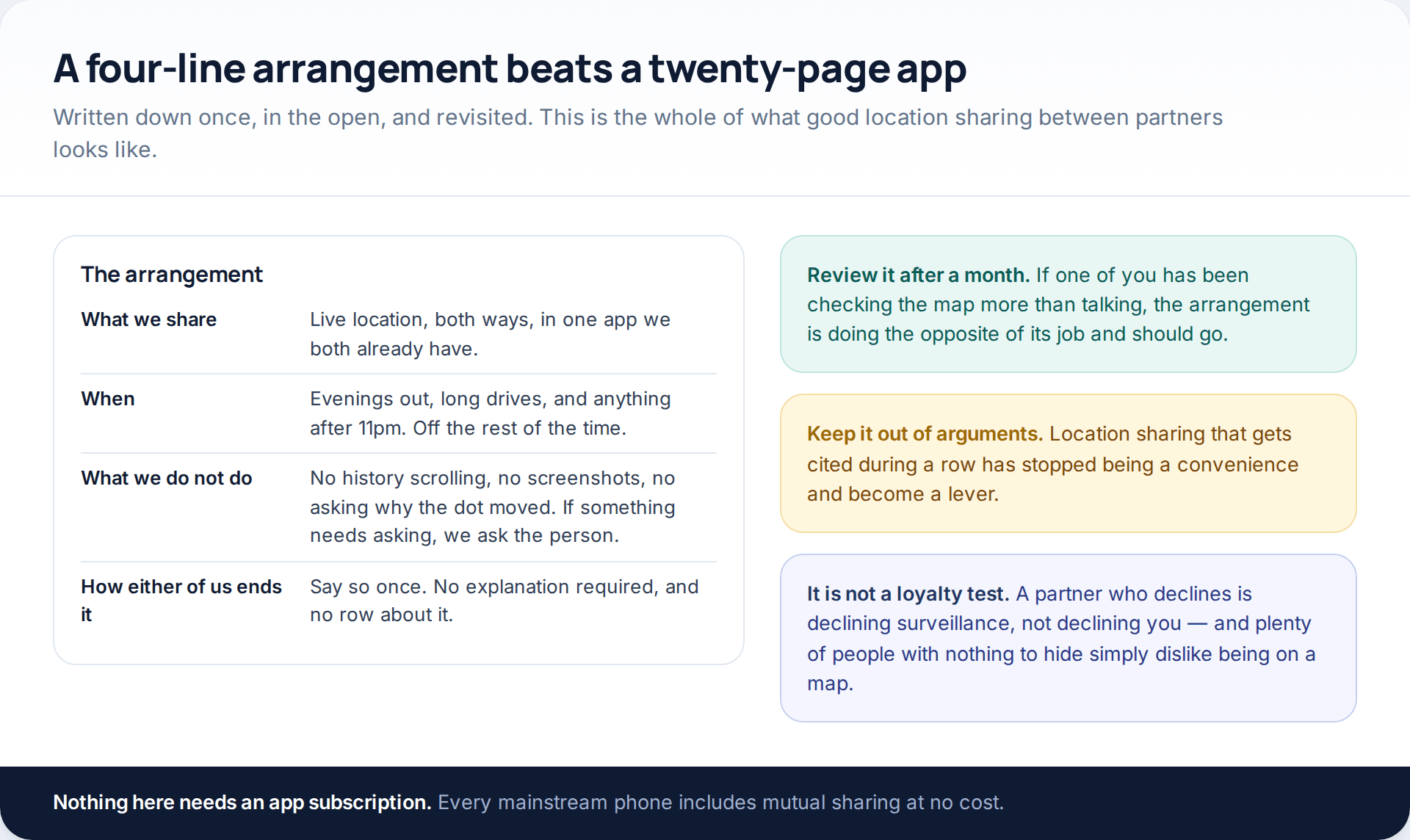
Plenty of couples share locations permanently and are entirely relaxed about it. It works when three conditions hold: it runs in both directions, both people chose it while calm, and either of them can switch it off without a row.
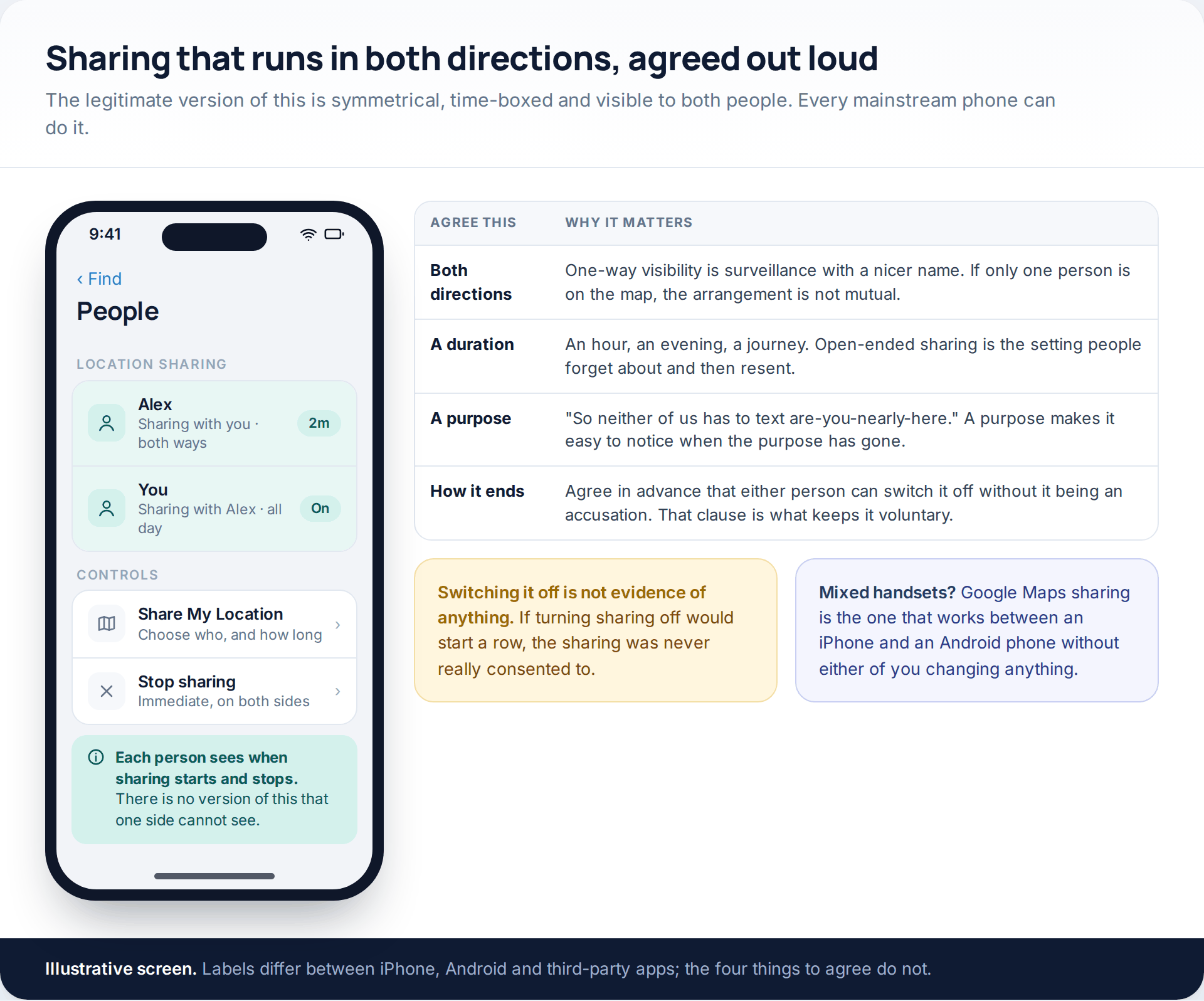
The mechanics are the same on every platform. On iPhone, sharing lives in the Find My app under the People tab, where you pick a person and a duration — an hour, the rest of the day, or open-ended. On Android, Find Hub and Google Maps both offer person-to-person sharing with the same three choices, and Google Maps works across iPhone and Android, which makes it the usual answer for a mixed-handset couple. Labels shift between versions, so if a screen is not quite where this describes, search the app’s settings for “share”.
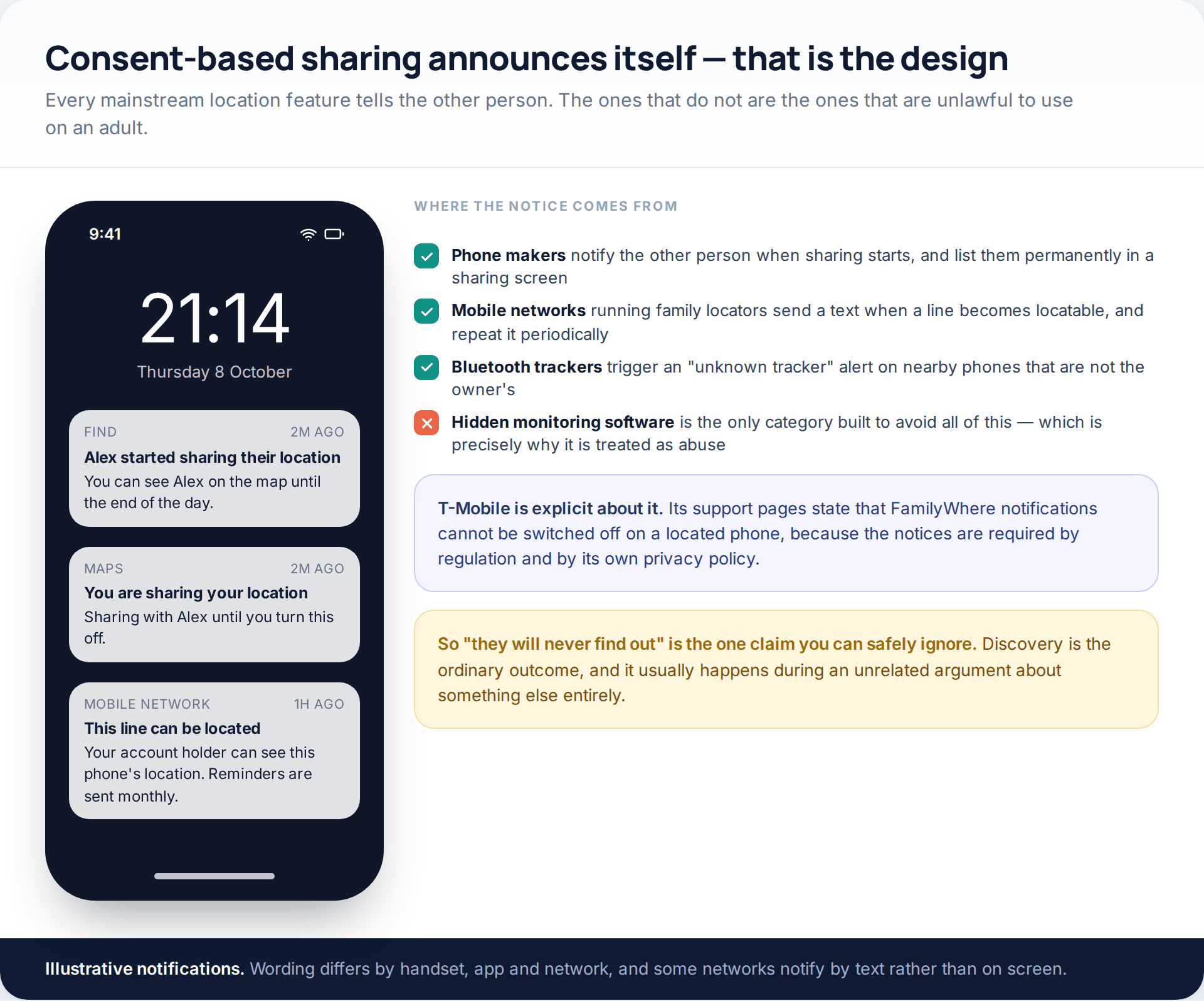
Notice what all of these have in common: the other person is told. Apple and Google both notify when sharing begins and keep a permanent list of who can see you. Mobile networks that offer family locators send a text to the located line, and T-Mobile states in its own support documentation that those notifications cannot be disabled, because regulation and its privacy policy require them. Even Bluetooth tags now raise a “tracker travelling with you” alert on nearby phones; Google and Apple shipped that cross-platform in May 2024, on Android 6.0 and later and on iOS 17.5.
If you want a longer discussion of where the boundaries sit — how often is too often to look, what to do when one person wants it and the other does not — we wrote that up separately in location sharing etiquette for families and couples.
If you are the one being tracked
Some people arrive at a page like this from the opposite side: not wondering whether to track a partner, but wondering whether a partner is tracking them. The signs are mostly behavioural rather than technical — he knows things he should not, he is unbothered by details you never told him, he reacts to your phone being off.
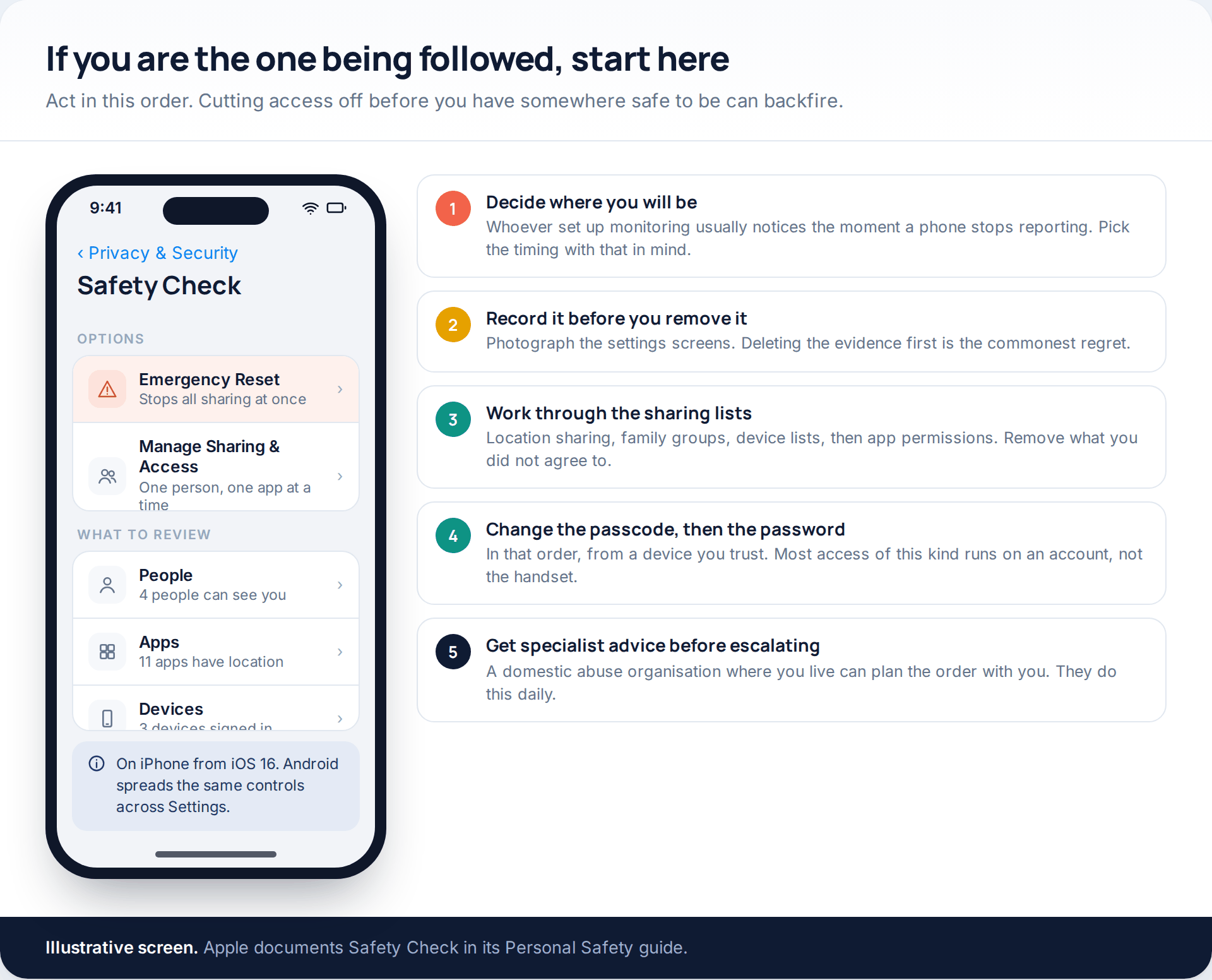
Two things are worth saying before you touch any settings. First, removing monitoring is noticeable: whoever set it up generally sees the moment it stops, so the timing is part of the plan rather than an afterthought. Second, screenshots of what you found are worth more than the satisfaction of deleting it, particularly if this ever becomes a police or court matter.
The technical steps — permissions, device lists, profile checks, account sessions — are laid out in detail in our guide to stopping someone tracking your location. If the person tracking you is someone you live with, read that alongside advice from a specialist domestic abuse service in your country rather than on its own.
If the worry is safety rather than suspicion
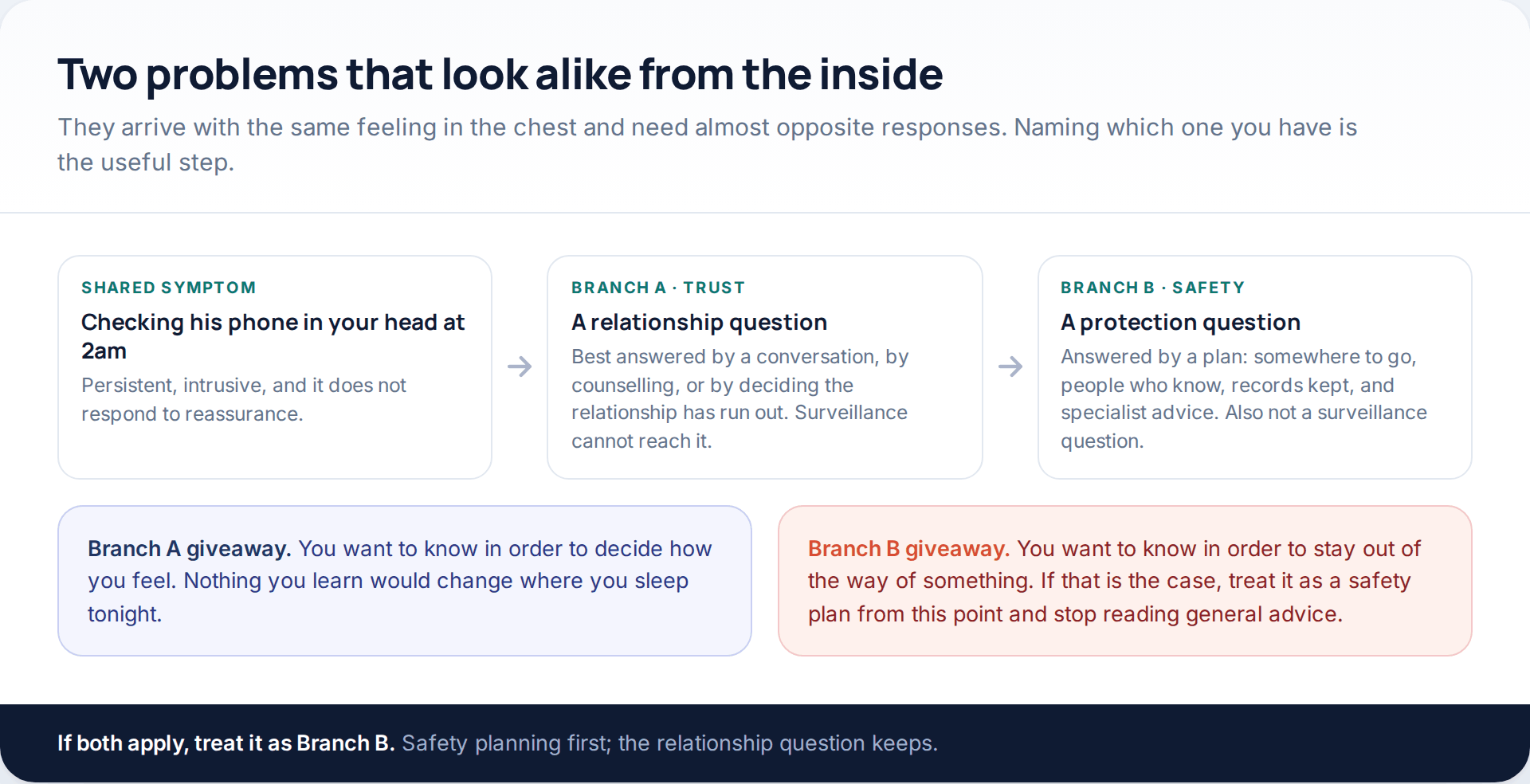
If any part of your reason for wanting to know where he is involves staying out of his way, avoiding his temper, or predicting an arrival, that is a safety question and it should be treated as one from this point. Surveillance is a poor tool for it and a dangerous one if discovered.
How this page was put together
The platform behaviour described here was checked in October 2026 against Apple’s Find My and Personal Safety documentation, Google’s Find Hub and Maps location-sharing help pages, and T-Mobile’s published support article on FamilyWhere, which is where the statement about non-disableable notifications comes from. The cross-platform unwanted-tracker alerts were announced by Google and Apple in May 2024 for Android 6.0 and later and iOS 17.5. The point about physical access comes from AV-Comparatives’ stalkerware test published in 2025, which assessed seventeen commercial monitoring apps on an Android 15 handset in September of that year.
We have deliberately not quantified the behavioural material. The fortnight timeline is a described pattern, not a measured one, and we have not invented percentages for how often covert monitoring is discovered or how relationships fare afterwards, because no reliable public figures exist. Nor have we named any of the sites selling number-lookup “tracking”, since the brands rotate faster than any page can keep up with. Nothing here is legal advice; the legal position varies considerably between countries and sometimes between states within one country.
If what you actually need is the law rather than the decision — which offences are in play, and what happens to covertly gathered material if a relationship ends up in court — that is set out in the consent rules for tracking a partner’s phone.
Questions people ask
Is it illegal to put a tracking app on my boyfriend’s phone?
In a great many places, yes. Depending on the country it can engage criminal surveillance-device law, stalking or harassment offences, controlling-or-coercive-behaviour provisions, computer-misuse law for accessing his accounts, and data protection or privacy claims on the civil side. It is not legal advice, but the safe assumption is that doing this to another adult without agreement is unlawful where you live.
Can I find his location just from his phone number?
No. Services claiming this send a text containing a link and report a position only if he taps it — so he knows, and the result is a one-off reading rather than ongoing tracking. Networks can locate handsets, but they do so for emergency services under legal process, not for the public.
What if we share a phone plan? Does that make it allowed?
Paying the bill is not the same as consent to be located. Network family locators are built on that assumption, which is why they text the located line when it becomes locatable and repeat the reminder. Being the account holder changes who can use the feature, not whether the other adult is told.
He has location sharing switched on with me already. Can I just check it constantly?
You can, and it tends to go badly. Sharing agreed for convenience turns into something else when it is used for monitoring, and most people can feel the difference well before they can name it. If you are checking in a way you would not want described out loud, the arrangement needs a conversation rather than more refreshing.
What if I am certain he is lying?
Then the question is what you want to do about a relationship in which you believe you are being lied to — which is a decision you can take without proof, and which people take every day. A map would at best confirm a feeling you already have, and at worst hand him a legitimate grievance in the middle of your own.
Would a private investigator be any different?
Legally, not necessarily. The German Federal Court of Justice held in 2013 that detectives who fitted covert GPS trackers to vehicles, including in infidelity cases, had committed a criminal data-protection offence except in near-emergency circumstances. Hiring the act out does not reliably make it lawful.
How do I know if he is tracking me?
Look for behaviour first: knowledge he should not have, indifference to information you never gave him. Then check the sharing lists on your phone, the devices signed into your accounts, your app permissions and any device-administrator entries. Do it when you are somewhere safe, photograph what you find before you change it, and get specialist advice if you live with him.
Using a monitoring app for this? GuestSpy is parental monitoring for Android that stays visible on the child's phone and runs from any browser. If it fits your family, see the Location & Places feature.
Related guides
Track SMS Messages: Free SMS Monitoring Apps for Parents, Compared
You cannot track SMS messages on a child’s phone from your own phone alone, and no free app changes that.…
Track an Android Phone From Another Android Phone: Three Family-Safe Methods
To track an Android phone from another Android phone, you need one of three things arranged in advance. Find Hub…

Best 10 Free SMS Tracker for Android and iPhone
Earlier, when there we no messenger apps, people used to rely on text messages. Although time and technology are changing,…
Monitoring your child can see.
Location, screen-time budgets, routines, app and website blocking and the alerts that matter, run from any browser and visible on the phone. Pair an Android phone in about fifteen minutes.