A Parent’s Guide to Screen Time by Age
What's generally reasonable at each age band, from toddlers to older teens, and what tends to matter more than the raw number of minutes.
 By GuestSpy Editor · Founder and editorPublished September 10, 2026Updated September 14, 202611 min read
“How much screen time is too much?” is the question every parent eventually asks, and it rarely has a single satisfying number attached to it. A ninety-minute video call with a grandparent and ninety minutes of scrolling alone at midnight are both “screen time,” and they are not remotely the same thing.
This guide sets out general, sensible starting points for screen time by age, from toddlers through to older teenagers, along with what tends to matter more than the raw total at each stage — sleep, homework, who they’re talking to, and how much of it happens alone. None of this is medical advice, and it isn’t meant to replace your own judgement about your own child. Use it as a starting conversation, not a rulebook.
Why age bands, not a single rule
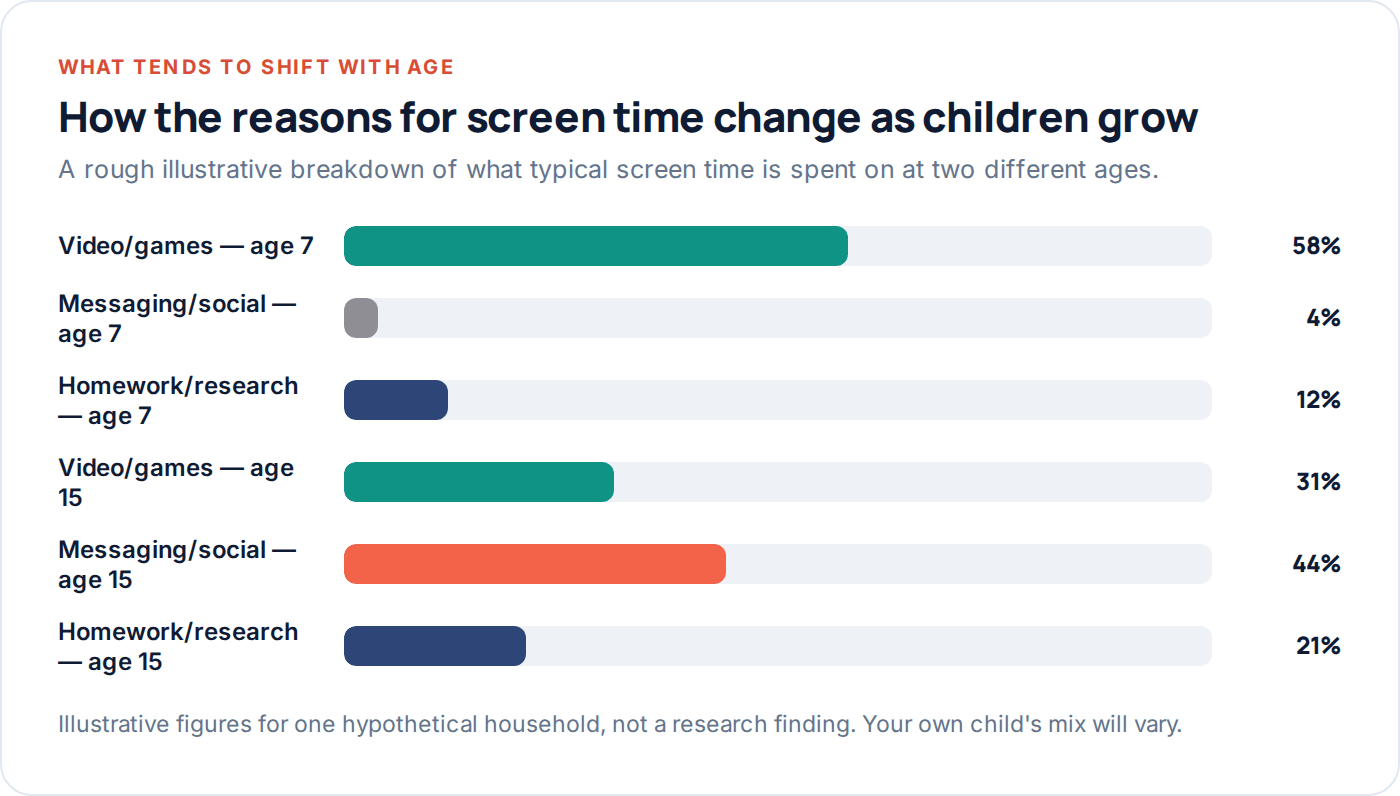
Any single number applied to “children” as a whole is going to be wrong for most children, because a six-year-old and a sixteen-year-old are using the phone or tablet for completely different reasons. The six-year-old is mostly watching or playing something chosen for them. The sixteen-year-old is doing homework, coordinating with friends, applying for a part-time job and, yes, also watching things — often on the same device, sometimes in the same hour.
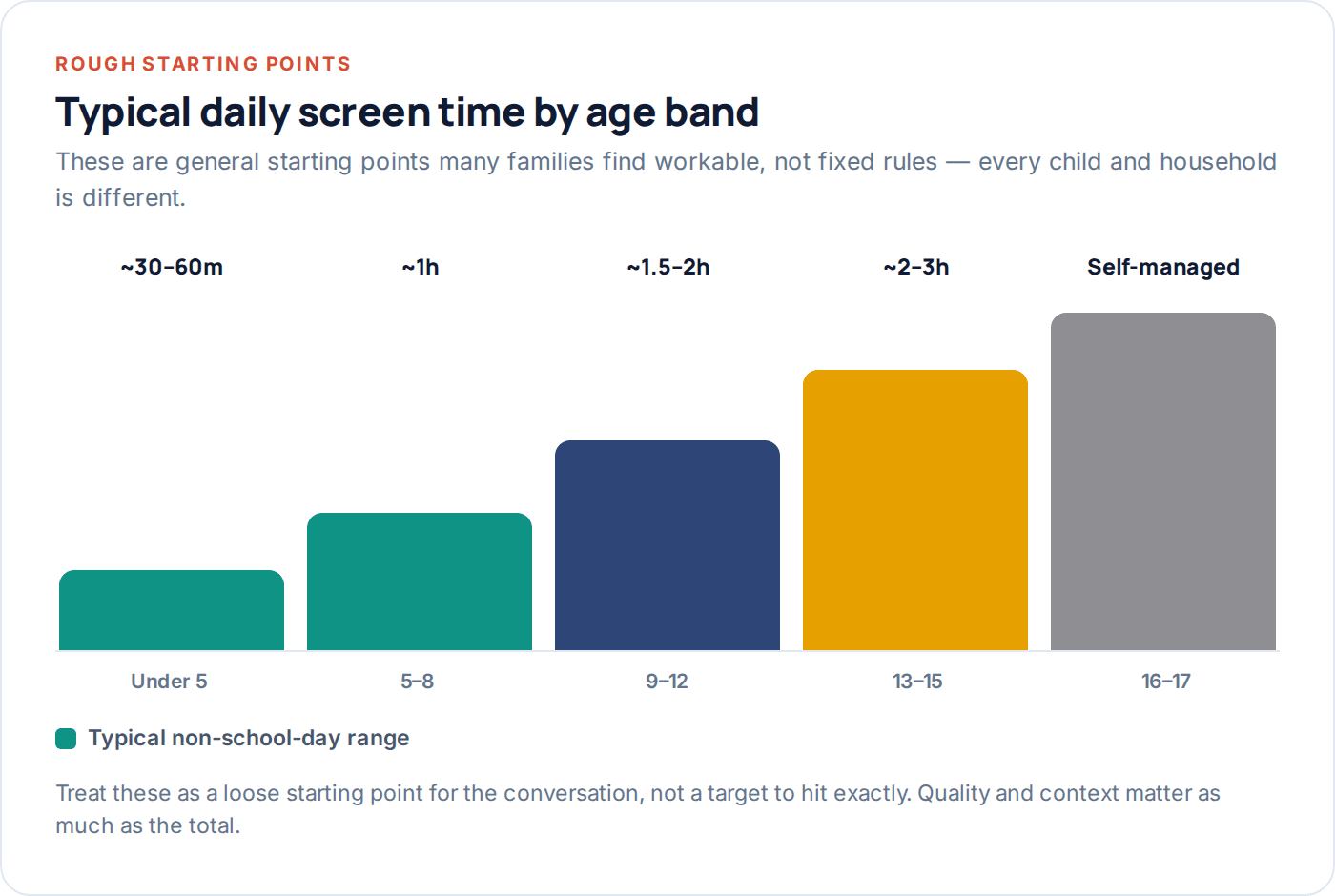
The bands below are general starting points that many families find workable, drawn from typical patterns rather than a fixed formula. Your own child, your own household routine, and your own judgement should carry more weight than any chart. If your ten-year-old reads for two hours a day on a tablet and it isn’t displacing sleep, friendships or homework, that is a different situation from two hours of unstructured video with no context — even though both are “two hours.”
Under 5
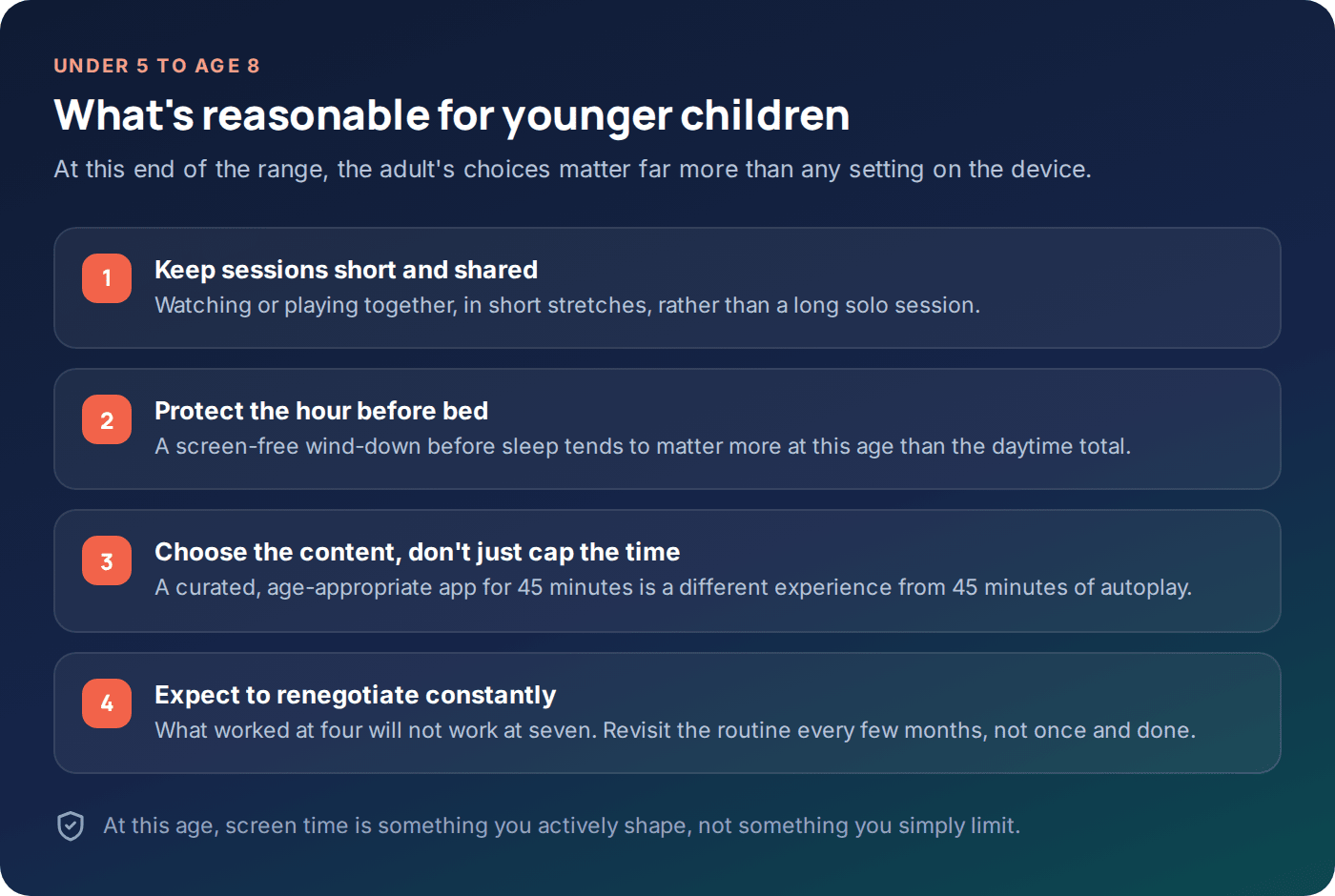
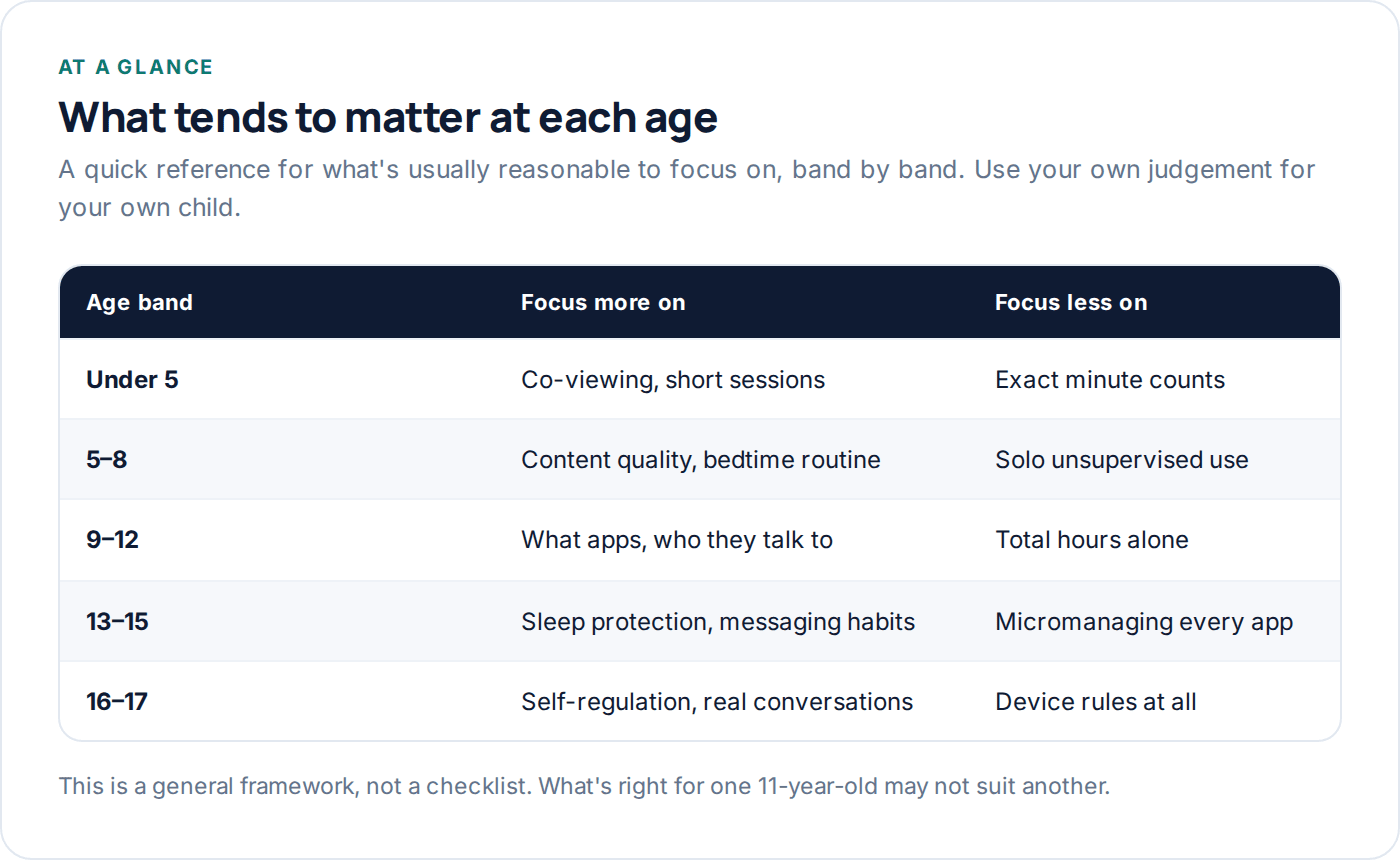
At this age, screen time is something you actively shape rather than something you simply cap. What is on the screen and whether you are alongside them tends to matter more than the exact number of minutes on the clock. Short sessions, ideally shared or at least chosen by you rather than autoplay, work better than a long solo stretch — not because of a fixed rule, but because a toddler or preschooler has very little ability to self-regulate a stopping point.
Many families find something in the region of thirty minutes to an hour on a typical day workable at this age, often built around a specific programme or app rather than open-ended browsing. That is a starting point, not a target — a longer session on a rainy day, or a shorter one on a day full of other activity, is normal and not something to worry about.
What actually matters more than the number
Protecting the hour before bed from screens tends to make the biggest visible difference at this age — many parents notice settling to sleep gets easier when that window is screen-free. Co-viewing, where you’re at least glancing at what’s on rather than handing over a device and walking away, also lets you catch anything unsuitable before it becomes a pattern.
It’s also worth resisting the urge to treat every screen as equal. A video call with a grandparent, a drawing app, and an autoplay queue of unrelated clips all count as “screen time” in a stopwatch sense, but they are very different experiences for a three-year-old. If you only have the energy to change one thing at this age, turning off autoplay and picking a specific programme in advance tends to do more than trimming five minutes off the total.
Ages 5 to 8
This band is still largely about the adult’s choices — what app, what programme, what time of day — but the child starts to have real opinions about it, and increasingly some unsupervised time, whether on a family tablet or their own device. A rough daily figure many families land on is around an hour on school days, more at weekends, though the type of activity still matters more than hitting a precise number.
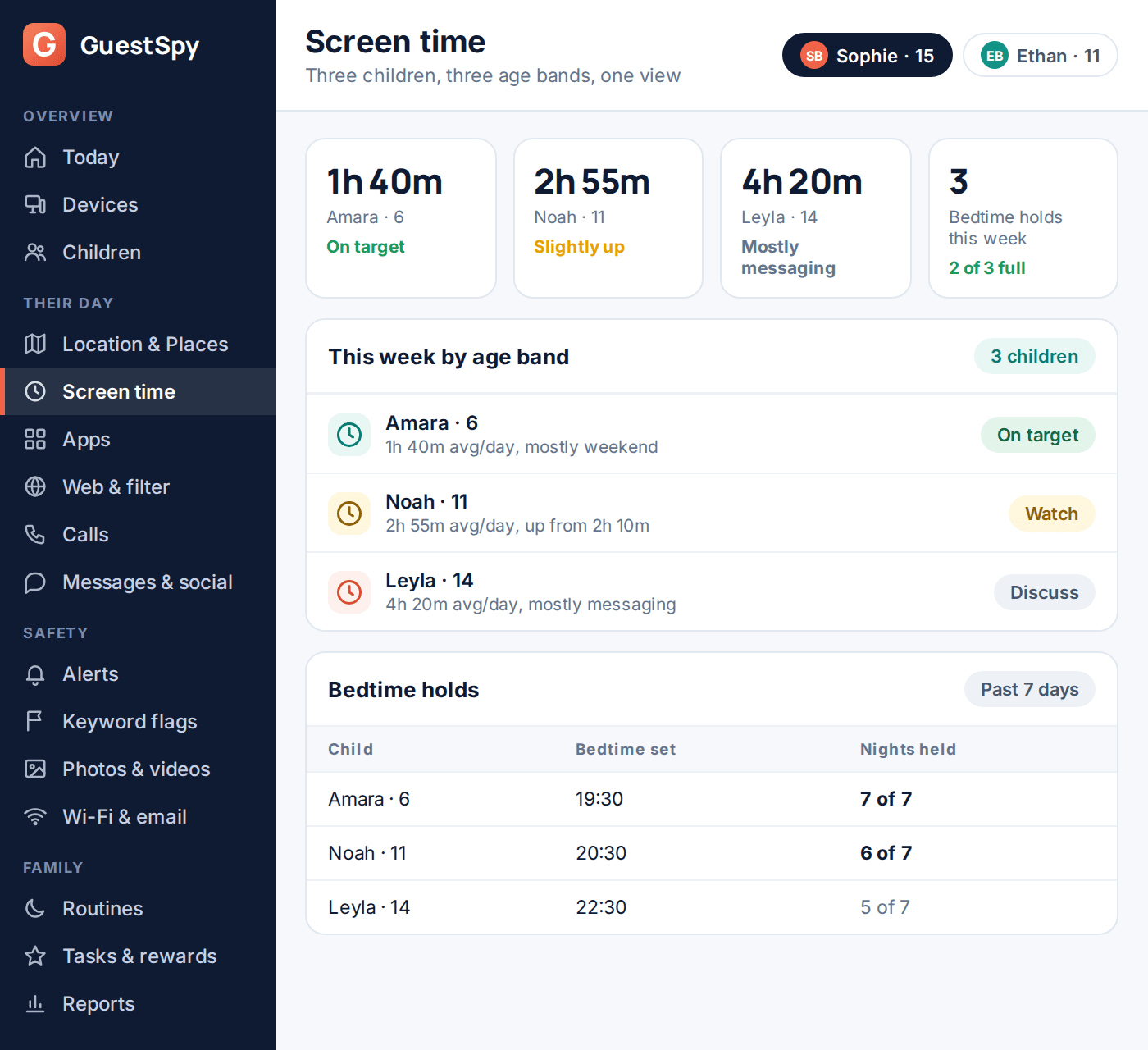
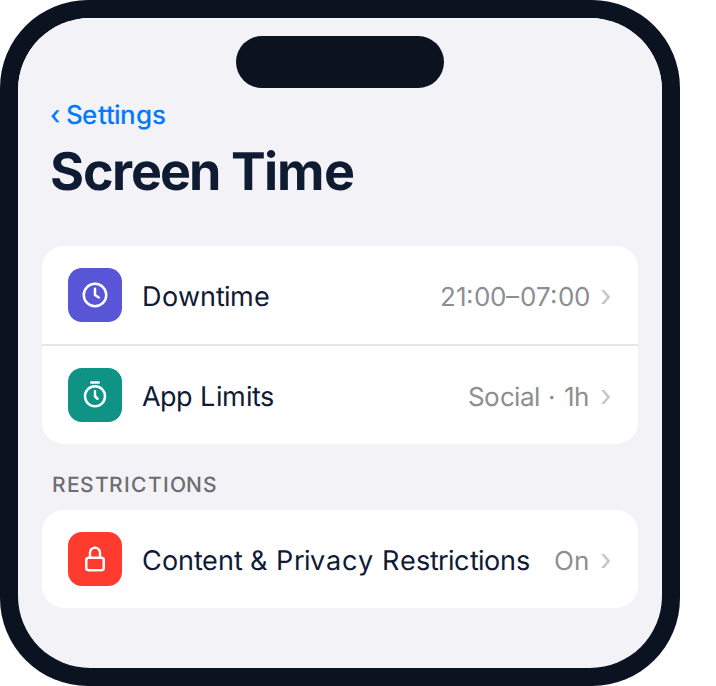
This is a reasonable age to introduce the idea of a routine rather than a rule imposed with no explanation — “screens go off after this show, then it’s dinner” is something a seven-year-old can understand and, over time, start to expect rather than fight. It’s also a sensible age to start a basic device-layer setup: a bedtime downtime window and a simple content filter, more to reinforce the routine than to police it minute by minute.
Ages 9 to 12
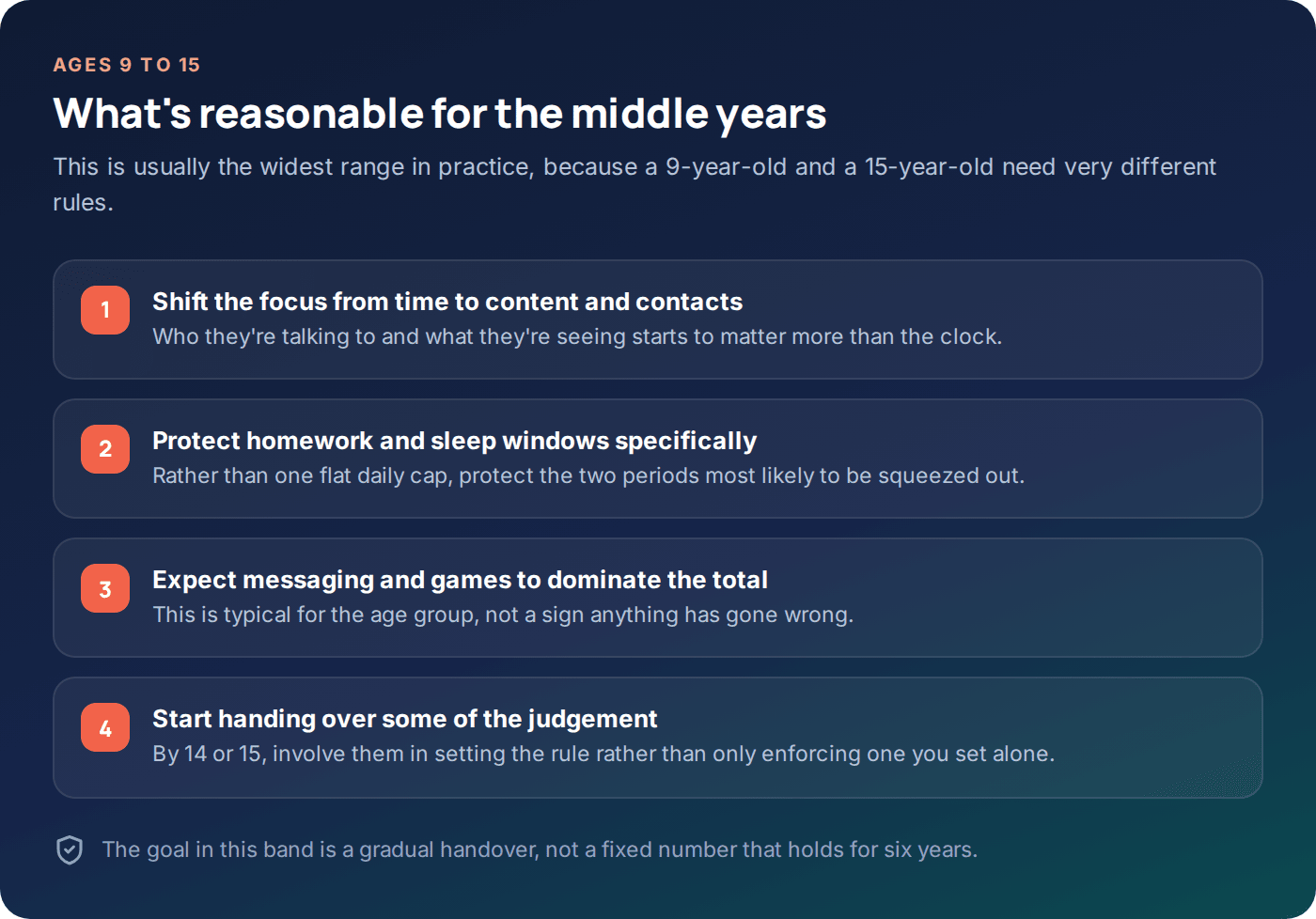
Somewhere in this band, screen time starts shifting from “what they watch” to “who they talk to and what they see” — a more useful thing to pay attention to than the total. Games with voice chat, group messaging, and the first social apps tend to appear here, sometimes earlier than parents expect. Many families find a total in the region of ninety minutes to two hours workable on school days, with more flexibility at weekends, but the specific number matters far less than what’s actually happening during that time.
Worth more attention
New contacts appearing in a group chat, a game that involves talking to strangers, screens replacing sleep on a school night.
Usually fine
A long-running game with friends they know from school, video calls with family, time spent on a creative or research app.
Worth setting up
Basic app time limits, a bedtime downtime window, and a simple conversation about what to do if a stranger messages them.
This is also a common age to introduce a monitoring layer if you’re going to at all — not because something has gone wrong, but because a child’s online contacts are starting to extend beyond people you already know.
Ages 13 to 15
Screen time usually climbs noticeably in this band, and messaging and social apps typically become the largest single category — a shift worth expecting rather than resisting outright. A number in the region of two to three hours on a school day is common in practice for this age group, though the range between individual teenagers is wide, and a lot of that time genuinely is homework, coordination with friends, or downtime that would otherwise be spent on a different device entirely.
The more useful things to watch at this age are less about the total and more about pattern: is sleep being pushed later and later by the phone, is homework genuinely getting done, and is messaging one specific friend group or drifting toward people they’ve never met. A hard total-hours cap tends to generate more conflict than benefit at this age without necessarily addressing any of those underlying questions.
What’s reasonable to still hold firm on
A bedtime downtime window remains one of the highest-value, lowest-conflict rules through this whole band — most teenagers, even while grumbling about it, don’t seriously contest “phone stays out of the room after 10.” What tends to work less well at this age is close message-by-message monitoring; it rarely improves safety and reliably damages trust.
Ages 16 to 17
By this stage, the honest goal is a teenager who can manage their own screen time without you, because that is precisely the skill they will need in a matter of months regardless of what rules are still in place. Formal limits at this age tend to do less than an ongoing, low-key conversation about sleep, workload and how they’re feeling about their own habits.
Most families find that by 16 or 17, device-level restrictions have mostly been switched off, with perhaps a shared understanding about phones at the dinner table or before exams, and location sharing kept on more as a mutual safety arrangement than a monitoring tool. If you are still running a tight downtime schedule and app caps at this age, it’s worth asking what specific problem it is solving — and whether a conversation would solve it just as well.
Quality versus quantity
Across every age band above, the type of screen time carries more information than the total. Two children with an identical two hours a day can be having very different experiences of it — one on a video call with a grandparent and drawing in an art app, the other alone, switching restlessly between apps late into the evening.
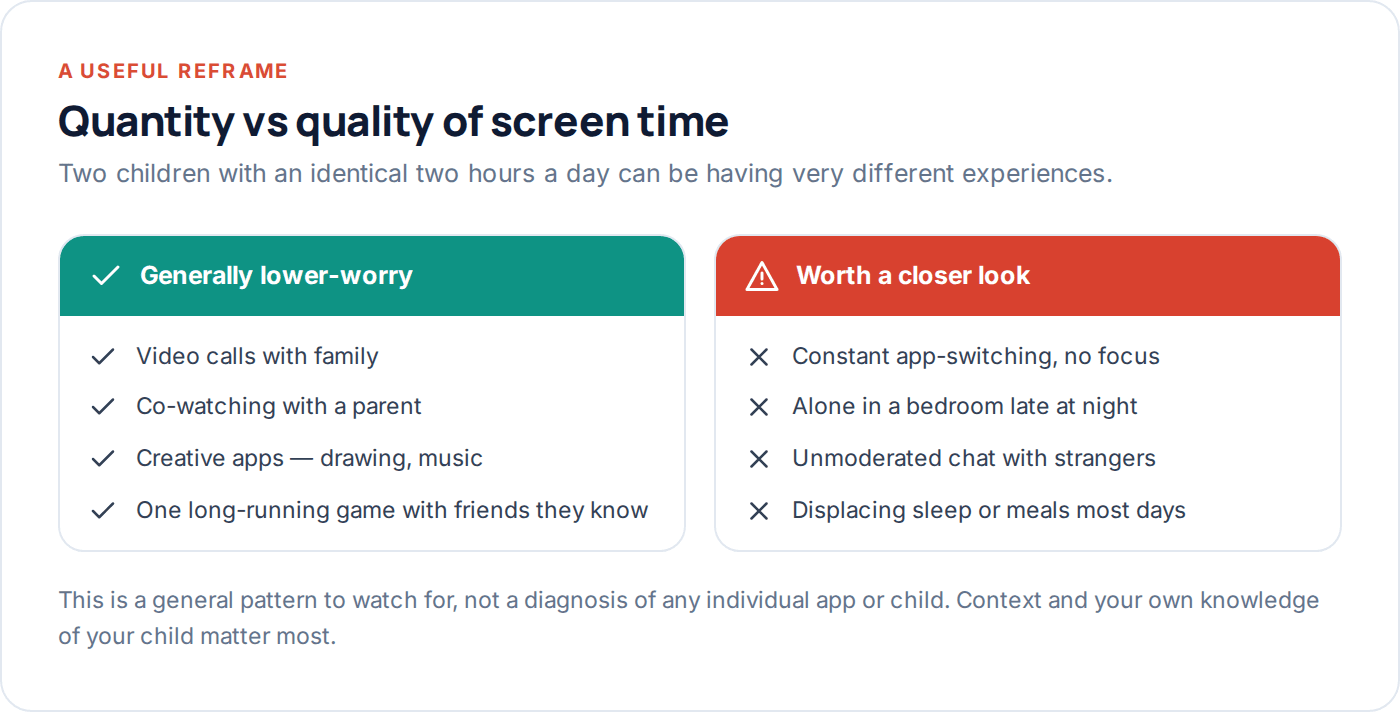
None of the categories above are a diagnosis, and plenty of ordinary, healthy screen time falls into the “worth a closer look” side occasionally — a late night before a sleepover, an intense phase with one game. What’s worth paying attention to is a pattern that persists: the same warning signs showing up week after week, not a single evening.
Sleep and homework: the two to protect
If you protect only two things across every age band, protect sleep and homework time specifically, rather than trying to police the total. A flat daily cap can still leave a child up until 1am on a night with no school the next day, while a protected bedtime window achieves the actual goal directly.
The same logic applies to homework: rather than a vague “less screen time,” a specific device-free or app-limited homework window tends to be both easier to enforce and easier for a child to accept, because it’s tied to a concrete task rather than an abstract total.
What to loosen as they grow
The single most common mistake across every age band is setting a rule once and never revisiting it. A downtime window that made sense at nine is often far too tight at thirteen, and a total-hours cap that made sense at eleven usually needs replacing with something more targeted by fourteen or fifteen.
- Under 5 to 8: loosen the requirement for co-viewing as reading and comprehension develop, but keep the bedtime window firm.
- 9 to 12: loosen strict content whitelists as trust builds, shift attention toward contacts and apps rather than minutes.
- 13 to 15: loosen total-hours caps, tighten focus on sleep protection and message-alert-style safety nets instead.
- 16 to 17: loosen almost everything except a shared, mutual location arrangement, and hand the remaining judgement over.
Put a rough date in your calendar every few months to revisit whatever you’ve set up — our screen time features page and the device-level tools in GuestSpy both make it easy to adjust limits as your child grows, rather than starting from scratch each time.
A useful test, whatever age band you’re in: if you can’t remember the last time you changed a limit, it’s probably overdue for a look. Children rarely announce that a rule has become outdated — they just quietly work around it, which is a worse outcome for everyone than simply loosening it on purpose.
Questions parents actually ask
Is there an official recommended screen time limit by age?
Different health bodies have published different general guidance over the years, and none of it is a strict rule with the force of law. Treat any published figure as a loose starting point for your own family’s conversation, and speak to a GP or paediatrician if you have specific concerns about your own child.
My child is well over the “typical” number for their age — should I worry?
Not automatically. Context matters more than the raw total — a child doing homework, video-calling family and playing one long-running game with friends is in a different situation from the same number of hours spent passively scrolling alone. Look at sleep, mood and friendships before the clock.
Should the limit be the same for weekdays and weekends?
Most families find it reasonable not to be — a tighter figure on school days to protect homework and sleep, more flexibility at weekends. What tends to matter most is that bedtime stays protected on both.
At what age should I stop setting any limits at all?
There’s no fixed age, but by 16 or 17 most families have shifted from formal limits to an ongoing conversation, aiming for a young adult who can manage their own habits before they leave home.
What if siblings of different ages want the same rules?
It’s reasonable to explain that older children get different privileges as they’ve earned more trust and judgement over time — most children accept an age-based explanation more easily than they accept an unexplained difference.
Does the type of screen time really matter more than the amount?
In general terms, yes — a video call with a relative and an hour of solitary late-night scrolling are both “screen time” but are unlikely to have the same effect. Total minutes is the easiest thing to measure, which is why it gets the most attention, but it isn’t the only thing worth looking at.
Where to go from here
Pick the band closest to your child’s age, use the starting points above as a loose reference, and adjust for the child actually in front of you. If you haven’t yet set up the basic tools to enforce a bedtime window or a homework-time app limit, our Screen Time and bedtime routines guides walk through exactly how.
Whatever number you land on, expect to change it. The right amount of screen time for a nine-year-old is, almost by definition, the wrong amount for the fifteen-year-old they’ll become.
Using a monitoring app for this? GuestSpy is parental monitoring for Android that stays visible on the child's phone and runs from any browser. If it fits your family, see the Screen time & budgets feature.
Related guides

How to Talk to Your Kid About Screen Time
The conversation decides whether a screen time rule holds or gets fought over daily. Scripts by age, how to involve…

How to Block Adult Websites on Every Device at Home
No single setting blocks adult content everywhere. Here's the layer-by-layer setup — device, DNS, router, browser, console and TV —…
How to Set App Time Limits That Actually Stick
Category limits beat per-app limits, warnings beat sudden cut-offs, and a limit set without a conversation gets bypassed within a…
Monitoring your child can see.
Location, screen-time budgets, routines, app and website blocking and the alerts that matter, run from any browser and visible on the phone. Pair an Android phone in about fifteen minutes.