How to Talk to Your Kid About Screen Time
Ruby, sixteen, once described the moment a screen time conversation goes wrong as “the second it stops being about me and starts being about the phone.” Her parents had opened with a statistic about teenage phone use. She stopped listening at the word “studies” and the whole evening became a stand-off about a number neither of them fully understood.
Every parent who has tried to talk to your kid about screen time has some version of that story — a reasonable worry, delivered badly, that turns into a row about something else entirely. This guide is about the conversation itself: how to raise it without a fight, how to involve your kid in setting the actual rule, how your own phone use undermines or backs up what you’re saying, and what to do on the days it goes wrong anyway, because some days it will.

- Why this conversation blows up more than most
- Before you say anything: three things to decide first
- Scripts by age: six to seventeen
- Involving your kid in setting the actual rule
- Your own phone use is part of the conversation
- Screen-free zones that apply to everyone
- When it becomes a daily fight instead of a conversation
- Repairing it after a blow-up
- Questions parents actually ask
Why this conversation blows up more than most
Most household conversations are about behaviour. This one gets tangled up with identity, because for a lot of kids — especially teenagers — a phone is where their friendships actually live. Criticise the phone and it can land as criticising the friendships, or the person, rather than the amount of time.
It also tends to arrive at the worst possible moment: mid-scroll, mid-argument about something unrelated, or as a rushed comment on the way out the door. None of that is really about screen time — it’s about timing and delivery, and both are fixable without changing a single rule.
There’s a third reason it’s harder than most household conversations: it’s rarely a one-off. A conversation about bedtime is over once bedtime is agreed. A conversation about screen time reopens every time a new app arrives, a friend gets a phone earlier, or a school term changes the homework load — so the goal isn’t to win it once, it’s to build a way of having it again without dread on either side.
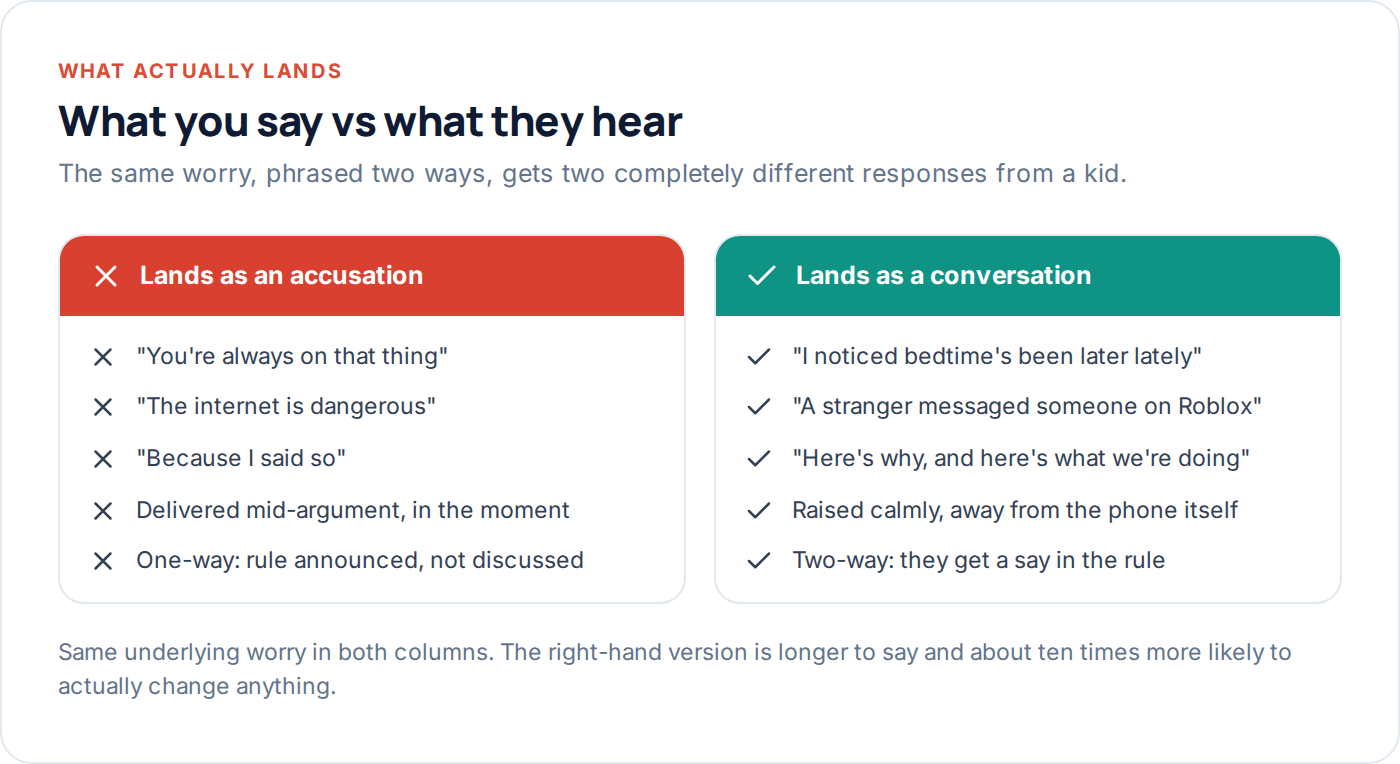
Before you say anything: three things to decide first
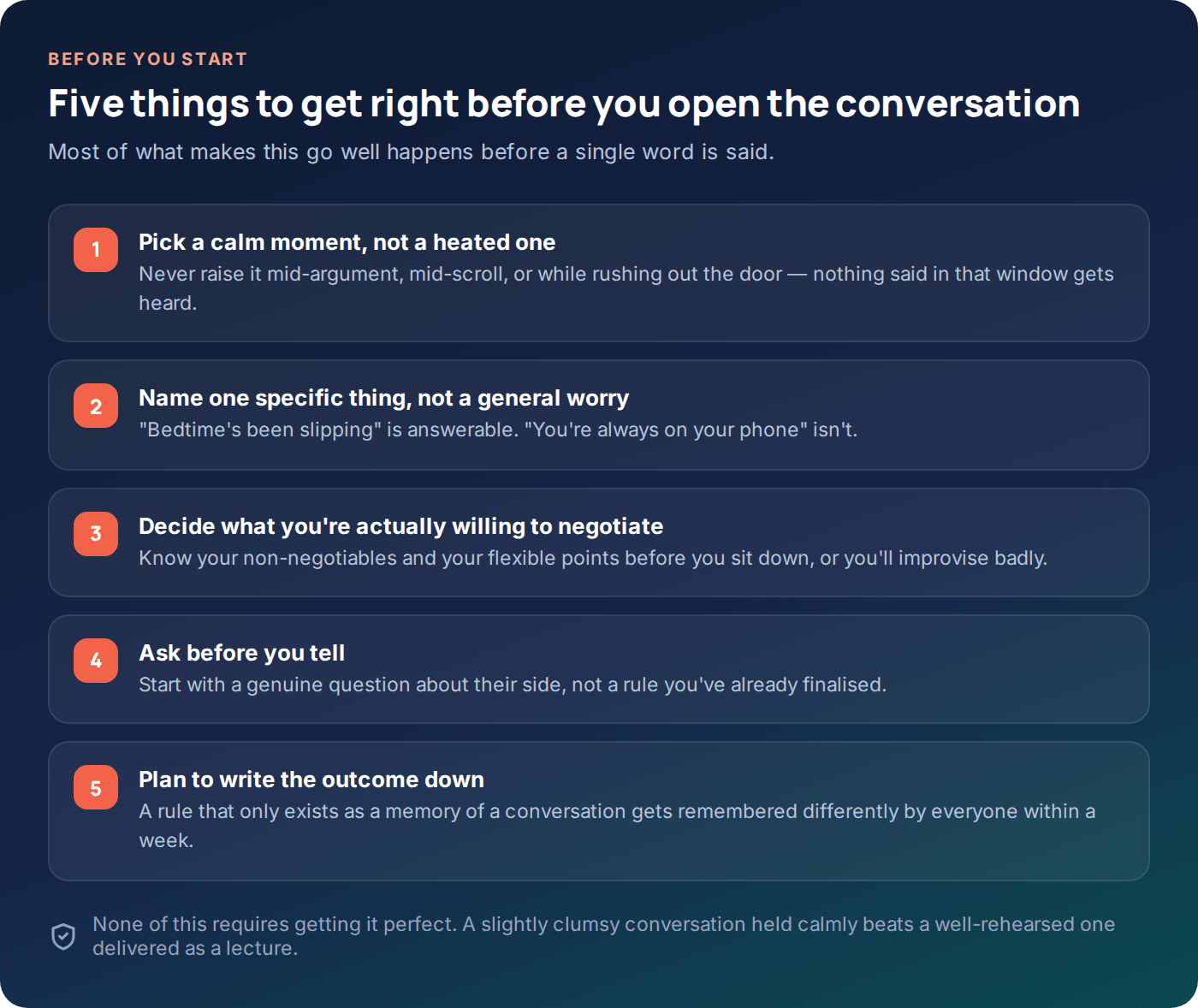
A conversation that goes well was usually prepared for, even briefly, rather than improvised in the heat of a moment. Three things are worth deciding before you open your mouth.
What’s the actual worry? “Bedtime’s been slipping for two weeks” is specific and answerable. “You’re always on that thing” is a mood, not a problem, and it invites a defensive response rather than a solution.
What are you willing to negotiate, and what isn’t up for discussion? Know this before you sit down. Deciding it out loud, in the moment, tends to produce a worse deal than either of you actually wanted.
How will you write down whatever you agree? A verbal agreement made once gets remembered differently by everyone within a fortnight. Decide in advance that the outcome goes somewhere shared — a note, a family calendar entry, an app both of you can check.
Scripts by age: six to seventeen
The shape of this conversation changes enormously by age, and using a teenager script on a seven-year-old — or vice versa — is a common way it goes sideways.
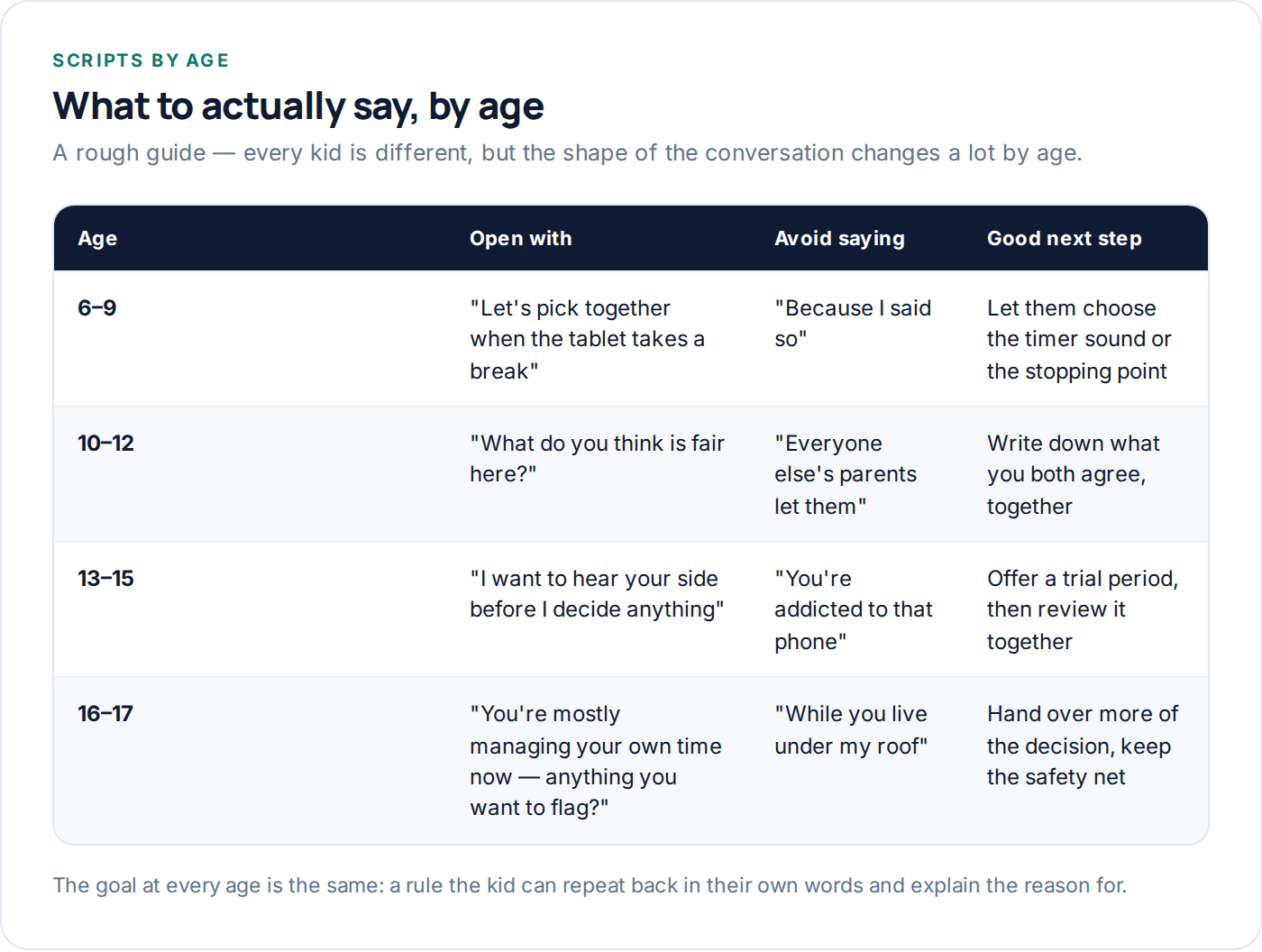
Six to nine
Young children generally aren’t negotiating a philosophy, they’re testing whether a boundary is real. Keep it short, concrete, and give them a small, genuine choice within it: “Tablet time ends when this timer goes off — do you want to pick the sound?” A choice about the mechanics, even a small one, does more here than a long explanation of reasons.
Ten to twelve
This is the age where “what do you think is fair?” starts to work as an actual opening question, not just a rhetorical one. They can usually propose something reasonable if you genuinely leave room for it — and a rule they helped write gets far less resistance than one delivered as a decision already made.
Thirteen to fifteen
Lead with listening, not with the rule. “I want to hear your side before I decide anything” signals that the conversation isn’t theatre — the outcome isn’t pre-written. This age group is highly sensitive to being talked at rather than talked with, and will disengage fast from anything that feels like a lecture.
Sixteen and seventeen
By now the conversation should mostly be a check-in, not a negotiation over control. “You’re managing most of this yourself — anything you want to flag, or anything you want more room on?” treats them as someone who’s nearly finished the job of managing their own time, because they nearly are.
Involving your kid in setting the actual rule
A rule a child helped write survives contact with real life in a way an announced rule doesn’t. This isn’t a soft parenting idea — it’s the single factor that shows up most consistently when families describe what actually reduced the daily argument.
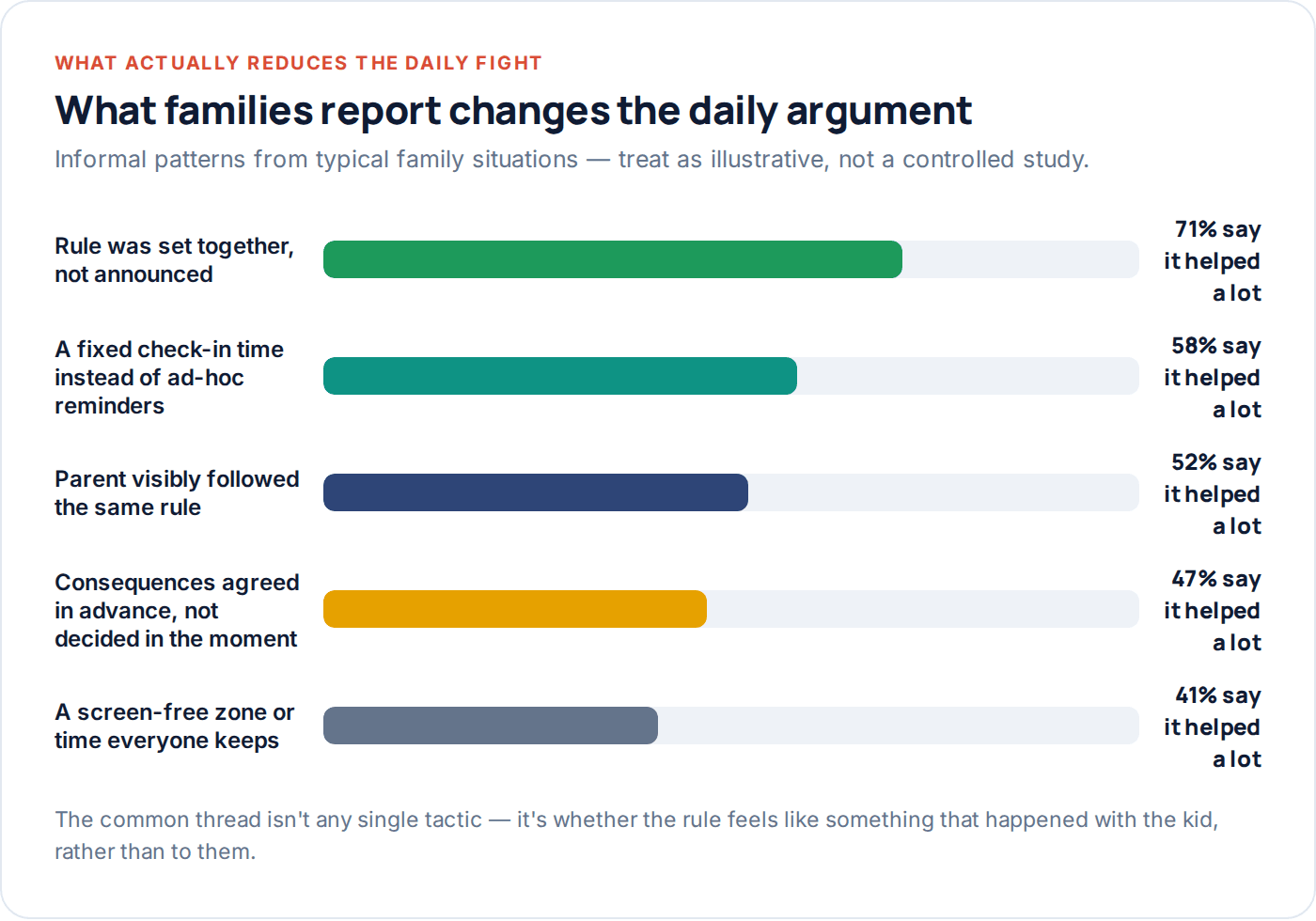
In practice this can be as simple as a ten-minute family check-in, roughly monthly, where the current rule gets read out loud, anyone can propose a change, and changes get written down rather than decided on the spot mid-request. Kids who have a real channel to ask for a change tend to stop testing the rule by breaking it, because there’s a legitimate route to the same outcome.
It helps to make the first version of the rule genuinely temporary — a two-week trial rather than a permanent decree. Framing it as an experiment you’ll both review, rather than a verdict, lowers the stakes of the initial conversation considerably, and gives everyone a built-in, non-confrontational moment to adjust it once you’ve both seen how it actually plays out day to day.
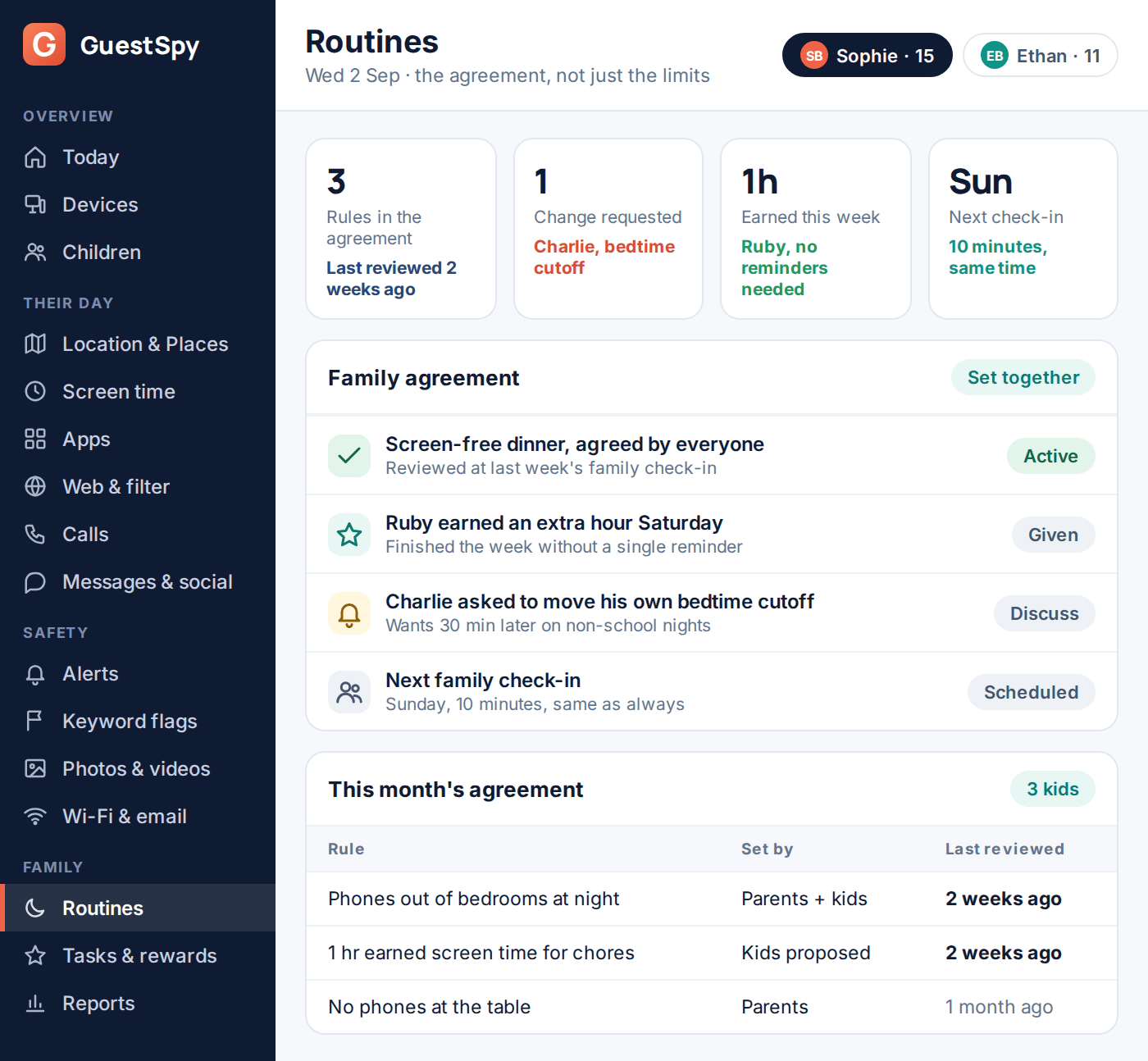
Your own phone use is part of the conversation
Almost every teenager can immediately name the moment their parent asked them to put the phone away while checking their own. It is, understandably, the single fastest way to lose credibility in this conversation, and kids notice it far more than parents assume.
This doesn’t mean parents need to be phone-free — that’s an unrealistic standard nobody actually holds themselves to. It means the same rules you’re asking for need to visibly apply to you where they overlap: phones off the dinner table for everyone, phones charging outside bedrooms overnight for the whole house, not just the kids’ rooms.
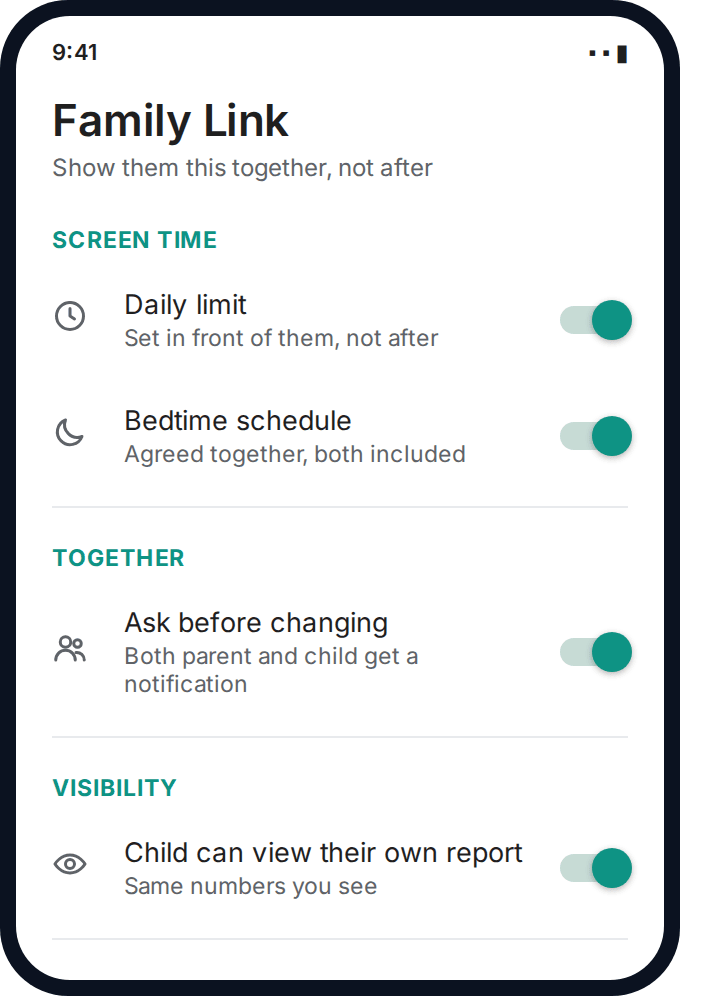
Screen-free zones that apply to everyone
A rule tied to a place or a time rather than a person is easier to keep and easier to defend, because it isn’t a judgment about anyone’s individual behaviour — it’s just how the house works.
The table
No phones during meals, for anyone. This is one of the easiest rules to keep precisely because it’s short, time-boxed, and applies equally.
The bedroom overnight
Phones charge in a shared space, not bedrooms. This one rule does more for sleep than almost any time limit, for kids and adults alike.
The first twenty minutes home
A short phone-free window after school or work gives everyone a chance to actually greet each other before the evening scrolls away.
Zones work better than blanket limits partly because they’re finite and easy to explain, and partly because — done properly — they cost the adults something too, which is exactly what makes them credible.
Pick one or two to start rather than declaring the whole house screen-free at once. A zone that’s actually kept, consistently, by everyone including the adults, does more for the household’s overall relationship with phones than three ambitious rules that quietly stop being followed within a fortnight.
When it becomes a daily fight instead of a conversation
If the same disagreement is happening every single day, the problem usually isn’t the rule itself — it’s that the rule has stopped feeling agreed and started feeling imposed, or the consequence for breaking it is being decided fresh each time, which invites negotiation on every single occasion.
The fix is almost always to step back and re-run the “before you start” section above, properly, rather than pushing harder on the existing rule. A daily fight is a sign the underlying agreement needs revisiting, not a sign you need to be stricter.
| What’s happening | Likely cause | What to try instead |
|---|---|---|
| Same argument, most evenings | Consequence decided in the moment, so it’s always up for debate | Agree the consequence in advance, in writing, once |
| They stopped explaining themselves, just get angry | They feel unheard, not just restricted | Next conversation, ask before you tell — genuinely |
| Rule keeps changing, seemingly on your mood | No written record, so both sides remember it differently | Write the current rule down somewhere shared |
| They negotiate every single limit individually | No fixed channel for change requests, so every moment becomes one | Set a regular check-in and route requests there instead |
Repairing it after a blow-up
Even a well-run version of this conversation goes badly sometimes. What matters more than avoiding that entirely is what happens in the hour and the day after.
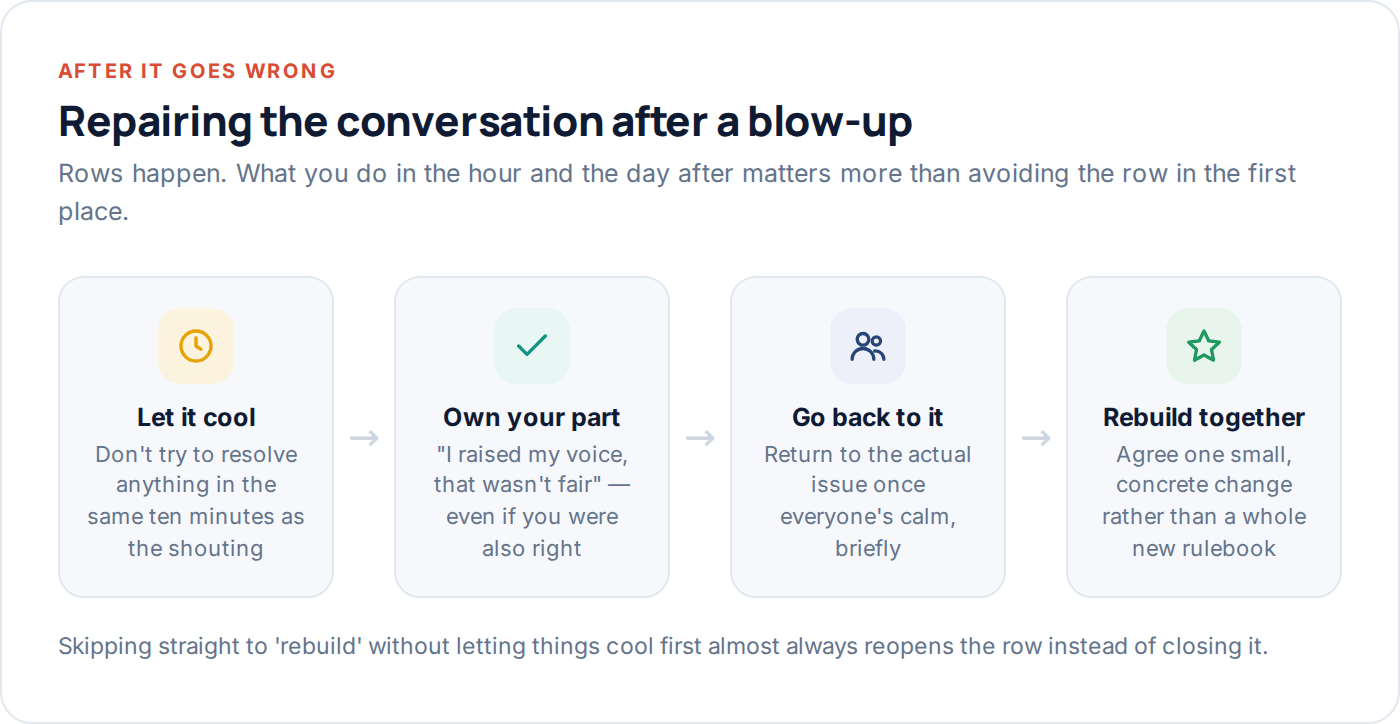
Let it cool before trying to fix anything — nothing said in the ten minutes after a raised voice tends to help. Own your own part specifically, even if you still think you were right about the underlying rule: “I raised my voice, that wasn’t fair” is a sentence that costs you nothing and buys back a lot of trust. Then go back to the actual issue once things are calm, briefly, and agree one small concrete change rather than trying to rebuild the whole rulebook in one sitting.
The repair doesn’t need its own big conversation. It needs to visibly happen, even in two sentences, rather than being left to fade and pretended away — kids notice the difference between a genuinely resolved blow-up and one that just got quietly dropped.
Questions parents actually ask
My child says I’m the only parent who limits their phone. How do I respond?
Ask what the actual limit is at their friends’ houses — it’s very often exaggerated in the retelling. Even where it’s true, “this is what our family does” is a complete and legitimate answer on its own, and doesn’t require winning an argument about fairness.
Should younger siblings get the same rules as older ones?
Not usually, and it helps to say so directly rather than pretending the rules are identical. “Your rules will loosen the same way theirs did, at your age” is honest and answers the fairness question without requiring identical treatment right now.
What if my teenager just refuses to engage in the conversation at all?
Don’t force it into one sitting. A short, low-pressure opening — “no pressure to decide anything now, just want to know your thinking” — followed by giving them real space, often gets further than pushing for resolution in one go. Some conversations genuinely need two attempts.
How often should we actually revisit the rules?
Roughly monthly works for most families — often enough that a rule doesn’t drift out of date, rare enough that it doesn’t feel like everything is permanently up for negotiation. A fixed, predictable time also means requests get routed there instead of raised constantly.
Is it okay to have different screen time rules for each child?
Yes, and pretending otherwise usually causes more arguments than it prevents. Different ages and different kids reasonably need different rules — what matters is being able to explain why, not making the numbers identical.
What if the argument is really about something else — grades, friendships, mood?
This is common, and worth naming directly: “This feels like it’s not really about the phone — what’s actually going on?” A screen time row is sometimes the safest-feeling place for a bigger worry to come out, and treating it as only about minutes can miss the real issue entirely.
Where to start this week
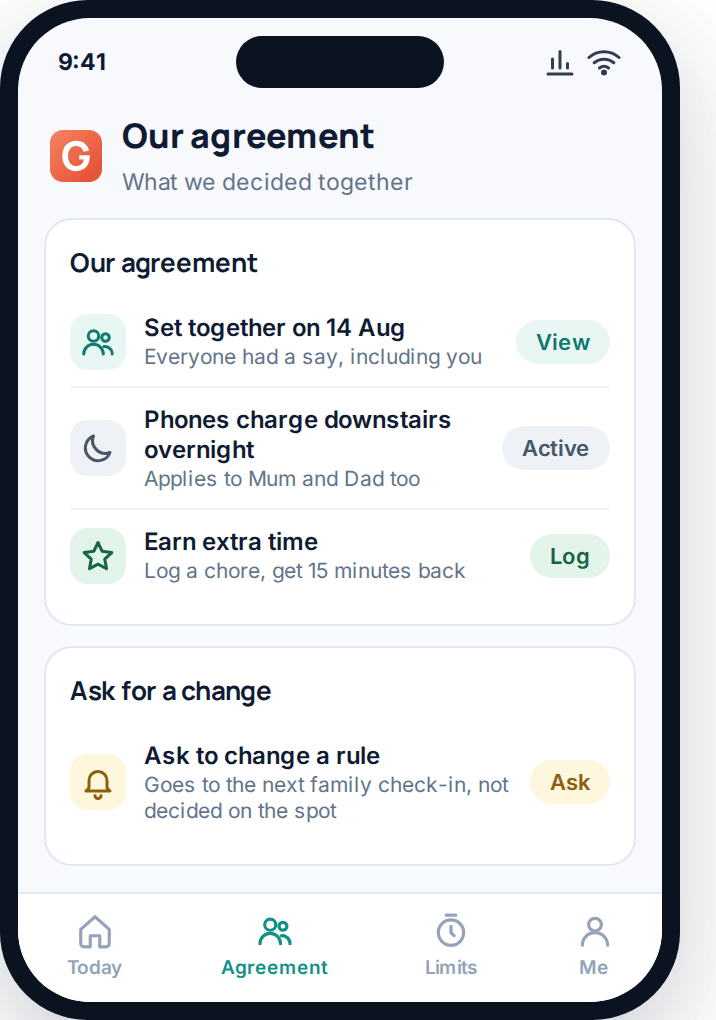
Pick one conversation from this guide — not all of them — and have it this week, at a calm moment, with one specific thing named rather than a general worry. Write down whatever you agree, and put a date in the calendar for when you’ll revisit it together.
If you want the agreement itself to live somewhere both of you can check rather than relying on memory, GuestSpy’s routines tools let a family record what was agreed and let a child view the same numbers a parent sees — which, per the research above, is most of what makes a rule feel fair rather than imposed. It’s free to set up, and the agreement is visible on the child’s own app screen at any time, not hidden behind a parent-only dashboard.
Keep reading

How to Set Up Google Family Link
Every Family Link setting worth turning on, in order, plus what changes at 13 and the things it genuinely cannot…
A Parent’s Guide to Screen Time by Age
What's generally reasonable at each age band, from toddlers to older teens, and what tends to matter more than the…

How to Block Adult Websites on Every Device at Home
No single setting blocks adult content everywhere. Here's the layer-by-layer setup — device, DNS, router, browser, console and TV —…