Location Sharing Etiquette for Families and Couples
Two people can share their exact location with each other using the same setting on the same app, and one pair will feel closer for it while the other starts quietly resenting their phone. The technology never explains the difference. The agreement behind it does.
This guide is about that agreement — the unwritten rules of location sharing etiquette between couples, within families, and between parents and teenagers. It has almost nothing to do with which app you use. It has everything to do with consent, whether the sharing goes both ways, and knowing the difference between checking in on someone and controlling them.
- Why etiquette matters more than the app
- The one rule everything else follows from
- Couples: mutual, or not at all
- Teenagers have a right to some privacy
- Reciprocity: why one-way sharing between adults goes wrong
- How to ask someone to stop sharing with you
- Red flags of coercive control
- Working through real scenarios
- Questions people actually ask
Why etiquette matters more than the app
Location sharing apps are built to be neutral. They will happily broadcast one person’s every move to another indefinitely, and they will not ask either person whether that’s still a good idea six months later. The app doesn’t have opinions. The people using it need to.
That’s the gap this guide fills. Most articles about location sharing are really about setup instructions — how to turn it on. Far fewer are honest about the fact that turning it on is a small relationship decision every time, one that deserves the same care as any other agreement between two people, and one that’s worth revisiting rather than setting once and forgetting.
It’s worth saying plainly why this matters beyond one uncomfortable conversation: the arrangements people set up in their twenties tend to still be running, unexamined, a decade later. A location-sharing habit that started as “just for this one road trip” quietly becomes the norm for an entire relationship, never actually agreed to as a permanent thing, just never turned off. Etiquette here isn’t about manners for their own sake — it’s about making sure an arrangement that shapes daily life was actually chosen, more than once, rather than simply never questioned.
The one rule everything else follows from
If there’s a single sentence to take from this entire guide, it’s this: tracking an adult without their knowledge is not acceptable, and in many places it’s illegal. Not “a bit much.” Not “old-fashioned.” Not acceptable — full stop, regardless of the relationship, regardless of how good the reason feels in the moment.
Everything that follows assumes consent is already in place — a partner who knows and agreed, a teenager who’s had the conversation, an elderly parent who said yes. If consent isn’t there, the rest of this guide doesn’t apply; the answer is simply: ask first, or don’t do it.
Couples: mutual, or not at all
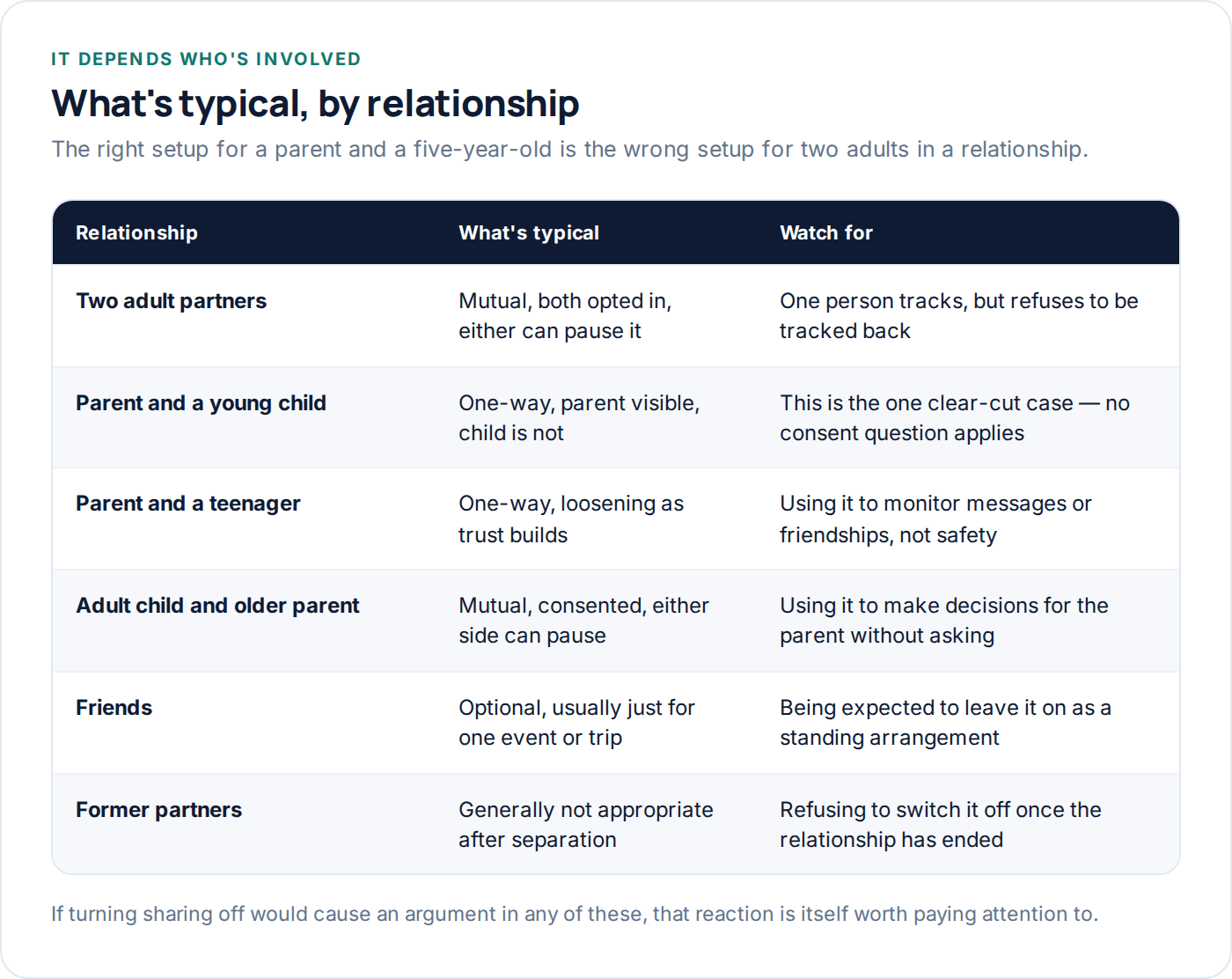
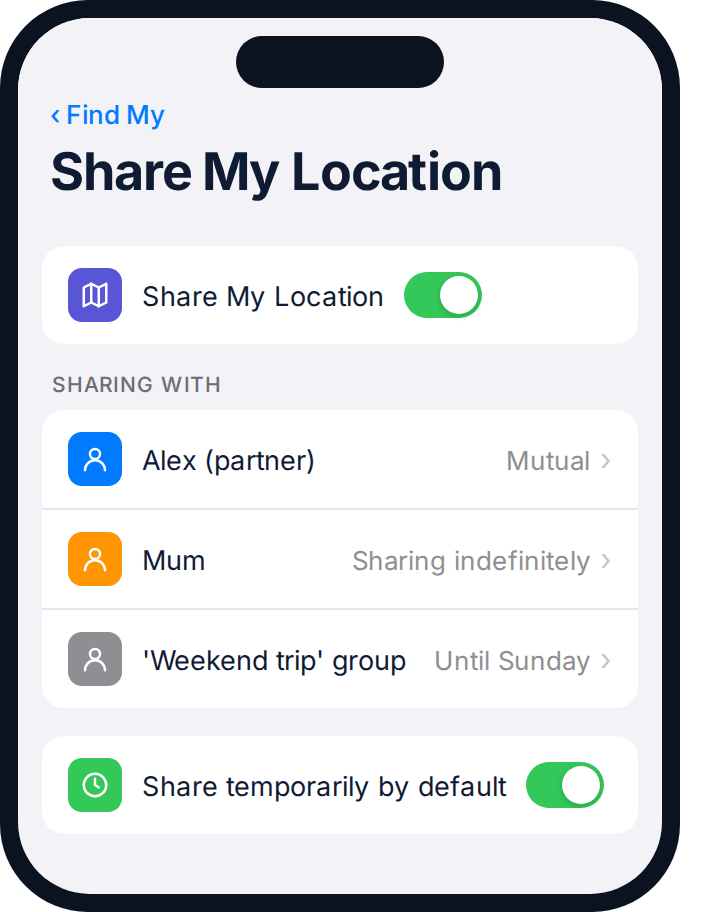
Between two adults in a relationship, location sharing works when it’s mutual — both people see each other, both people agreed to it, and either person can turn it off without it becoming a crisis. One-sided sharing between partners, where one person is tracked and the other isn’t, is worth questioning even when both people say they’re fine with it.
A useful test: would the arrangement survive being flipped? If the answer is “he’d never agree to me tracking him the way he tracks me,” that asymmetry is the actual problem, whatever reason is being given for it. Genuine safety reasons — a late-night commute through an unfamiliar area, a habit of checking in during a long solo drive — tend to be occasional and mutual by nature, not permanent and one-sided.
What a reasonable version looks like
Sharing that’s turned on together, for a stated reason both people understand, that either person can pause without an argument, and that gets revisited occasionally rather than left running for years by default. That’s not surveillance. That’s two adults using a tool they both chose.
It’s worth separating the tool from the trust it’s supposed to represent. Location sharing can genuinely help two busy people coordinate — knowing a partner has left work is a small, practical convenience. It becomes a problem the moment it’s treated as a substitute for trust rather than a convenience alongside it: checking the map instead of asking how someone’s day went, or using a late arrival as evidence for an argument that was never actually about the lateness. If the app is doing emotional work that a conversation should be doing instead, that’s worth noticing before it becomes the relationship’s default way of relating to each other.
Teenagers have a right to some privacy
Parents monitoring a minor child sit in a genuinely different category to two adults tracking each other — a parent is legally and practically responsible for a child’s safety in a way that simply doesn’t apply between partners. But “different category” doesn’t mean “no limits,” and teenagers in particular deserve real thought here.
A reasonable approach loosens with age. Location sharing for a ten-year-old walking to school alone for the first time is uncontroversial. The same blanket setup for a seventeen-year-old, watched constantly and used to interrogate every stop on the way home, teaches them to route around it rather than trust it — and most manage to, eventually. The goal isn’t permanent visibility; it’s a young adult who reaches eighteen having learned to manage their own location, their own risk, and their own privacy.
Message content and browsing history are a separate question from location, and a much more invasive one — our wider guide on screen time and privacy by age goes into that in more depth. For location specifically, a good marker is whether the teenager can see the same screen you can: what’s shared, with whom, and why.
Reciprocity: why one-way sharing between adults goes wrong
Reciprocity is the quiet mechanism that keeps sharing healthy. When it’s mutual, both people have equal information and, just as importantly, equal power to change the arrangement. When it isn’t, one person accumulates knowledge the other doesn’t have, and knowledge without reciprocity tends to curdle into something else over time, even with good intentions at the start.
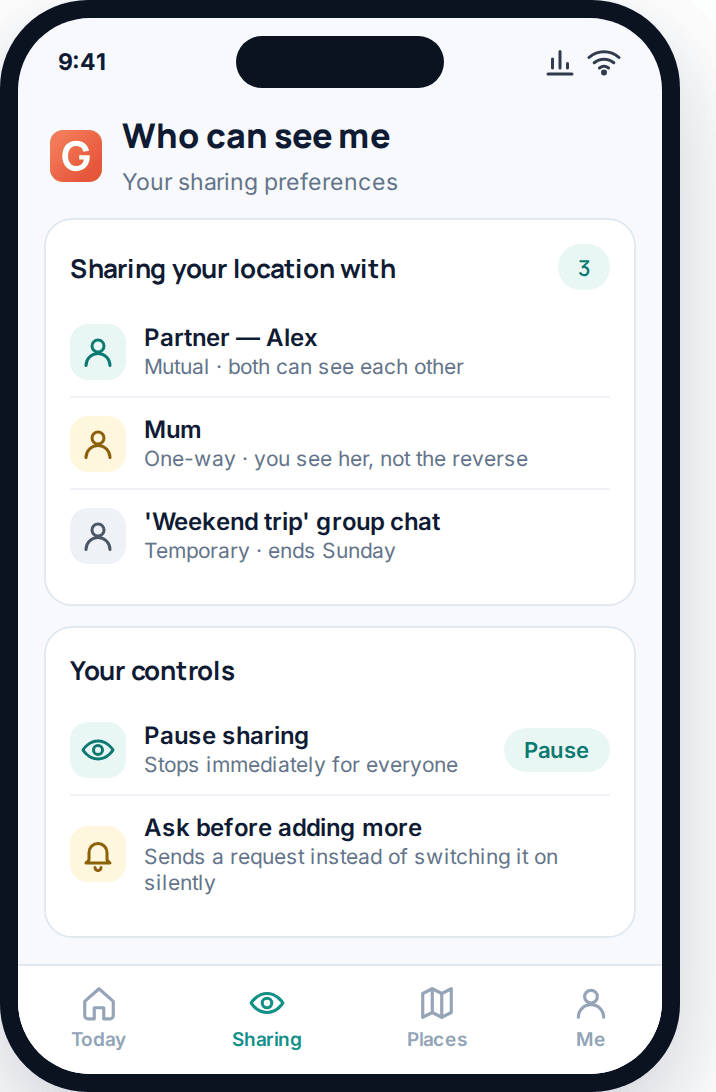
This is why “just for now, until things settle down” one-way arrangements between adults are worth watching closely. They’re not inherently wrong — a partner recovering from a health scare, someone going through a genuinely frightening situation, might reasonably ask for one-way visibility temporarily. The problem is when “temporarily” quietly becomes permanent and nobody revisits it.
Set an end date
Any one-way arrangement between adults should have a review point, spoken out loud, not an indefinite default.
Name the reason
“I’m worried about the late shift” is a reason. “Because you should be fine with it” is not.
Check it still fits
What made sense during a crisis rarely still makes sense once the crisis has passed.
How to ask someone to stop sharing with you
Asking to turn off location sharing shouldn’t feel like a confession, but for a lot of people it does — which is itself a small sign of how loaded these arrangements can quietly become.
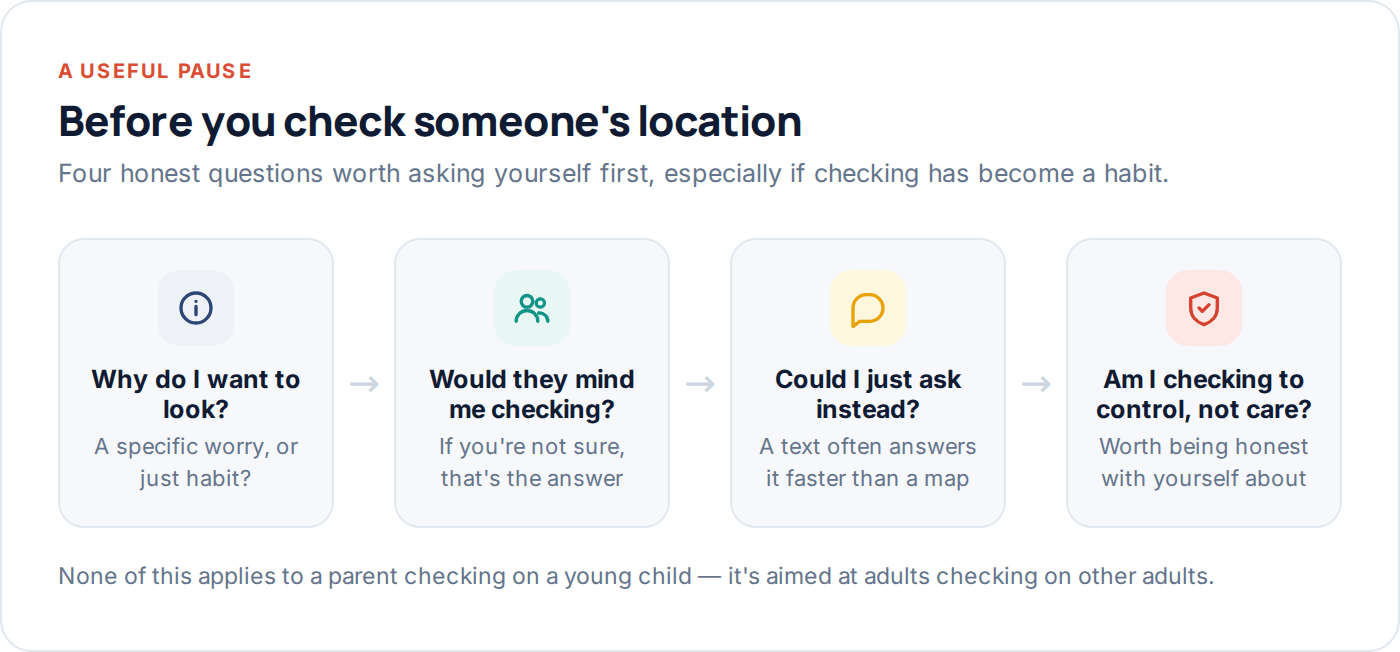
The mechanics matter less than the framing. Lead with what changed for you, not with a complaint about the other person. “I’ve noticed I check the app more than I need to and I’d rather trust myself without it” is honest and hard to argue with. It also puts the decision back where it belongs — with the person whose phone it is.
Red flags of coercive control
Most location sharing between people who care about each other is completely fine. But a specific pattern is worth naming clearly, because people inside it often don’t recognise it as anything unusual until someone else points it out.
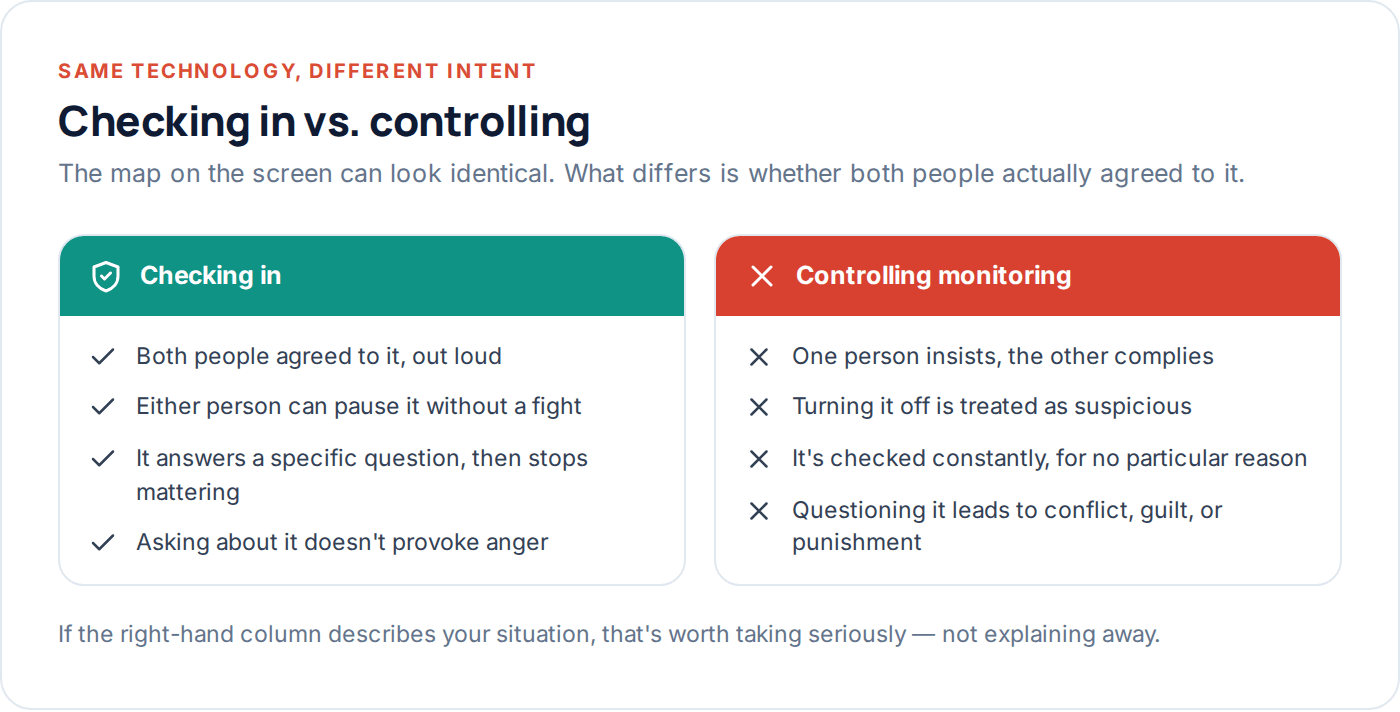
- Sharing is demanded, not agreed. “Turn it on or I’ll assume you’re hiding something” is coercion dressed up as a reasonable request.
- Turning it off isn’t a real option. If asking to pause sharing leads to accusations, silence treatment, or an argument that doesn’t end until you turn it back on, that isn’t consent — it’s compliance.
- It’s paired with checking messages, monitoring calls, or controlling money. Location tracking rarely arrives alone in a genuinely controlling relationship — it tends to sit alongside other forms of monitoring.
- You’ve started managing your movements around being watched — taking longer routes, timing stops, explaining detours before you’re asked. That’s a significant sign, not an overreaction.
If any of that sounds familiar, it’s worth talking to someone you trust, or a domestic abuse helpline in your country — most take calls about situations that don’t yet feel “serious enough,” and this kind of pattern is exactly the sort of thing they help people think through.
It’s also worth saying what this isn’t. A partner who feels a flicker of jealousy and mentions it once isn’t automatically controlling — people are allowed the occasional insecure moment, and naming it honestly is healthier than either suppressing it or acting on it unilaterally. The distinction is whether that flicker turns into a standing demand, whether it’s raised as a feeling to talk through or an ultimatum to comply with, and whether “no” is ever actually available as an answer. One uncomfortable conversation is normal relationship territory. A pattern where sharing is required and refusal isn’t tolerated is a different thing entirely.
Working through real scenarios
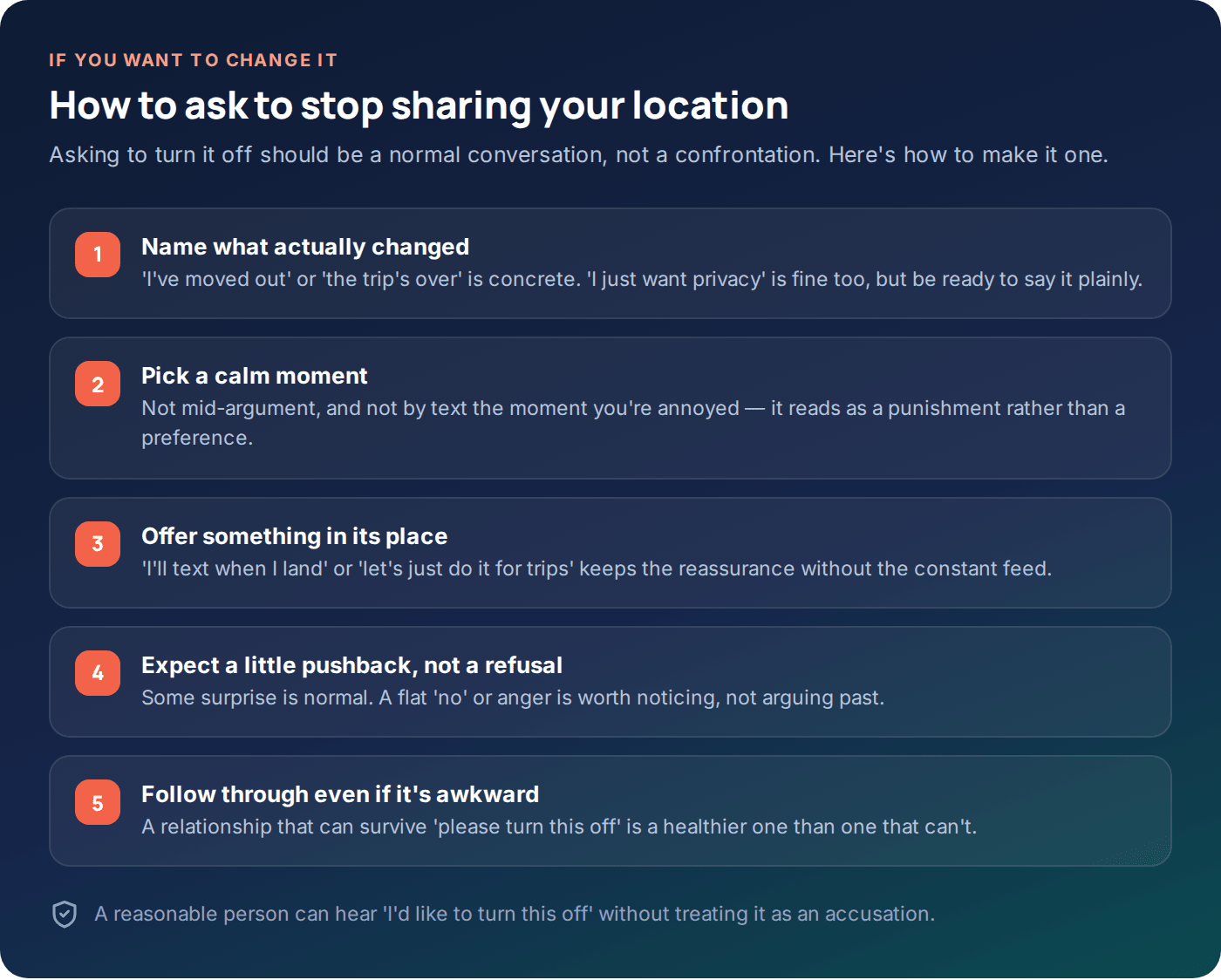
Etiquette gets clearer with specifics rather than principles alone, so here’s how a few common situations tend to play out.
“My partner wants to share locations after only a few weeks together.” There’s no rule against it, but pace matters. A reasonable version is small and specific — sharing for a night out, not a permanent always-on arrangement — with room to say it feels early without that being treated as suspicious in itself.
“My adult child wants to track me ‘just in case.'” Worth taking at face value if it comes from genuine concern, and worth being just as free to decline. A parent doesn’t owe an adult child visibility into their day any more than the reverse — our guide on tracking elderly parents with consent covers this specific relationship properly.
“We share locations but he gets annoyed if I don’t answer why I stopped somewhere.” This is the clearest version of the checking-in-versus-controlling line in this whole guide. Seeing a dot on a map and demanding an explanation for it are two very different things, and the second one is the problem, not the sharing itself.
Questions people actually ask
Is it normal for new couples to share locations?
It’s common, but “common” and “necessary” aren’t the same thing. There’s nothing wrong with it if both people genuinely want to and it’s mutual — the thing to watch is whether it was actually a shared decision or something one person pushed for and the other went along with to avoid an argument.
My partner won’t let me turn off location sharing. What does that mean?
On its own, reluctance is normal — most people feel a moment of unease when an arrangement they’re used to changes. A flat refusal, anger, or making you feel guilty for asking is different, and worth taking seriously as a sign the relationship’s dynamic around this needs attention, possibly with outside support.
Is it ever okay to track a partner without telling them?
No. Covert tracking of a partner is not location sharing etiquette gone slightly wrong — it’s surveillance without consent, and depending on where you live it can be a criminal offence. If you’re worried about a partner’s safety or honesty, that’s worth addressing directly with them or with outside help, not by installing something in secret.
Should I share my location with my teenager’s friends’ parents?
Not by default. That’s usually better handled case by case — for a specific trip or event, with everyone’s agreement — rather than as a permanent standing arrangement between families who happen to know each other.
How do I bring up wanting more privacy without it turning into an argument?
Pick a calm, unrelated moment rather than raising it right after a disagreement. Frame it as what you want, not what the other person is doing wrong, and be ready to offer something in its place, like a check-in text for the situations that actually matter to them.
Is one-way sharing ever appropriate between two adults?
Sometimes, temporarily, and with a clear reason both people understand — recovering from an illness, a genuinely frightening period, a long solo trip. The thing to watch for is “temporarily” quietly becoming permanent with nobody ever revisiting it.
The short version
Location sharing works when it’s chosen, mutual between adults, loosened with age for teenagers, and easy to pause without a fight. It stops working the moment any of those stop being true — and when that happens, it’s worth naming, not ignoring.
If you’re setting up sharing as a family and want the technical side to actually support consent rather than undermine it, our guide on setting up location sharing and our acceptable use page both go into the practical side in more depth.
Keep reading
The Complete Guide to Finding a Lost Phone
A calm, step-by-step guide to finding a lost or stolen phone — what to do in the first five minutes,…
A Step-by-Step Guide to Setting Up Family Location Sharing
Three ways to set up family location sharing on iPhone and Android, the settings that quietly break each one, and…
How to Set Up a Family Safety Circle
Who belongs in a family safety circle, how mutual and one-way sharing differ, and how to set one up that…