How to Tell Your Child You’re Monitoring Their Phone
The software is the easy part. The genuinely hard part — the one most guides skip past in a sentence — is sitting down and telling your child you’re monitoring their phone in a way that doesn’t sound like an accusation. Get that conversation right and the settings barely matter. Get it wrong and no amount of careful configuration fixes what it costs you.
This article is only about that conversation. Not the technical setup, not the ethics debate, not what to monitor at what age — just the actual words, by age, including the harder version of this where you already installed something and now need to explain it. If you want the broader setup guide, it’s here on the blog; this one is deliberately narrow.
Why the words matter more than the settings
Two households can run the identical monitoring app, identically configured, and end up in completely different places six months later — one with a kid who checks the transparency screen occasionally and shrugs, the other with a kid who’s furious and finding workarounds. The difference, almost every time, traces back to how the conversation went, not what was switched on.
That’s genuinely good news, because it means the highest-leverage thing you can do here costs nothing and takes fifteen minutes: get the conversation right before you touch a single setting.
It’s not really about being persuasive. It’s about which version of the same underlying fact you choose to lead with — and whether they hear it from you or find it out some other way.
Before you start: decide three things
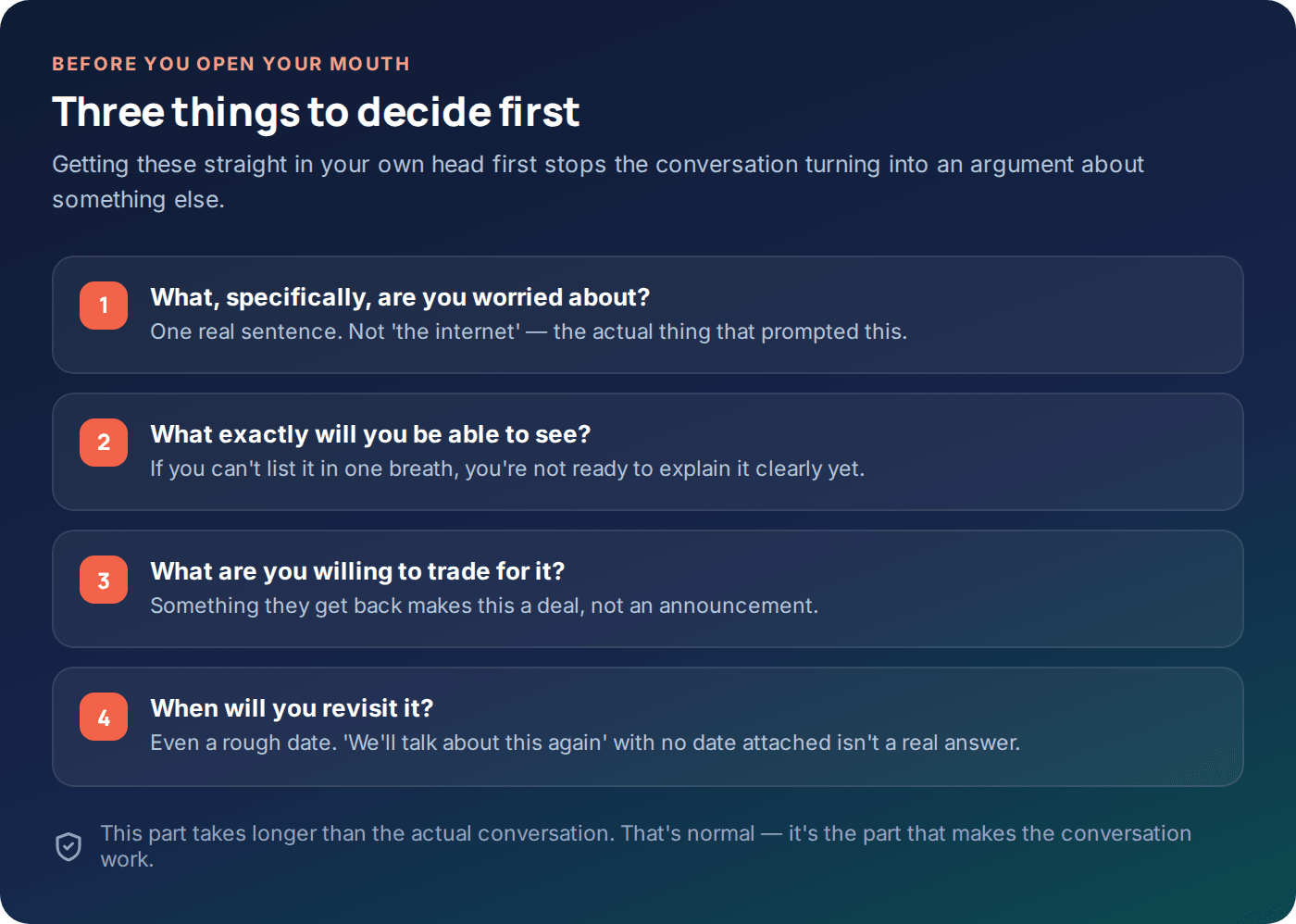
Walking in without having thought this through is the single most common way this goes sideways. Three things, worked out beforehand, make the actual conversation far easier.
First, the real worry, in one sentence — not “the internet” but the specific thing that’s actually on your mind. Second, an honest, short list of exactly what you’ll be able to see; if you can’t say it in one breath, simplify it until you can. Third, what you’re willing to offer back, because a rule that only takes something away invites resistance in a way a genuine trade doesn’t.
Scripts by age
These are starting points, not scripts to read verbatim — your child will hear it as more genuine in your own words. But the shape of each one is worth keeping.
Ages 6–9
“I’m going to be able to see where your phone is and how much time you spend on games, the same way I know when you’re at the park. It’s so I can help keep you safe, not because you did anything wrong.” Young children rarely push back hard on this. Keep it short, answer whatever they ask, and move on — a long explanation at this age creates more anxiety than it resolves.
Ages 10–12
“Now that you’ve got your own phone, I’m setting it up so I can see roughly how you’re using it — screen time, where it is, that kind of thing. I want you to see the same screen I see, so it’s not a secret. What questions do you have?” This is the age where showing the transparency screen together, right there, matters most — it turns an announcement into something concrete they can see and ask about.
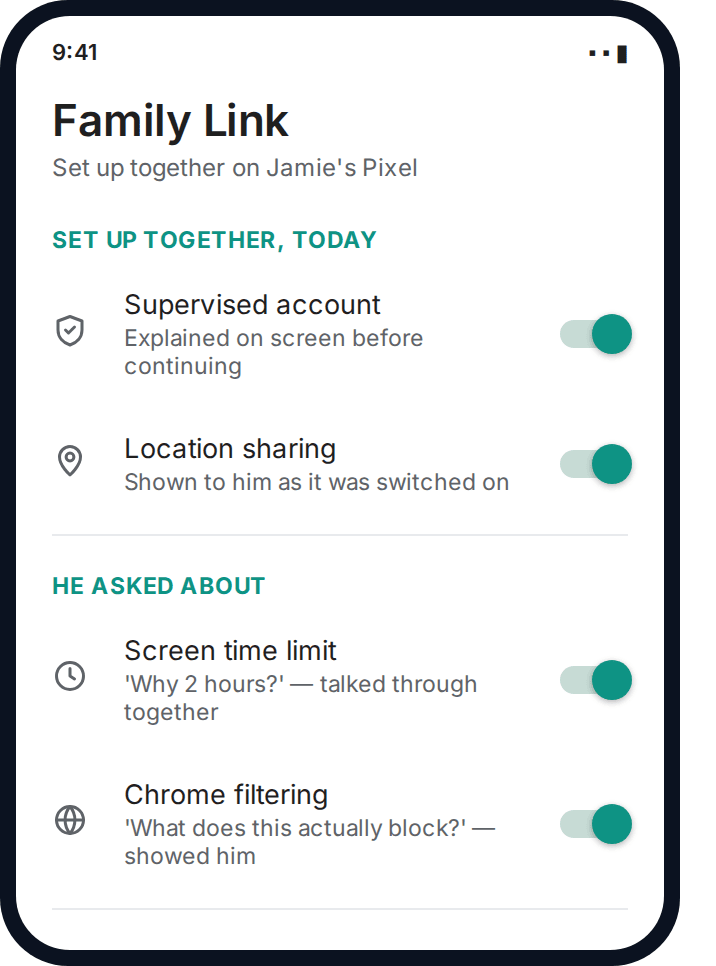
At this age, doing the setup together works better than doing it beforehand and explaining it after. Watching each screen go on — location, screen time, the filtering settings — and being able to ask “what does this actually block?” turns the conversation from something that happened to them into something they took part in.
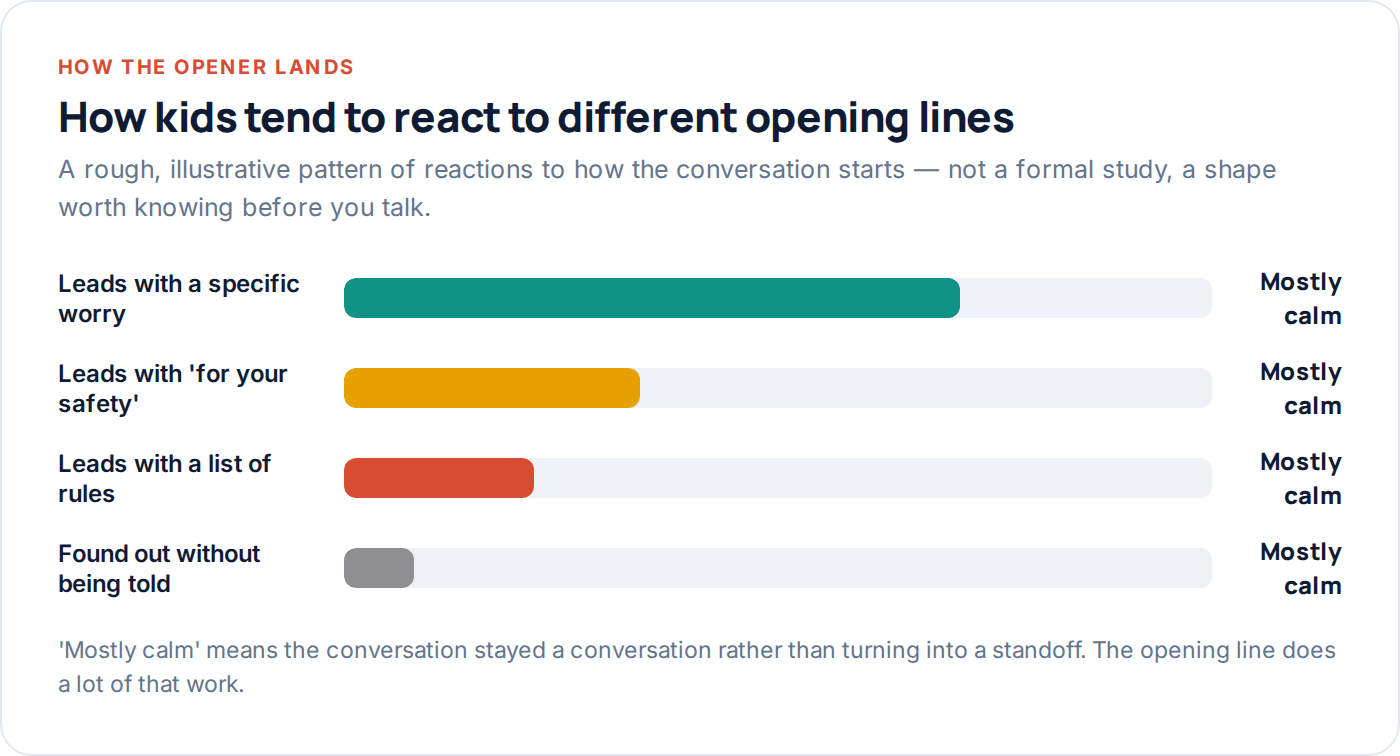
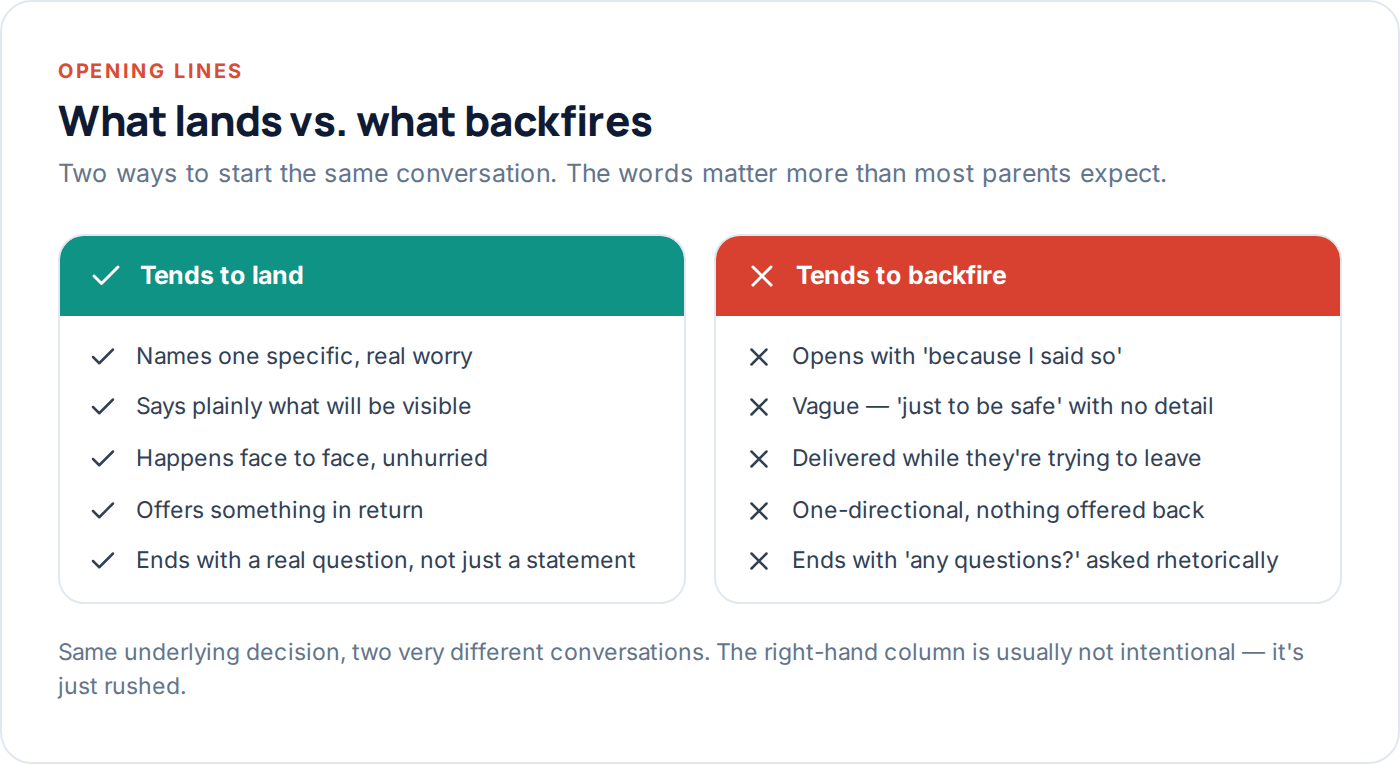
How the conversation opens carries more weight than most parents expect, across every age bracket. Leading with one real, specific worry consistently lands better than a vague “it’s for your safety” — and both land far better than a kid finding out with no conversation at all. Worth keeping in mind as the scripts get more negotiated from here.
Ages 13–15
“I want to talk about what I’m going to be able to see on your phone, and I want your input on it before we set anything up. Here’s what’s worrying me specifically — [name it]. Here’s what I’m thinking of watching for that. What would feel fair to you?” Note the shift: this age gets a genuine say in the terms, not just notice that terms exist. Expect negotiation, and treat it as the point, not an obstacle.
Ages 16–17
“You’re old enough that I want this to be close to an agreement between us, not a rule I’m handing down. Here’s roughly what I’d keep — mostly location — and here’s what I think you should manage yourself now. Does that match how you see it?” By this age the conversation should sound less like informing and more like collaboratively deciding what’s left, because most of it should already be handed back.
Keep it short
Longer than a couple of minutes at any age and the actual point gets lost in the explanation. Say the worry, say what’s visible, stop.
Do it face to face
Not a text, not a message left on the fridge. A short conversation in person carries weight a written notice doesn’t.
Leave room to answer
Ask a genuine question at the end and wait for a real answer, even if it’s just “does that sound fair?”
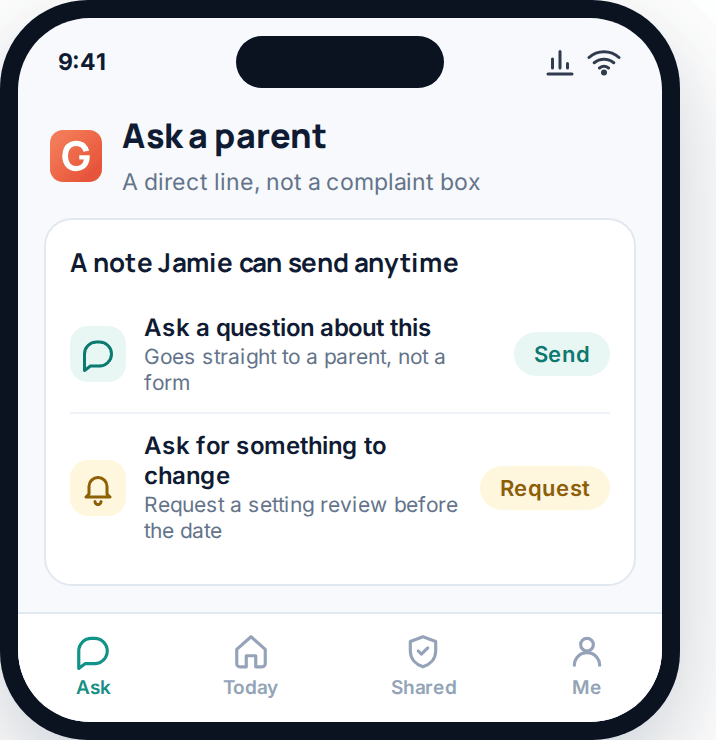
Whatever age you’re talking to, it helps enormously to end the conversation by showing them a real way to come back to you — a button that sends a question or a request straight to a parent, not a form to fill in later. A rule that only goes one direction reads as surveillance. A rule with a line back to you reads as an agreement.
Handling the common pushback
Whatever the age, a handful of objections come up again and again. Having a considered response ready — rather than improvising defensively in the moment — keeps the conversation a conversation.
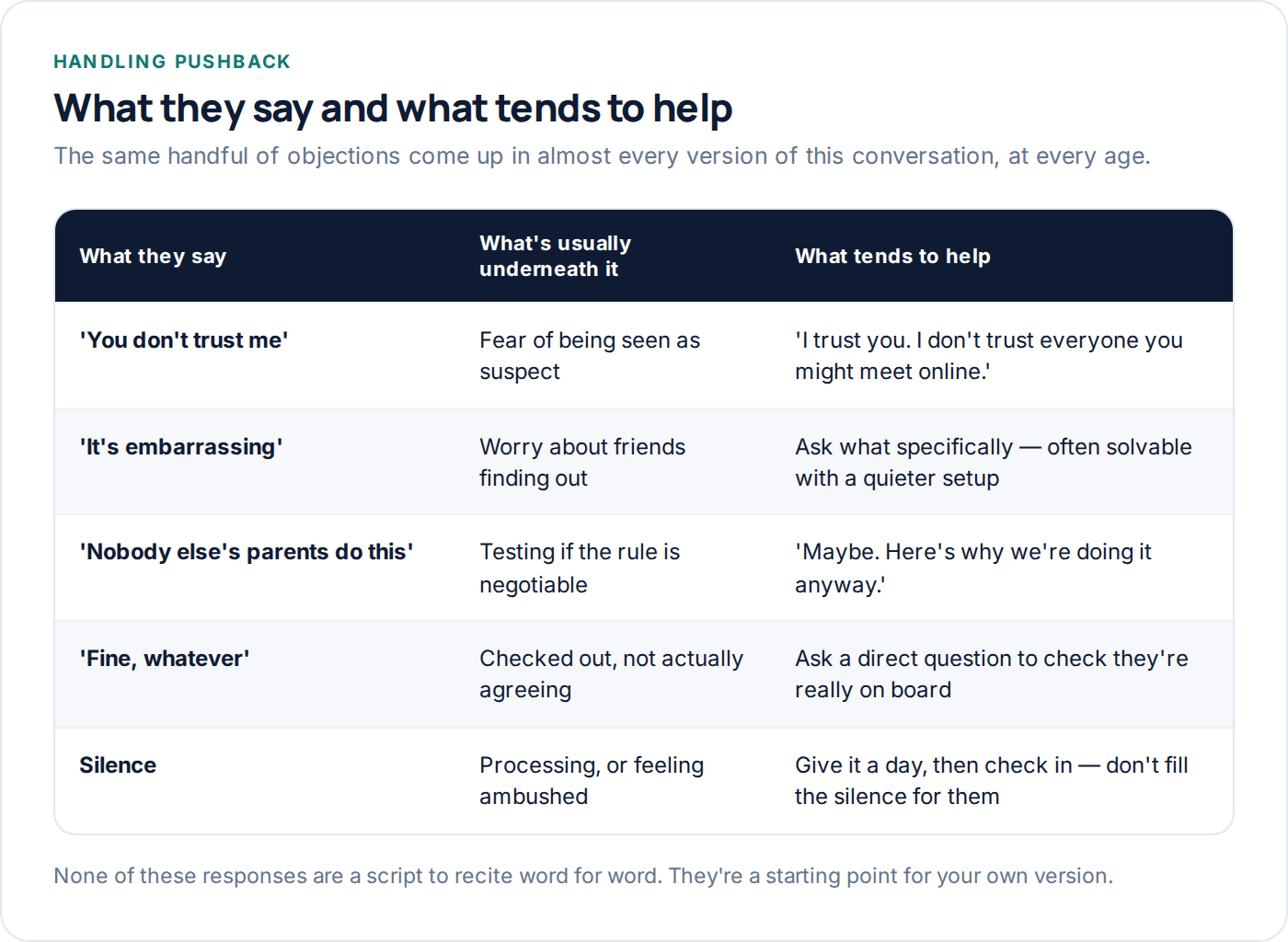
The single most useful habit across all of these: answer the objection, then ask a question back. “What would make this feel fair to you?” does more work than any explanation you can give, because it invites them into shaping the outcome rather than just receiving it.
If they flatly refuse
Sometimes, especially with young teenagers, the answer is a flat no with no negotiation offered. Before deciding what that means, find out what’s actually behind it — a direct, calm “help me understand what’s worrying you about this” usually surfaces something specific: embarrassment about friends noticing, a general objection to any oversight, or occasionally something they don’t want you to see that isn’t actually the thing you were worried about at all.
Whatever’s behind it, installing something secretly in response to a refusal is close to the worst available option — it resolves the immediate standoff and creates a much bigger, harder problem the moment it’s discovered, which it usually is. If the refusal is genuinely unmoveable and you believe a baseline is still necessary for their age, say so plainly: “I hear that you don’t want this, and I’m still going to set up [the specific, minimal thing] because of [the specific reason]. Let’s talk about when that changes.”
If you already installed it secretly
This happens more than guides usually admit — a parent installs something during a worrying moment, means to mention it, and doesn’t, and time passes. If that’s where you are, the fix is the conversation you should have had at the start, just later and slightly harder.
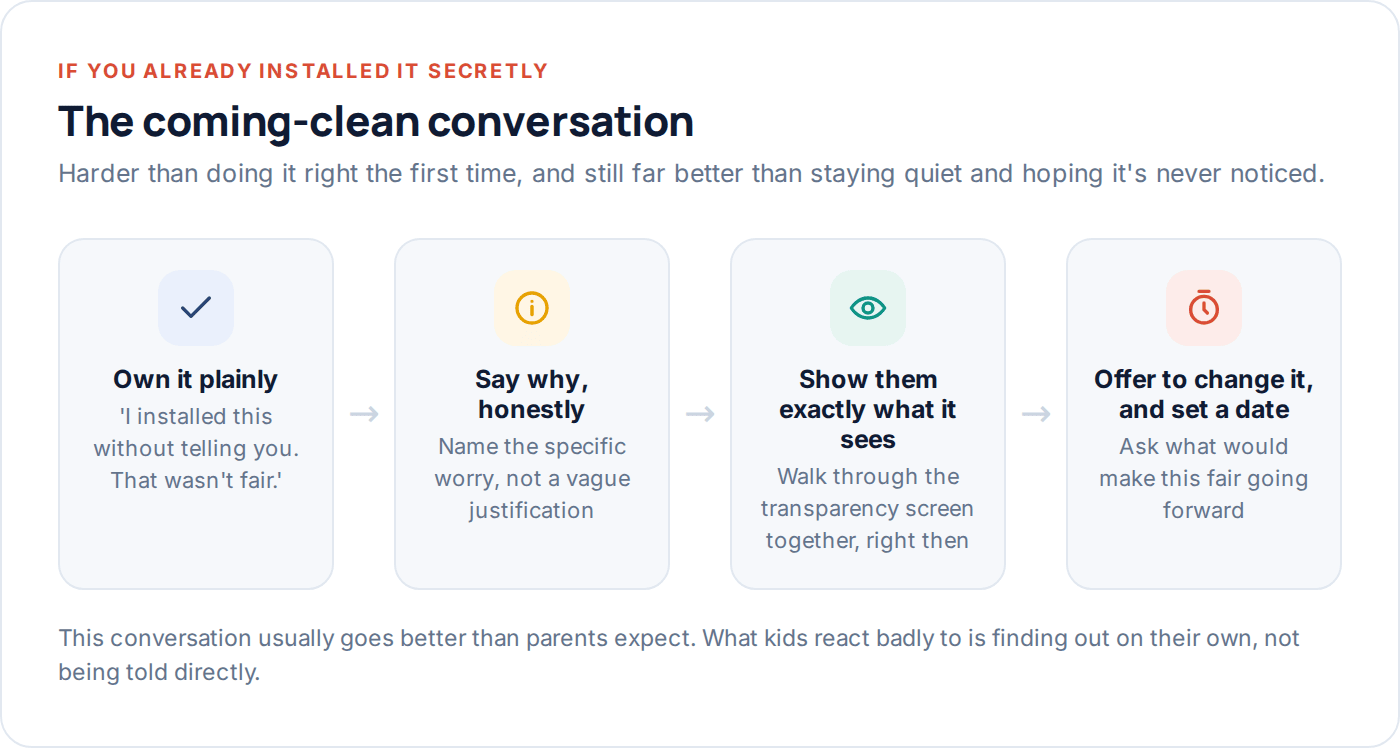
Own it plainly, without over-explaining: “I installed something on your phone without telling you, and that wasn’t fair — I should have talked to you first.” Then say why, honestly, naming the actual worry rather than a vague justification. Show them exactly what it sees, right then, on the transparency screen — this is the step that does the most repair, because it replaces their imagination of what you can see with the actual, bounded reality. Finally, ask what would make it fair going forward, and actually change something based on the answer.
This conversation goes better than most parents fear. What damages trust badly is a child discovering monitoring on their own, weeks or months later. A parent who brings it up first, unprompted, is already doing the harder and more repairable version of this.
Keeping the promise afterward
The conversation sets the terms. What actually determines whether they hold is whether you keep them, quietly, over the following months. If you said message content was off, it needs to stay off — the temptation to peek “just this once” during a worrying moment is exactly the moment the promise matters most, and breaking it once tends to cost more trust than years of consistent behaviour built up.
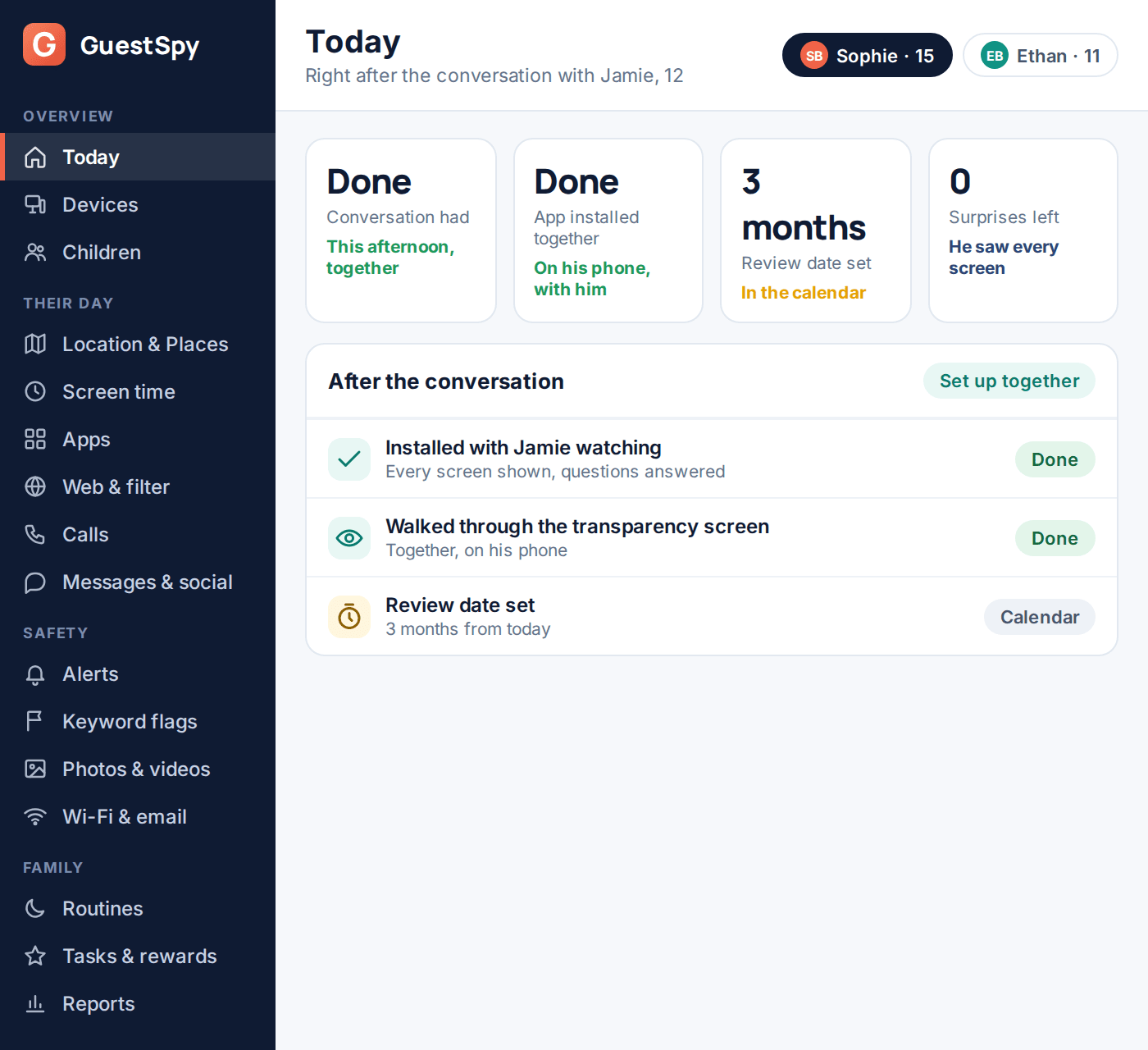
A good sign, right after a conversation like this one, is that the dashboard shows nothing left ambiguous — the app installed together, the transparency screen walked through, a review date already sitting in the calendar. That’s a small thing to look at, and it’s a useful way to confirm the conversation actually did what it was meant to, rather than just feeling like it went well at the time.
| What you said | What to check, a month later |
|---|---|
| “I’ll tell you before I look at anything” | Did a conversation happen the last time something came up, or did it stay silent? |
| “Message content stays off” | Has it, actually — including during a moment you were worried? |
| “We’ll revisit this in three months” | Is that date still in the calendar, or has it quietly slipped? |
| “You can ask me to change something” | Has a request ever actually been acted on, or only offered? |
Signs the conversation didn’t land
Some signals worth watching for in the weeks after: your child never mentions the app again, in either direction, in a way that reads like resignation rather than acceptance. They stop asking you anything about their phone at all, where they used to. A sibling mentions they’re using a friend’s old phone for things, which is often a sign the monitored one has become the “safe” phone and a second, unmonitored one has quietly appeared.
Any of those is worth a short, low-key follow-up conversation — not a re-run of the original talk, just a genuine “how’s this actually feeling, a few weeks in?” Sometimes the honest answer changes something. Sometimes it just confirms you got it right the first time.
Questions parents actually ask
Do I need to have this conversation with a six-year-old?
A short, simple version, yes — even a young child benefits from knowing a phone is watched over rather than discovering a mysterious icon later. It doesn’t need to be a sit-down discussion; a sentence while setting the phone up together is enough at this age.
What if my child cries or gets very upset?
Give it space rather than rushing to fix the reaction. Pause, acknowledge it plainly — “I can see this is upsetting, and I still think it’s important, let’s talk again once you’ve had a bit of time” — and come back to it later rather than pushing through in the moment.
Should I let them see me set it up, or do it beforehand?
Set it up together where possible, especially from around age ten up. Watching each screen as it’s switched on turns an abstract idea into something concrete, and it’s the single biggest thing that makes the transparency screen feel real rather than theoretical.
What if they ask a question I don’t have a good answer to?
Say so honestly — “that’s a fair question, let me think about it and come back to you” is a completely reasonable answer and often lands better than an improvised one that doesn’t hold up.
Is it ever okay to skip this conversation entirely?
Not in this guide’s framing — GuestSpy is built around the child knowing, and that starts with being told directly. A monitoring arrangement your child doesn’t know about is a different thing entirely, with different risks and, in many places, different legal standing.
How do I bring it up again after a mistake — theirs or mine?
Plainly and promptly, rather than waiting for the “right moment,” which rarely arrives on its own. Name what happened, say what you’re thinking of changing, and ask what they think — the same structure as the original conversation, just shorter.
Where to go from here
Pick the age bracket above that matches your child, adapt the words to sound like you, and have the conversation before you open the app for the first time, not after. The transparency screen is designed specifically to make this conversation easier to keep true over time, and the FAQ covers the practical questions that tend to come up once the settings are actually live.
Whatever you say, the thing that makes it work isn’t the exact wording. It’s that they heard it from you, directly, before they found out any other way.
Keep reading
The Complete Guide to Monitoring a Teen Respectfully
A step-down approach to monitoring a teenager's phone: what to negotiate, what to drop by 15 and 17, and how…
What to Do When You Find Something Worrying on Your Child’s Phone
A calm, practical playbook for the moment you see something worrying: what to do first, what not to do, and…
How to Monitor My Child’s Social Media
Every platform has its own supervision tools, and every one of them has real gaps. Here's what Instagram, Snapchat, TikTok,…