The Complete Guide to Monitoring a Teen Respectfully
A thirteen-year-old mostly accepts whatever you set up. A sixteen-year-old will ask you, reasonably, why you still need to know who she’s messaging when she’s never once given you a reason to worry. Both of those are the same child, eighteen months apart, and treating them with the same rule is where most families go wrong.
This guide is specifically about how to monitor a teenager’s phone — not a younger child’s, and not with the assumption that whatever you set up at thirteen should still be running unchanged at seventeen. Teenagers are not smaller adults and they are not older children; they are people in the middle of building the judgement they’ll need to run their own life, and monitoring that doesn’t make room for that ends up working against the thing it’s trying to protect.
- Why teenagers need a different approach
- What teenagers actually push back on
- Building the agreement, not just the settings
- A step-down schedule by age
- What to leave alone, even at 13
- Handling the pushback
- When it’s fair to tighten a rule again
- Signs you’re overdue to loosen up
- Questions parents of teens actually ask
Why teenagers need a different approach
A nine-year-old’s phone is mostly a tool you’ve lent them. A sixteen-year-old’s phone is closer to a diary, a social calendar, a wallet and a driving licence in waiting — it’s the place where their actual social life happens, and they know it. Monitoring it the way you’d monitor a nine-year-old’s device doesn’t read as caution to a teenager. It reads as a statement that you don’t trust them to be a person yet.
That doesn’t mean teenagers shouldn’t be monitored at all. It means the target changes. With a young child the goal is mostly prevention — stop them stumbling into something. With a teenager the goal shifts toward a safety net with clear edges: you’re there if something goes seriously wrong, and otherwise you’re staying out of the day-to-day. Getting that balance wrong in either direction has a cost. Too little and you miss the handful of situations — an adult stranger, a genuinely dangerous meet-up, a mental health crisis — where a parent noticing early matters enormously. Too much and you teach a capable seventeen-year-old nothing about managing their own risk before they leave for the situation where you can’t see any of it.
What teenagers actually push back on
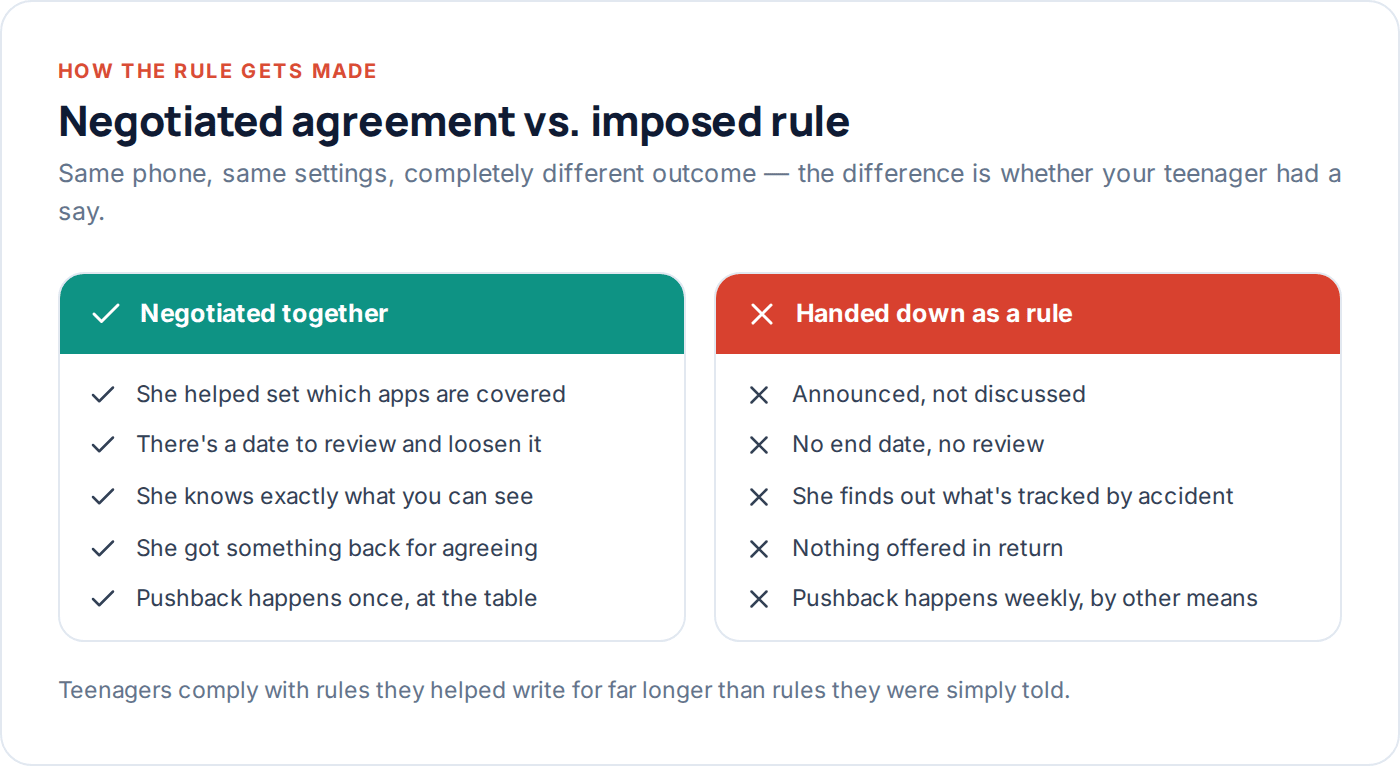
It’s rarely the fact of monitoring itself. Most teenagers, asked directly, will concede that a parent tracking location or a screen time cap is not unreasonable. What generates the real friction is usually one of three things: not knowing exactly what’s being watched, feeling like the rule was announced rather than discussed, or having no path to less monitoring as they prove themselves.
Fix those three and most of the conflict disappears, even with the same underlying settings. A fifteen-year-old who knows precisely what’s shared, who was in the room when the rule was set, and who has a date on the calendar to revisit it, tends to treat the arrangement as fair — even when it includes things she’d rather not have on.
Building the agreement, not just the settings
The mistake most parents make with teenagers specifically — as opposed to younger kids — is treating this as a settings problem. Open the app, tick some boxes, done. With a teenager, the settings are the easy part. The agreement is the actual work.
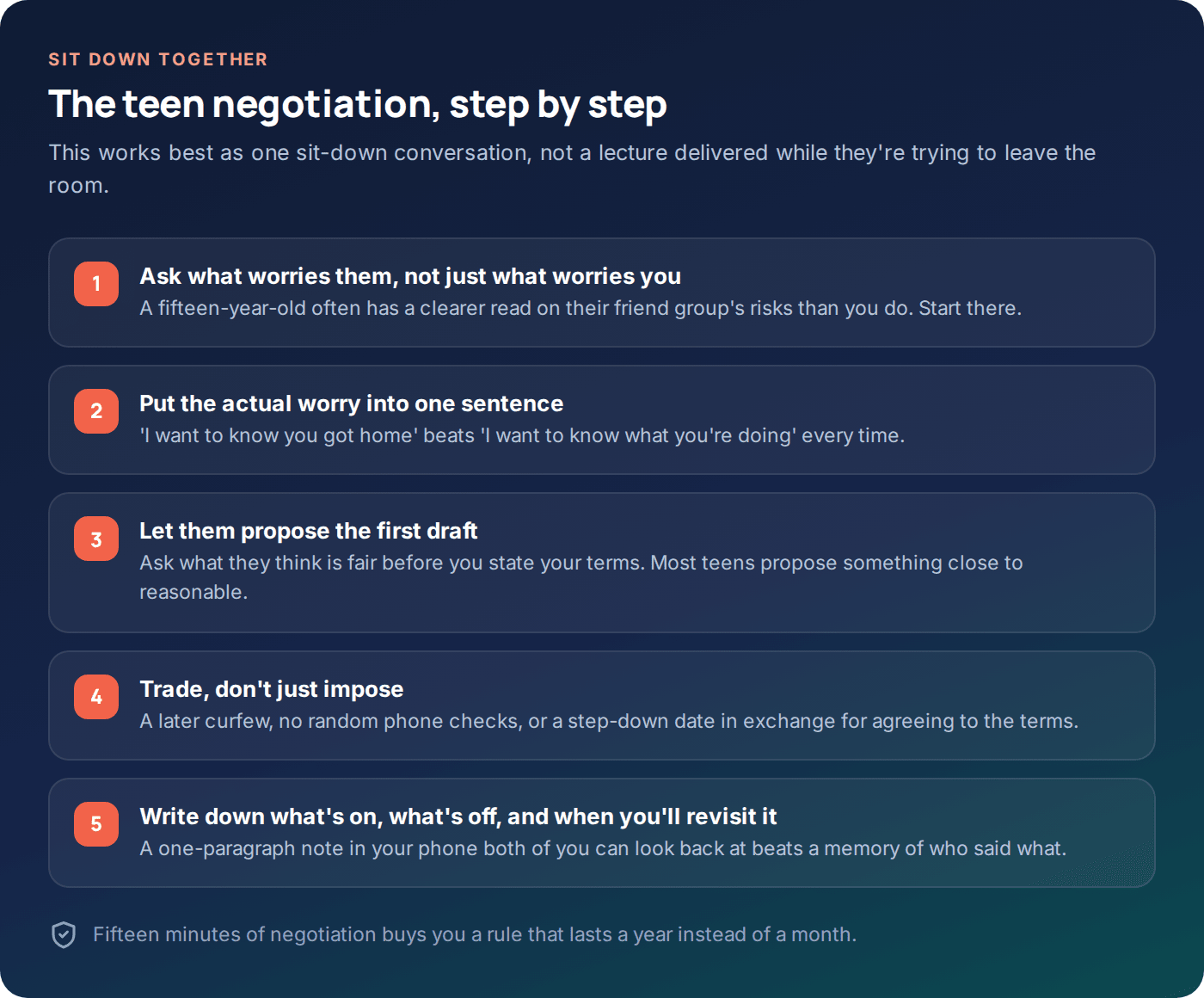
A working agreement covers four things in plain language: what’s monitored, what isn’t, what happens if something concerning turns up, and when you’ll next talk about loosening it. Write it down somewhere both of you can see it again — a note on both phones is enough. The point isn’t the paper trail; it’s that neither of you can quietly redefine the deal three months later.
What to trade, not just what to ask for
Monitoring that only ever tightens gives a teenager no reason to cooperate with it. The most effective agreements include something they visibly get in return: a later bedtime cutoff, no random phone checks outside the agreed categories, or — the one that tends to matter most — a firm date when a specific restriction comes off if the previous period went fine. A deal with nothing in it for them is a deal they’ll quietly work around.
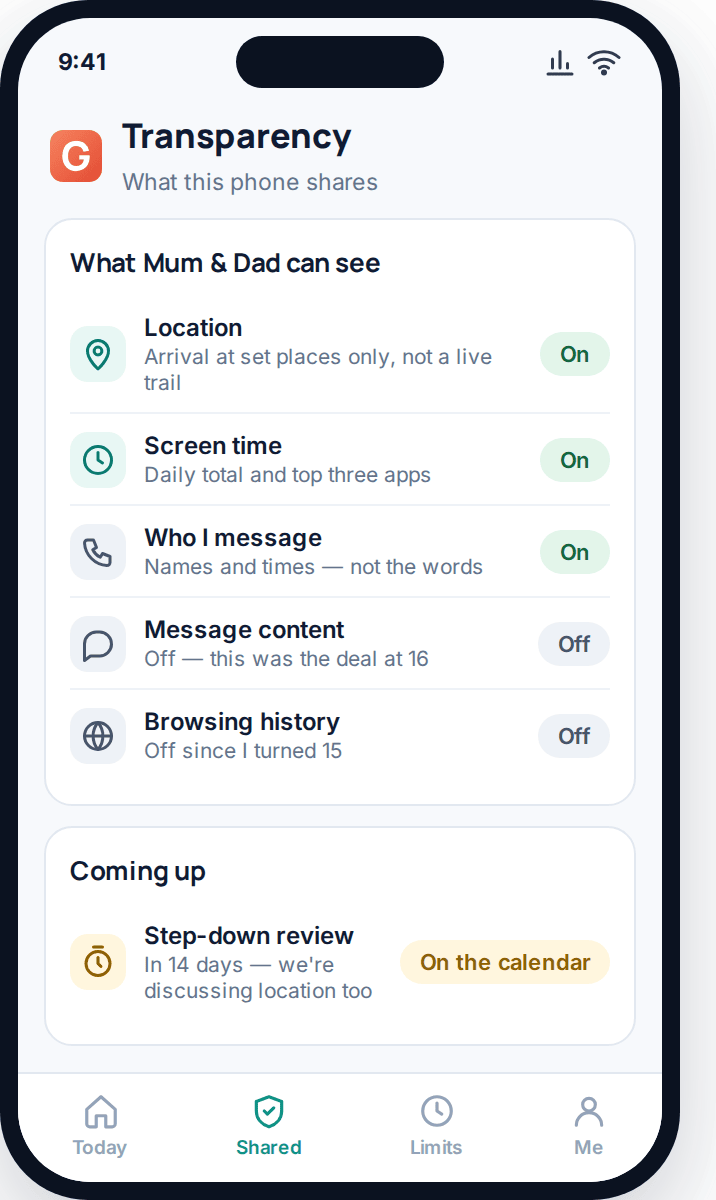
Whatever you agree, it should be visible on the phone itself, not just remembered from the conversation. A teenager who can open the transparency screen months later and see it still matches what was actually discussed trusts the arrangement in a way one running on memory alone never quite manages.
A step-down schedule by age
There’s no universal formula, but families who avoid constant conflict tend to converge on something close to this. Treat it as a starting draft to negotiate from, not a script.
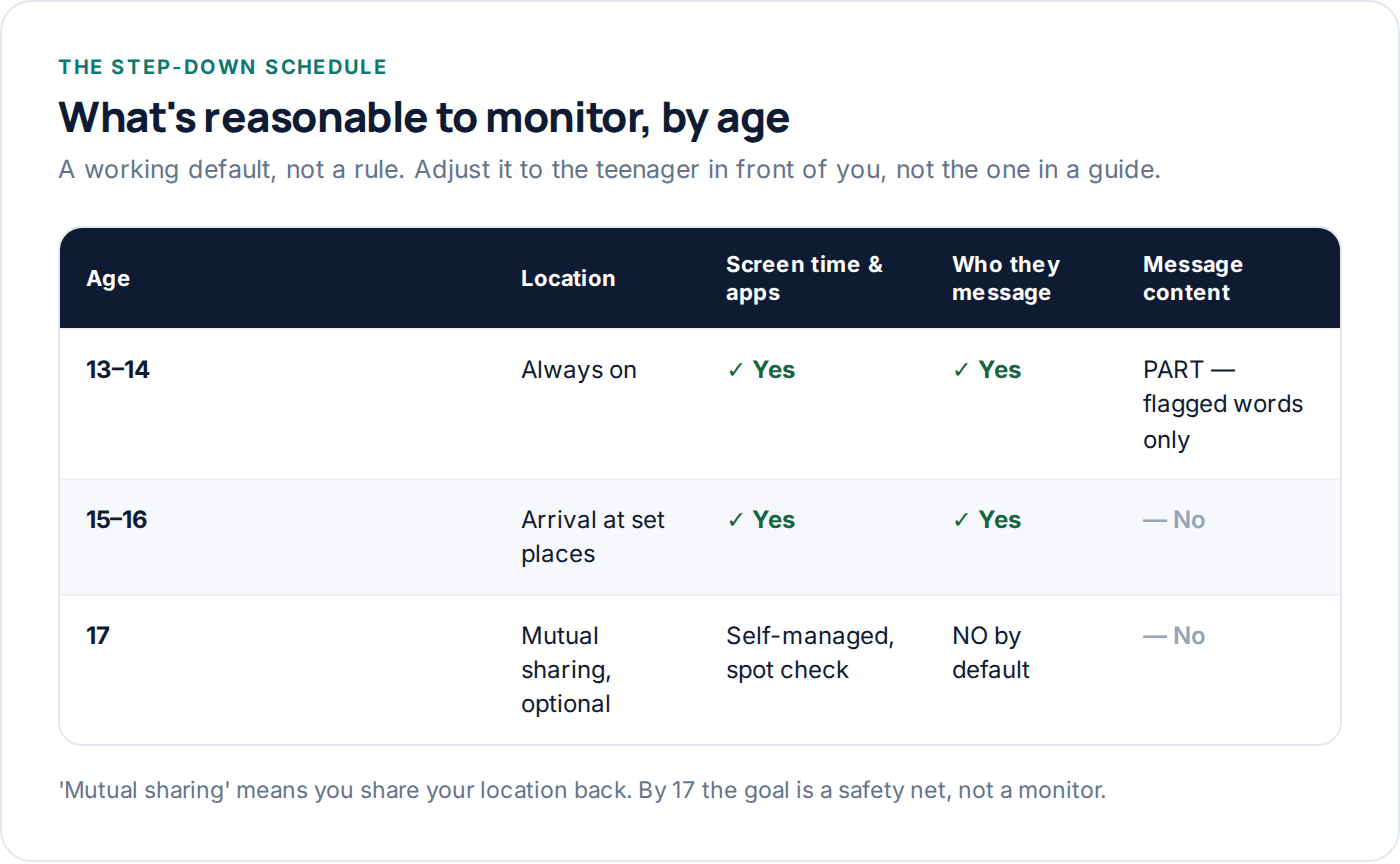
13–14: full net
Location on, screen time capped, app approval on, message content mostly off except for a short, explicit list of flagged words. This is close to what a younger child gets, with more explanation of why.
15–16: safety net
Location narrows to arrivals rather than a live trail. Who they message stays visible; what they say generally doesn’t. Screen time becomes something they self-report with occasional checking rather than a hard wall.
17: mostly handed back
Location sharing becomes mutual rather than one-directional — you share back. Almost everything else is self-managed. The goal by now is a young adult who has already been practising managing their own phone.
Notice the direction: every category moves toward less, not more, as they get older. A step-down schedule with no actual steps down isn’t one — it’s just monitoring with a age-appropriate label glued on.
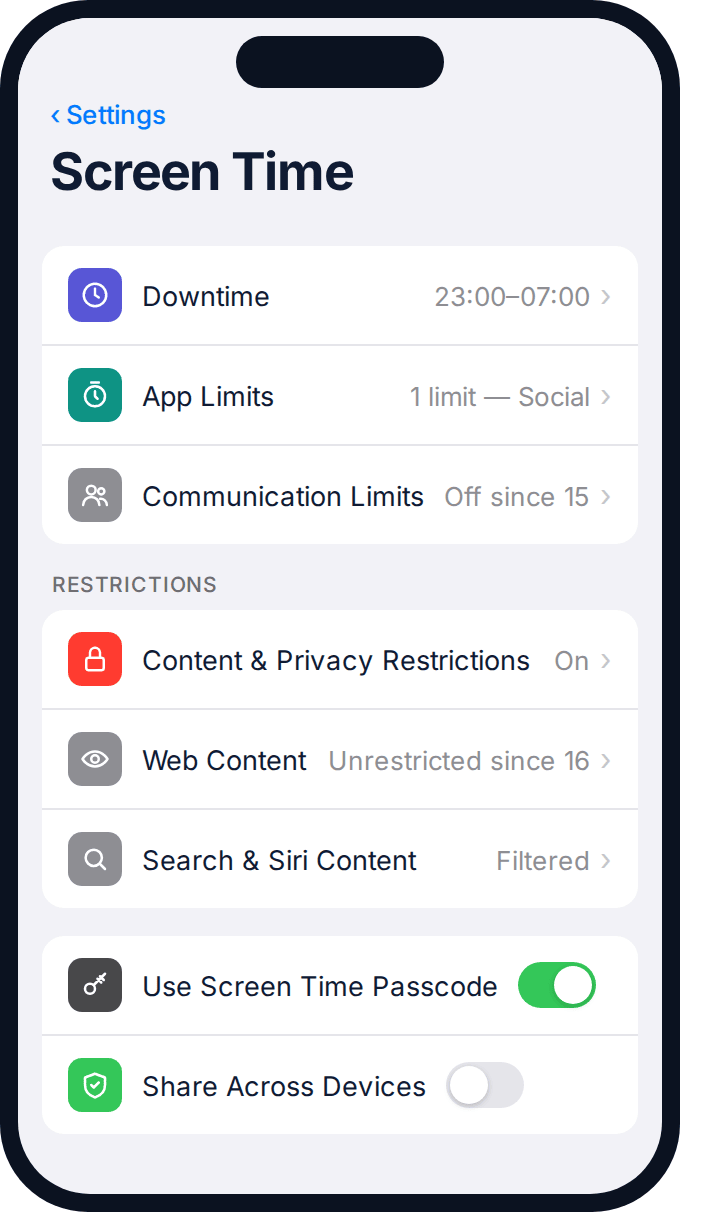
The platform settings should visibly reflect that direction, not just the app’s dashboard. If you’re still running the same iPhone Screen Time restrictions on a sixteen-year-old that you set at thirteen — the same downtime window, the same content restrictions, the same communication limits — that’s usually a sign the step-down conversation never actually happened, even if you meant to have it.
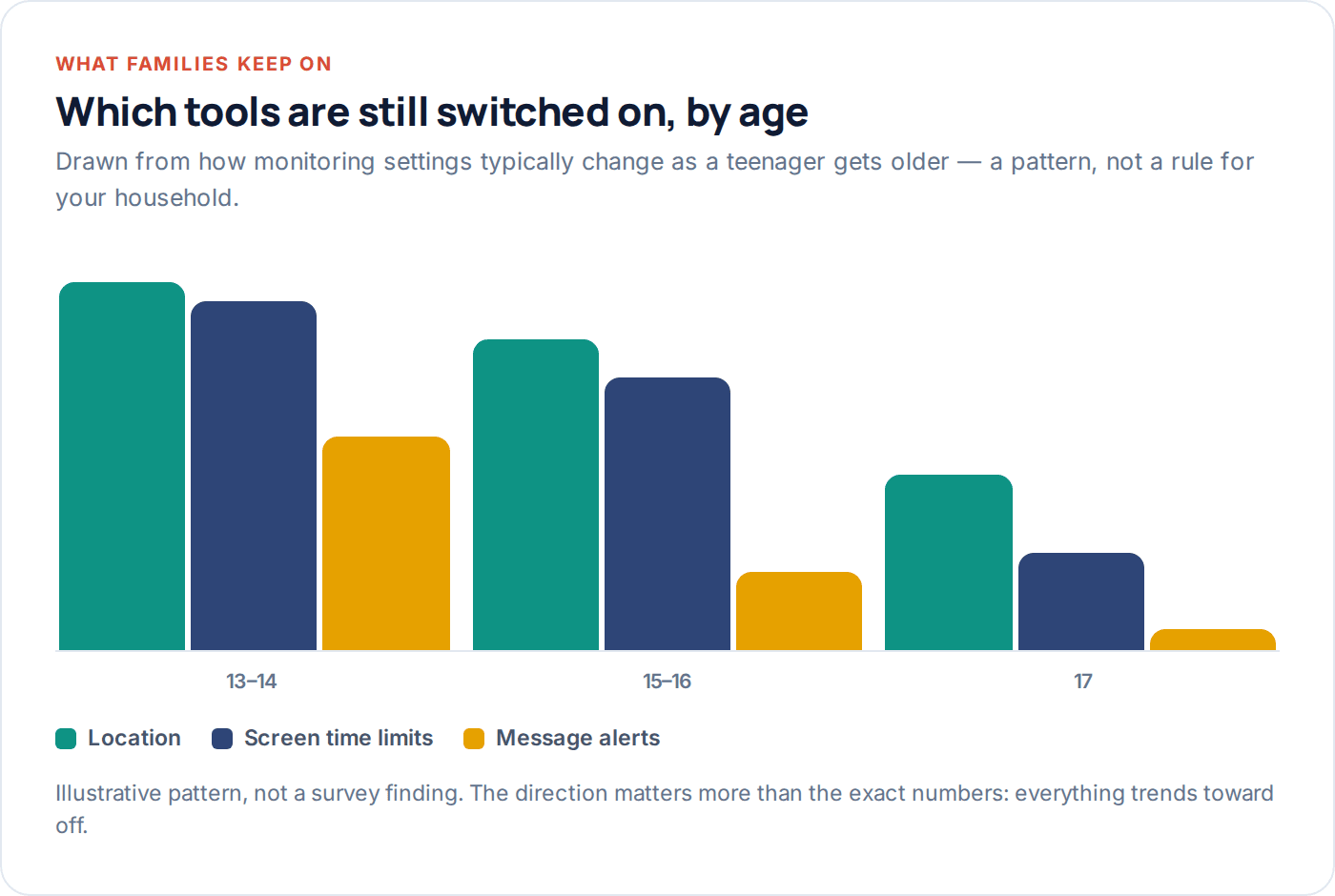
The pattern holds across every family we’ve looked at this way: the heavier tools get switched off first, and location survives longest, because it’s the one feature that answers a genuine worry without generating daily friction. If your setup doesn’t look roughly like that chart by the time your teenager is sixteen, it’s worth asking why not.
| Category | Default answer at any teen age | The narrow exception |
|---|---|---|
| Full message content | Off | A short, pre-agreed list of flagged words only |
| Private diary or notes apps | Off, always | None — this is a conversation, not a setting |
| Photos and camera roll | Off from 13 up | A single photo shared to report a specific worry |
| Location | On, narrowing to arrivals by 15–16 | Mutual sharing by 17, not one-directional |
| Who they message (not what’s said) | On through most of the teen years | Drops off by 17 alongside everything else |
What to leave alone, even at 13
Two things stay off the table at every age in this guide, and they’re worth stating plainly because they’re the two a worried parent is most tempted to add. Message content — the actual words in a chat — should be off by default at every age from thirteen up, with narrow exceptions for specific flagged words agreed in advance, not a blanket read of everything sent. And private diary-style apps or notes apps a teenager uses for their own thoughts shouldn’t be monitored at all; if you’re worried enough to need to see those, that’s a conversation, not a setting.
The reasoning is the same at every age: these are the categories where reading them rarely surfaces the thing you were actually worried about, and reliably costs you the thing that would have surfaced it on its own — a kid who still tells you things.
Handling the pushback
Teenagers negotiate. That’s not defiance, it’s a completely normal and healthy response to being asked to give something up, and treating it as a sign of guilt is one of the fastest ways to turn a reasonable conversation into a fight.
Common lines and what tends to actually work as a response:
- “You don’t trust me.” — Separate trust in them as a person from risk in the world. “I trust you completely. I don’t trust the twenty-five-year-old who might message you” lands better than arguing the point.
- “None of my friends’ parents do this.” — Probably true for some of them and not true for others; it’s not actually the argument it sounds like. “Maybe. This is what we’re doing in this house, and here’s why” is a fine, calm answer.
- “This is embarrassing.” — Often genuinely true and worth taking seriously. Ask what specifically would be embarrassing — a visible icon, a friend finding out — and see if there’s a version that solves the actual concern.
- “I’m not a little kid.” — Agree, out loud, and point to the step-down schedule as proof the rules already reflect that. This is usually the strongest response available.
When it’s fair to tighten a rule again
Stepping down is the default direction, but it isn’t a one-way ratchet with no exceptions. If something specific happens — an unfamiliar adult contact, a missed check-in that genuinely worried you, a sudden and sustained change in mood or grades — it’s fair to turn one thing back on.
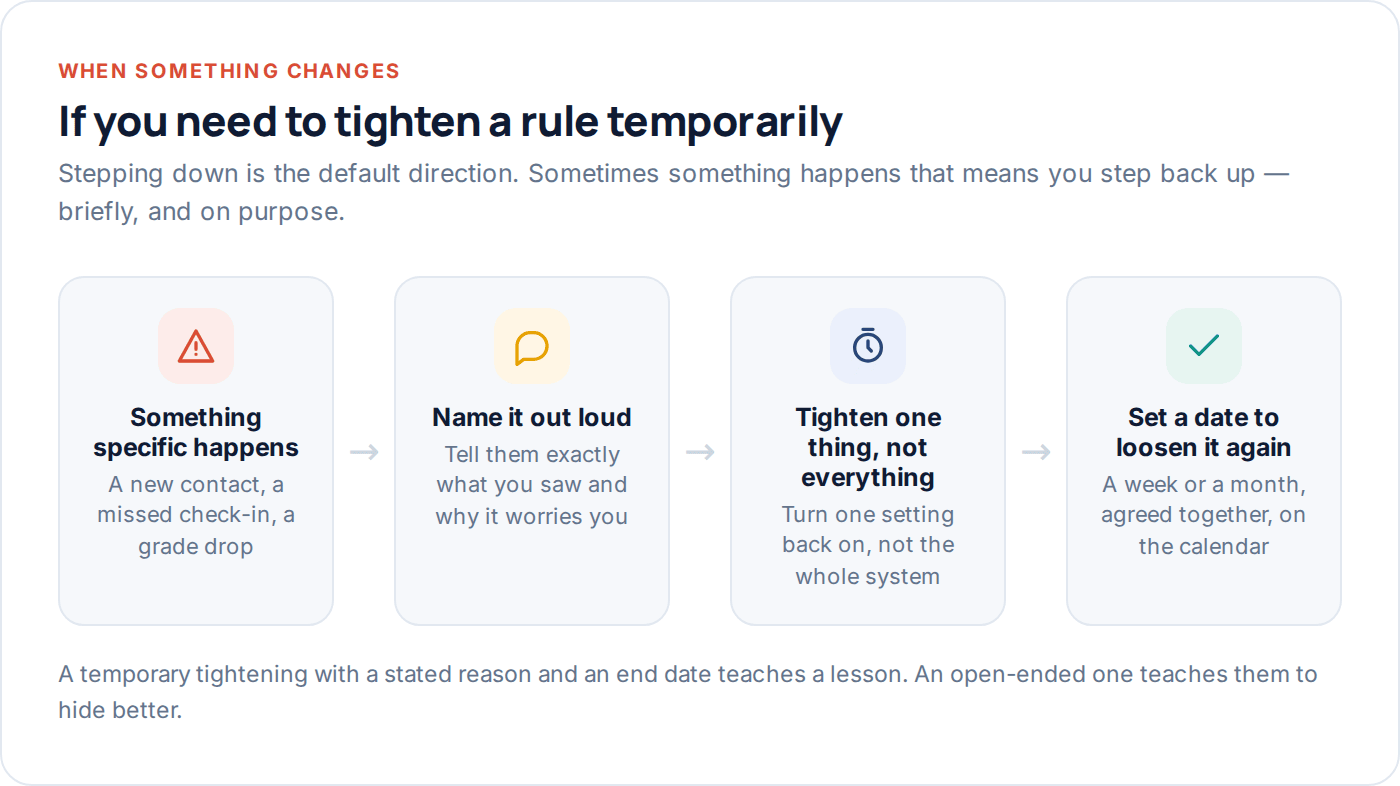
The word doing the work there is one. Tightening everything because of one flagged conversation reads as punishment and teaches a teenager to get better at hiding, not to come to you next time. Naming the specific thing you saw, tightening the specific setting that addresses it, and putting a date on the calendar to loosen it again keeps the response proportionate — and keeps the agreement intact for the parts that weren’t the problem.
Signs you’re overdue to loosen up
Parents are generally quicker to notice when to tighten than when to loosen, which skews the whole system toward accumulating restrictions nobody ever revisits. Worth checking for, every few months: has the review date on your agreement quietly passed without a conversation? Are you still watching a category — browsing history, message content — that hasn’t flagged anything in six months? Has your teenager stopped mentioning the app entirely, in a way that reads more like resignation than acceptance?
Any of those is a signal that the monitoring has drifted ahead of what the relationship actually needs. The fix is the same conversation you started with: sit down, look at what’s on, and ask honestly whether it’s still earning its place.
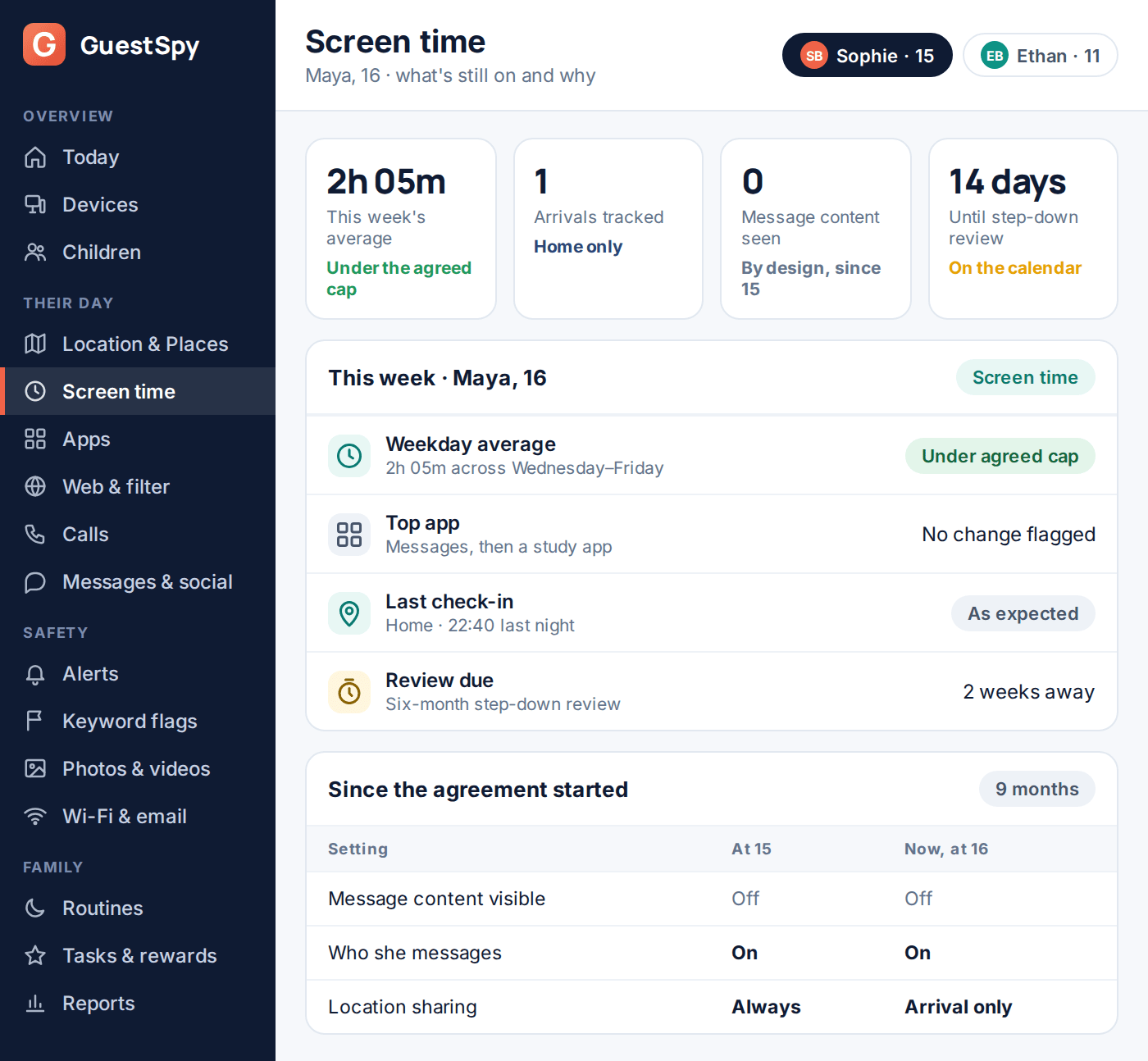
A useful gut check is simply to look at the dashboard itself. A working setup for an older teenager should look sparse — a screen time average, an arrival note, a review date coming up — not a busy list of things needing attention every day. If your dashboard for a sixteen-year-old still looks like it did when she was thirteen, that’s usually the app telling you the step-down never happened, not evidence that anything is actually wrong.
Questions parents of teens actually ask
My 14-year-old refuses outright. What now?
Find out why before deciding what it means. Sometimes it’s genuine embarrassment about friends seeing an app icon — solvable with a quieter setup. Sometimes it’s a flat objection to any oversight at all, which is worth a calm conversation about why some baseline exists in your house regardless. Refusal isn’t itself a reason to install something secretly; that trades a short-term win for a much larger long-term cost.
Should message content ever be on for a teenager?
As a default, no — from roughly thirteen up it costs more trust than it returns in useful information. The narrow exception some families use is a short list of specific flagged words tied to real safety concerns, agreed in advance, rather than reading full conversations.
What if my 17-year-old still wants heavy monitoring?
Some do, especially if a specific incident happened recently. That’s fine — the step-down schedule is a default, not an obligation, and a teenager who wants a safety net kept in place should get to ask for one, the same way they should get to ask for less.
How do I know if I’m monitoring too little?
If you genuinely have no visibility into where your young teenager is or roughly who they’re spending unsupervised time with, that’s usually too little at any age under sixteen. The line isn’t “any monitoring is too much” — it’s whether what you have matches what a reasonable person would consider proportionate for their age.
Does stepping down mean removing the app entirely?
Not necessarily. Many families keep location sharing running mutually well into early adulthood, simply because both people find it useful, not because it’s enforced. Stepping down is mostly about what’s switched on within the app, not always about removing it.
What if we never had this conversation and the app’s already installed?
Have the conversation now — later than ideal is still much better than never. Tell them plainly what’s on, offer to walk through the transparency screen together, and treat the coming-clean conversation itself as the actual start of the agreement.
Where to start with your teenager
Pick one number: how old is your teenager right now, and where does that put them on the step-down schedule above? Start the conversation from there, not from what you set up two years ago. If you’re building this in GuestSpy, the screen time and location tools scale down as easily as they scale up, and the child app’s transparency screen is exactly the tool for showing a teenager what’s on and what isn’t.
The measure of success here isn’t a clean dashboard. It’s a nineteen-year-old who calls you when something’s actually gone wrong, because monitoring never became the reason they stopped telling you things in the first place.
Keep reading
How to Tell Your Child You’re Monitoring Their Phone
Word-for-word scripts for telling a child their phone is monitored, by age, plus how to handle the most common pushback…
At What Age Should You Monitor Your Child’s Phone?
There is no single right age — there's a right amount of monitoring for each stage. Here's the age-by-age framework,…

The Honest Parent’s Guide to Phone Monitoring
What phone monitoring actually delivers versus what the marketing promises, five claims worth being sceptical of, and a straight framework…